PHILADELPHIA — One team jumped the board, big time. Two brothers were reunited with the Brew Crew. And it wasn’t the greatest day to be a pitcher.

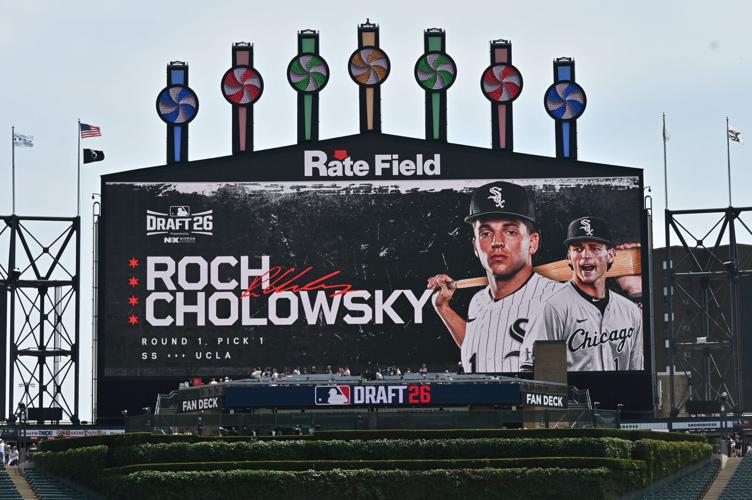
The scoreboard is seen on Saturday in Chicago as the White Sox select Roch Cholowsky as the No. 1 pick in the 2026 MLB Draft before a game against the Athletics.
While Major League Baseball’s draft began in relatively predictable fashion — UCLA shortstop Roch Cholowsky was chosen first overall by the Chicago White Sox, despite some smoke and a few mirrors in recent days — it also had its share of unforeseen turns.
USA Today Sports breaks down the first round and a little bit beyond as the game’s annual selection meeting tipped off at Philadelphia’s Convention Center on Saturday:
A hitter’s haven
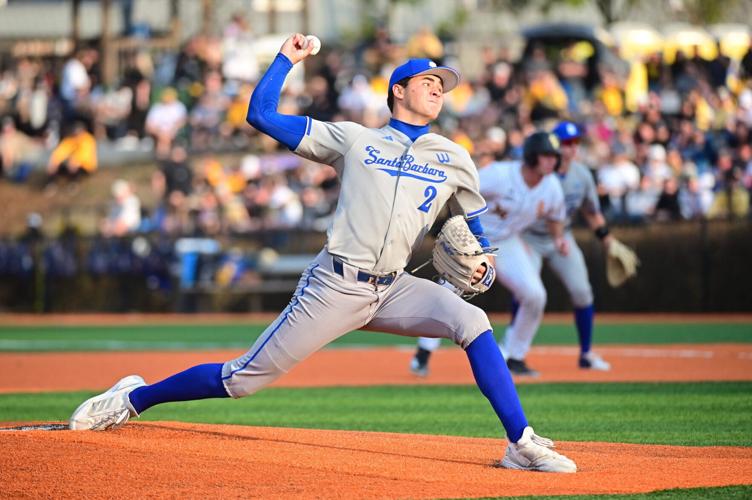
Perhaps general managers took one of the most cynical phrases of scouting — “There’s no such thing as a pitching prospect” — a little too literally. This draft made history when 15 of the first 16 players selected were hitters. The San Francisco Giants were the only ones zagging by taking UC Santa Barbara right-hander Jackson Flora fourth overall. After that, a pitcher didn’t get selected until the Texas Rangers took Gio Rojas, the lefty from Florida baseball factory Marjory Stoneman Douglas High School, with the 16th pick.
People are also reading…

UC Santa Barbara Gauchos right-handed pitcher Jackson Flora pitches during a game against the Southern Miss Golden Eagles on Feb. 13 in Hattiesburg, Miss.
What gives? Well, many of the anticipated top college arms had concerns. Cameron Flukey missed time with a rib fracture this year, leaving him available to the Detroit Tigers at No. 22. Logan Reddenmann and Cole Carlon each suffered velocity dips late in the year, leaving them available to the Colorado Rockies and Toronto Blue Jays, respectively, at picks 38 and 39. And a bevy of SEC pitchers — from Florida’s Liam Peterson (19th, Guardians) to Arkansas’ Hunter Dietz (35th, Yankees) and Carson Wiggins (27th, Mets) had command or health concerns that suppressed their value.
Lukewarm take: Many of these arms will be viewed, with the benefit of hindsight, as fantastic values.
A Royal surprise
Draft values can become chalk over time, but they never calcify until commissioner Rob Manfred gets up to the podium and utters all the names. Case in point: The No. 6 overall pick.
It was supposed to come from a consensus group of Cholowsky, Texas prep shortstop Grady Emerson, Georgia Tech catcher Vahn Lackey, Flora, and prep bats Jacob Lombard and Eric Booth.

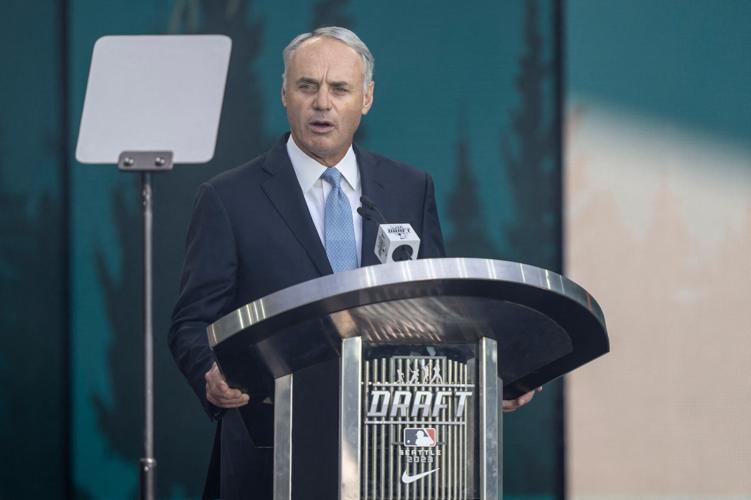
MLB commissioner Rob Manfred speaks during the first round of the MLB Draft on July 9, 2023, in Seattle.
And then the Pittsburgh Pirates jumped in and grabbed Derek Curiel, the elite bat from LSU who can play all three positions, with the No. 5 overall pick. Unexpected, but understandable.
The Royals, though, startled the drafteratti by reaching deep into the bag for the No. 6 overall pick with Louisville outfielder Zion Rose, who was ranked 30th by MLB Pipeline and 23rd by Baseball America. While the draftniks will be the first to tell you their rankings aren’t gospel, they are sourced from industrywide conjecture.
In that sense, the Royals are on an island.
Rose is certainly a Kauffman Stadium-type player — great speed and gap power. That’s a profile that also fits Booth, the Mississippi prep outfielder many expected Kansas City to draft.
The Baltimore Orioles snatched Booth immediately after the Royals’ hiccup and immediately after that, the Athletics grabbed Georgia Tech slugger Drew Burress — long expected to be an Oriole until Booth was available.
The beauty of the draft is, ultimately, hindsight. Maybe the Royals will be proven correct. But they also set themselves up for Rose’s professional arc constantly compared to Booth’s and Burress’. Good luck to them all.
A Brewery of Ebels
Los Angeles Dodgers third base coach Dino Ebel’s kids have been hard to miss at the ballpark, be it Dodger Stadium or around the diamonds of SoCal, where they’ve dominated for powerhouse Corona High School. Brady is the older, taller, left-handed swinging infielder drafted 32nd overall by Milwaukee a year ago while Trey bats right-handed, was slightly less regarded as a prospect and was ticketed for Texas A&M this fall.
Well, guess who’s got bragging rights now?
The Brewers made it back-to-back Ebels by snagging Trey with the 25th overall pick this year, a selection possibly rooted in bonus pool ramifications (Trey was ranked 86th by Baseball America, 107 by MLB Pipeline) but also familiarity.
After all, Brady is working out OK, with a .412 OBP and 26 steals as an 18-year-old in the Carolina League. And as they’ve proven at the big league level this year, the Brewers seem to know what they’re doing.
Rockies party like it’s 2002
Paul DePodesta was brought in to significantly modernize the Colorado Rockies, and his efforts have already shown up positively on the field in Denver. Yet when it came time for his first draft, he went full Moneyball.
A protagonist of the book and movie (“Peter Brand” in the latter, portrayed by Jonah Hill), DePodesta was armed with three of the top 38 picks and went very college-heavy. Not unlike the DePodesta of Oakland vintage, where he pioneered draft models that kept the A’s viable well into the 2000s.
Now, after a long stint with the Cleveland Browns, DePodesta is back in ball and so are his college tendencies. Kentucky shortstop Tyler Bell (10th overall), Georgia catcher Daniel Jackson (37th) and UCLA right-hander Reddenmann (38th) were the first picks of his tenure, stoking memories of the Nick Swisher-Joe Blanton-Mark Teahen-A bunch-of-guys-who-didn’t-pan-out Moneyball draft of 2002.
This one looks strong, too: Bell was getting bandied about among the top five picks, while Jackson hit 32 homers for Georgia and Reddenmann was both precise and dominant for the Bruins — he’ll be DePodesta’s first draft-day guinea pig in trying to figure out the Coors Field pitching conundrum. The Rockies later added Cincinnati catcher Jack Natill and Mississippi State pitcher Ben Davis in the third and fourth rounds, respectively, making it an all-college day.
Beware the Dodgers, still
You can take away draft picks for free agent compensation, penalize them for violating every last luxury tax threshold and paint them as the enemy in collective bargaining negotiations, but somehow, the Los Angeles Dodgers get the last laugh.
Oh, we’re not anointing 40th overall pick Bo Lowrance a Hall of Famer just yet. But fewer hitters had more helium coming into this draft, as he was easily considered first-round talent.
And there he was for the Dodgers, his 6-5 frame and long levers still sitting on the board at No. 40. He was the 10th shortstop and 13th high school player taken.
“We are ecstatic,” Dodgers amateur scouting director Zach Fitzpatrick said, “about landing Bo Lowrance.”
Hey, everybody looks great on draft day. Yet the Dodgers’ track record — 2/40 was the exact slot Dalton Rushing went four years ago — suggests Lowrance is a dude who will sow regret for some who passed on him.