

When the gold medal aspirations of a hockey-crazed country were on the brink this spring, and its thin defense corps was further depleted by injury, Canada coach Gerard Gallant unleashed the 18-year-old scouts were waiting to see.
Owen Power, a 6-foot-6 draft-eligible prospect equipped with remarkable skating and beyond-his-years on-ice instincts, went from playing under eight minutes in Canada’s opening game of the IIHF World Championship to seizing a prominent role on the blue line.
Power did not falter when given 24:07 of ice time against Russia, earning player-of-the-game honors for his responsible performance from the back end in a 2-1 overtime win. His resolve with and without the puck was evident in each of his shifts during a semifinal victory in which he skated more than 27 minutes in a shutdown role versus a United States team filled with NHL talent.
People are also reading…
In the final, Power was on the ice for 24:17 to help Canada earn gold at the annual event for the first time since 2005, strengthening his case to be drafted first overall by the Buffalo Sabres.
“It didn’t surprise me,” Brock Sheahan, who coached Power with the United States Hockey League’s Chicago Steel, told The Buffalo News. “I was very hopeful that they would start playing him because it would really help their chances. … For a kid his size to skate the way he does, to be able to think the game the way he does on both sides of the puck, he’s not just an offensive defenseman. He's a complete defenseman. And I think he is extremely special in that regard.”
“They won the gold medal and he was a big part of it,” added TSN director of scouting Craig Button.
“And I think that all those elements that Owen possesses, just scream being able to be a number one defenseman and control the game in all its critical areas.”
The performance helped Power earn the distinction of NHL Central Scouting’s top North American skater in the 2021 draft, which begins at 8 p.m. ET Friday. He is the Sabres’ presumed selection with the first overall pick, but it’s uncertain where Power will play this season.
Power has expressed interest in returning to the University of Michigan for his sophomore season, a scenario that would make him only the second player since 2000 to willingly not make an immediate jump to the NHL. Waiting for another defenseman to develop is a tough sell to Sabres fans, who have suffered through 10 seasons without playoff hockey and likely will watch their franchise center, Jack Eichel, depart this summer. History shows, though, that patience is important when selecting a player on defense, particularly when the prospect is stepping into a situation like the one in Buffalo.
“The National Hockey League is hard,” Button said. “It's a hard league that will chew you up and spit you out if you're not ready. So, the first part of this is, if I'm sitting with Owen Power, or any of those top defensemen, I would tell them to go back to school for another year. Go and play another year of college hockey and dominate. I think players rush the process. They come to the league before they're ready.”
‘You have to be ready’
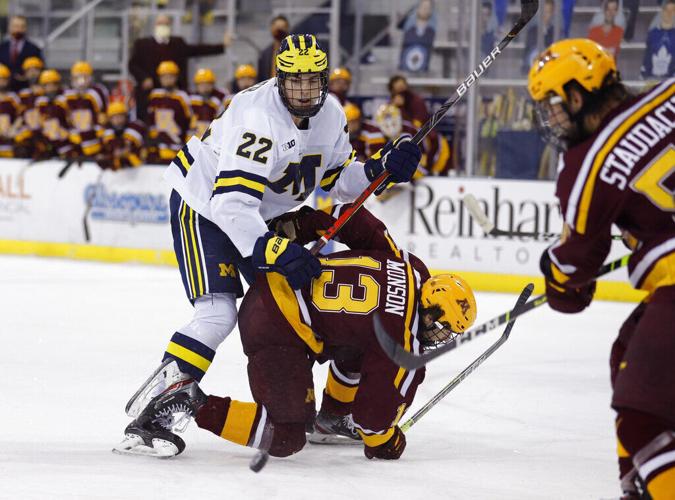
Mel Pearson did not need to see a replay of the goal to recall every detail of Power’s most impressive individual feat as a freshman.
Without hesitation, Power skated deep into the offensive zone for the Wolverines and, upon reaching the high slot, corralled a backhanded pass from fellow top draft-eligible prospect, forward Kent Johnson. Power then maneuvered around a defender by moving the puck to his backhand and drove toward the right side of the net. At the last moment, Power quickly stickhandled back to his forehand and quickly snapped a shot past the University of Wisconsin goaltender to tie the score on Feb. 17.
“I had seen some of his offensive creativity before he arrived, but it’s another step up and can you do it when you’re playing against guys who are six, seven years older than you and they’re strong?” said Pearson, coach of the Wolverines. “They don’t care where you’re ranked or how good you are, any of that. … You know, for a kid 6-foot-5 to even think about doing that and then to be able to execute it, his skill level is really good.”
Across 26 games as a freshman, Power totaled three goals and 16 points. His 0.62 points per game helped him secure rookie of the year honors from the College Hockey News, and he was Big Ten Freshman of the Year finalist.
Power’s impact can’t be measured by traditional statistics, though. He played in every situation for the Wolverines, running a lethal power play and suffocating penalty kill. Moments in games that are typically difficult for freshmen looked simple with Power on the ice, whether it was retrieving a puck under pressure or executing a breakout pass to start Michigan’s transition offense.
Some scouts questioned the lack of physicality in Power’s game and wished the Mississauga product played with a mean streak, but Pearson requested that his top blue liner defend conservatively because the Wolverines did not need their stalwart in the penalty box. Officials in the NCAA call the game tight and Power’s size would have made him a target.
“He’s got a bite to his game and we saw that in practice every day,” said Pearson. “He had no problem giving the Saskatchewan two-hand to anybody. There's no issues there.”
“I think I'm a two-way defenseman that can play in all situations and log a lot of minutes,” Power said during a conference call with reporters. “I think any team in the NHL would want someone like that. I think that's what I'll bring.”
Power is in position to be the 16th defenseman drafted No. 1 since 1970 and the first since the Sabres’ Rasmus Dahlin in 2018. Sabres General Manager Kevyn Adams and his scouting staff also are high on USA Hockey National Team Development Program defenseman Luke Hughes and Swedish forward William Eklund, according to sources, but it would be a draft-day stunner if the pick isn’t Power.
Drafting Power eventually could make the Sabres’ depth on defense among the best in the NHL, as Adams’ plan for the future is expected to include Dahlin, Henri Jokiharju, Mattias Samuelsson and 2019 first-round draft choice Ryan Johnson. But Power may wait to realize his dream of making an impact in the NHL.
Although the decision will ultimately be up to whichever team drafts Power, another season at Michigan would provide Power with more time to gain strength in preparation for the grind of an 82-game NHL season and allow a more forgiving setting for him to work on specific areas on the ice.
“Could he play in the National Hockey League next year? Absolutely” said Pearson. “But having said that, I have so much respect for the NHL. It's the greatest league in the world. You have to be ready. It's a man's league and you have to be ready to step in and perform and contribute on a nightly basis. You have to be ready for that physically, emotionally, spiritually …
“Number one, can he put on some man strength and be so much more ready to play at that level? I totally think he can. Just because you’re drafted first, or when you turn 18, doesn’t mean you’re necessarily ready to play in the National Hockey League. Everybody is ready at different times. Owen’s a great player. He’s going to play in the league, whether it’s next year or the year after.”
Patience
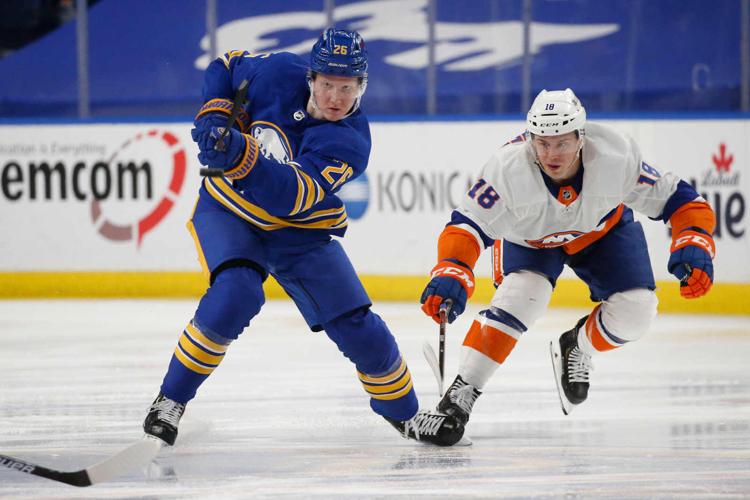
Rasmus Dahlin’s struggles under Ralph Krueger should be a cautionary tale for the Sabres.
Dahlin, still only 21 years old, finished his third NHL season with a league-worst minus-36 rating. Krueger begrudgingly refused to make any changes to his system at 5-on-5, despite its negative impact on Dahlin, in particular. Dahlin wasn’t allowed to use his dynamic skill to lead the rush. The calculated risks that led to otherworldly plays during his rookie season were no more.
It wasn’t until Don Granato took over as coach on March 17 that Dahlin began to return to form, a rebound he attributed to Granato’s preferred style of play, which resembles the way defensemen are taught to play and think the game in Sweden. Despite the difficult season under Krueger, Dahlin’s 50 power-play points since the start of 2018-19 rank ninth among NHL defensemen.
Though Dahlin and Power are very different players, the struggles of Buffalo’s most recent No. 1 pick illustrated that bringing along young defensemen isn’t a simple process. Stability is important.
“I can give you examples of players that leave (college or junior) they get; I don't want to say get chewed up, but they get scars on them,” said Button. “And then you’ve got to work through those scars. … I think Rasmus might be a great example of that. He's a good player. He's a really good player. But you know, because the team's had challenges, he's had challenges. You better not give up on Rasmus Dahlin, that’s all I can say.”
Tampa Bay Lightning defenseman Victor Hedman was solid in his first four seasons – a steady supporting cast and stable coaching situation helped prevent any significant dips in performance – but it wasn’t until year five that he eclipsed 30 points. His goals above replacement, a metric by Evolving-Hockey.com that ranks a player’s overall contributions to his team, skyrocketed from 5.6 as a rookie in 2009 to 22.5 in Year 8.
Hedman had a breakout 55-point season in Year 5, followed by a year in which he helped the Lightning reach the Stanley Cup Final. Since, Hedman has won a Norris Trophy and owns two Cup rings. Though Power has been compared to Hedman, the latter’s development track is a better comparable for Dahlin because they both learned the game on the bigger ice surface in Sweden.
Cale Makar, Quinn Hughes, Adam Fox and Zach Werenski are interesting case studies in how more time in college can benefit a young defenseman. Makar, drafted fourth overall in 2017, became one of the league’s best after playing two seasons at UMass-Amherst. Hughes, who went to Vancouver at No. 7 in 2018, went back to Michigan for his sophomore season and finished second in Calder Trophy voting for 2019-20. Werenski made the same decision in 2015 after his selection eighth overall by Columbus. Fox won the Norris Trophy in Year 2 with the Rangers after spending three years at Harvard University.
Since the 2004-05 lockout, no notable defenseman drafted high out of the NCAA has posted a positive goals above replacement as a rookie after making the immediate jump to the NHL.
“The scariest play in hockey, the hardest play in hockey, for me, is a puck in your corner, and you're having to go back for it as a defenseman,” said Josh Wrobel, a Toronto-based skills coach whose client list includes NHLers and top draft-eligible prospects. “The puck is bouncing around, it's spinning, and you have a guy coming to make contact and put you in the third row. That’s a tough play for a 19-year-old coming out of junior or college. That’s something that young forwards don’t have to deal with as often. I feel like that's why with D the development curve just takes a little bit longer.”
Help needed
A young defenseman is at the mercy of his partner and coach.
Hughes and Dahlin are some of the most recent examples. Hughes, 21, was not exposed as often as a rookie because he played most of his 5-on-5 minutes with reliable veteran defenseman Chris Tanev. Year 2 for Hughes was more of a struggle, as he did not have the same type of help to mask mistakes.
Dahlin, meanwhile, has played at least 100 minutes at 5-on-5 with six different defensemen – Jokiharju, Colin Miller, Zach Bogosian, Brandon Montour, Casey Nelson and Rasmus Ristolainen, none of whom are lockdown defenders – across his three seasons.
“You want to insulate your young defenseman if he's going to make the team right away with a veteran guy that understands the game and can really help you along the way and help you when you make mistakes,” said Ken Daneyko, an NHL Network analyst whose work on defense helped the New Jersey Devils win three Stanley Cups. “When you make a mistake and it doesn't end up in the back of your net, you live with it and you learn from it and you grow. If it continually ends up in the back of your net on a bad pass or hanging on to the puck too long, it can hurt your confidence a little bit and that can have a domino effect. … It’s helpful to have someone there you can learn from.”
Coaching also matters. Former Sabres coach Phil Housley’s run-and-gun system fit with Dahlin’s offensive talents, as illustrated by a historic rookie year in 2018-19, but a preference to play man-to-man coverage in the defensive zone may have led to bad habits and caused overthinking. Krueger was also a horrible fit for Dahlin.
Though Granato’s systems and approach fit well with dynamic defensemen such as Dahlin and Power, it’s likely the Sabres won’t have the proper veteran presence to insulate a rookie learning on the job.
The speed of the modern-day NHL is tailor-made for the talents of these young, offensive-minded defensemen to make the immediate jump to the NHL. Dahlin is a notable example with his 84 points as a teenager ranking second all-time behind Housley (143). But the ups and downs for a prospect at the position can be stabilized if development is handled properly. A spot on Buffalo’s roster this season would come with a significant learning curve for Power.
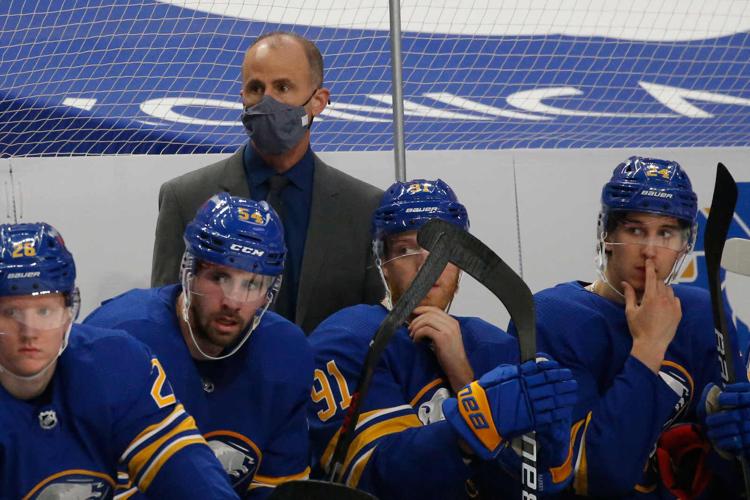
“Every player has a different identity,” said Granato. “You have to help them not only find their identity because their identity is at the previous level they played. They had a skill set that was maybe 10 different skills at the college level and the junior level and then they come to the NHL and that skill set of 10, maybe speed was their attribute at the previous level and they scored 30 goals because they had great speed, but they’re not fast in the NHL so they’re not going to score those goals. It’s helping them recognize what they can and can’t do, supporting that and giving them reason to be confident moving forward.”


