Editor’s note: This is the first of a two-part series examining the day-to-day life and background of Desireé Reed-Francois in conjunction with her two-year anniversary as Arizona’s athletic director.
Feb. 4, 7:50 a.m.

Michael Lev is a senior writer/columnist for the Arizona Daily Star, Tucson.com and The Wildcaster.
Desireé Reed-Francois’ day is already more than three hours old when I arrive at the University of Arizona campus to begin a unique assignment.
I’m shadowing the UA athletic director, who, at the time of our meeting last month, was closing in on two years on the job in Tucson.
Time flies when you’re remaking an athletic department in the midst of the most transformative period in the history of college sports, right?
When she isn’t on the road for a big game or important meeting, Reed-Francois wakes up at 4:25 a.m. to participate in a running group. The runs are typically 5 miles long. The locales include A Mountain and Reid Park.
People are also reading…
Reed-Francois, 53, describes herself as “naturally uncoordinated.” She tried just about every sport as a youth. Nothing really stuck. But she could always run. It brings her a sense of peace.

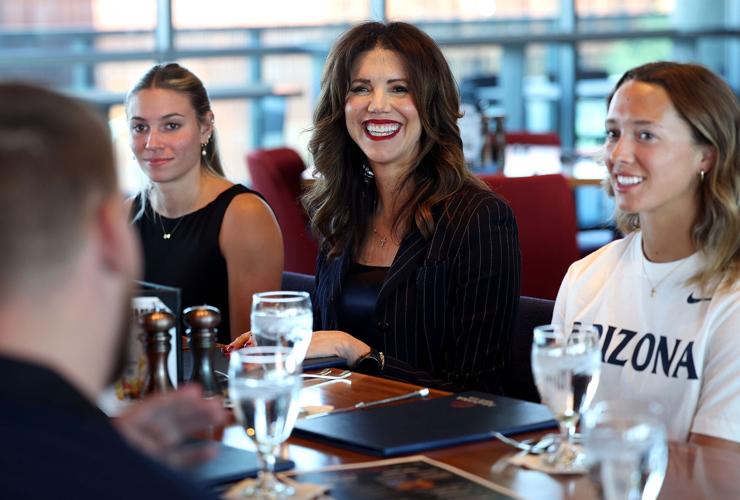
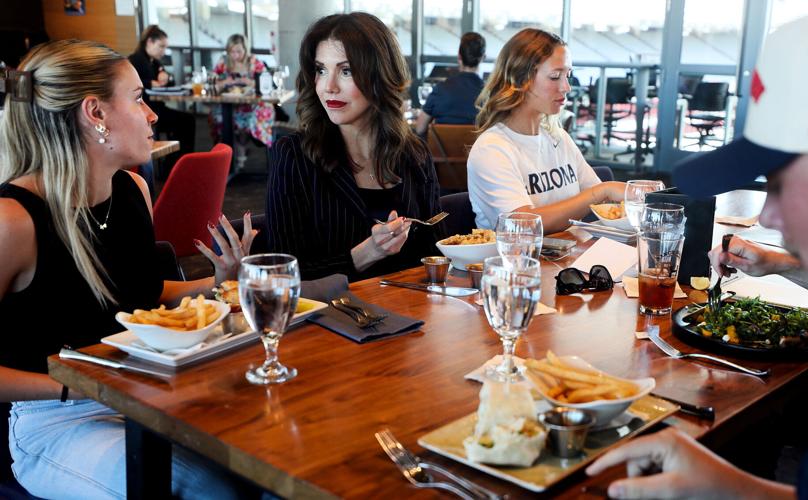
Arizona athletic director Desireé Reed-Francois, middle, listens to Tristan Bounds as he answers an ice-breaker question during a regular lunch with student-athletes she refers to as "Party of Five" at the Sands Club in Tucson on Feb. 4, 2026. Laina Friedmann, far left, and Tylee Shires look on.
“It’s almost like Zen meditation for me,” Reed-Francois says.
The rest of her day, she concedes, is “controlled chaos.”
8:15 a.m.
Reed-Francois has wrapped up a coffee meeting with Col. Cory Christoffer of the ROTC at the campus Starbucks, and now we’re walking to her car. The next stop is a local brunch spot, where Reed-Francois has a monthly check-in with Tucson real-estate mogul, philanthropist and UA donor Humberto Lopez.
The two place the same order every time: lattes with oat milk and baked oatmeal. They discuss several pressing matters pertaining to the athletic department — naming rights, budgetary issues, facility upgrades, ideas for Casino Del Sol Stadium.
In exchange for this access, Reed-Francois and I agreed that certain conversations and details would remain off the record. Why bother then? I wanted to find out what a typical day is like for the person who runs the $150 million enterprise that is the UA athletic department. I also wanted to find out more about the person herself.

The Arizona Board of Regents unanimously approved a three-year contract extension Thursday Desireé Reed-Francois, the University of Arizona's athletic director.
Her office provides some clues.
The first item of note is its location. The AD’s office had been in the bowels of McKale Center. Now it’s on the second floor of the Ginny L. Clements Academic Center across Enke Drive.
“I love being around the students,” Reed-Francois says. “They give me energy and remind me of why I do what I do.”
The window facing the interior of the building once had a frosted film on it. Reed-Francois peeled it off.
“I don’t want to be separated from everybody,” she says.
Some might view the very act of moving her office across the street as an attempt to do just that. But she’s right in the middle of the action here. It’s not a secluded locale.
The large, rectangular office is divided into two spaces. As you walk through the door, you come upon four blue leather chairs surrounding a square glass coffee table. A flat screen takes up most of the west wall.

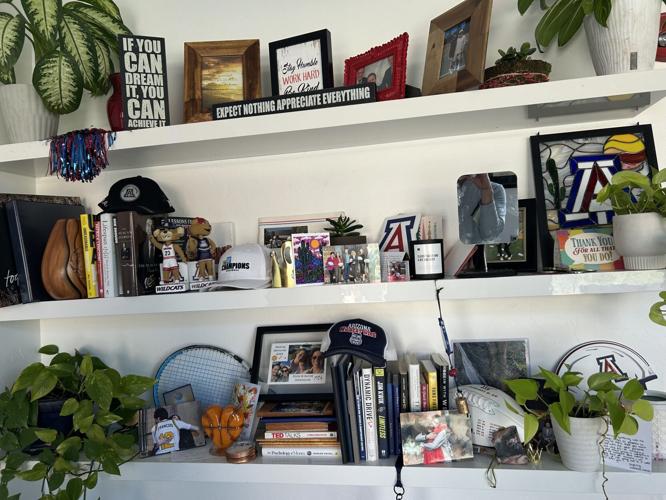
Shelves in Arizona athletic director Desireé Reed-Francois' office feature plants, books, photos and inspirational quote blocks. A picture on the top shelf to the right shows Reed-Francois with her late grandfather, Charles.
Papers are strewn about. Reed-Francois is slightly embarrassed that she hadn’t tidied up before my visit, but the minor mess shows that she’s busy. She’s rarely not busy.
The wall next to the flat screen features mementos and plaques. They include a tennis racket given to her by former UA standout Colton Smith and baseballs from each of the clinching postseason wins by Chip Hale’s squad last spring.
On the other side of the office is Reed-Francois’ desk. It’s a standing desk. Underneath it is a small treadmill. If Reed-Francois happens to be on a long Zoom call, she’ll start walking.
“I’m always in motion,” she says.
To the right are shelves filled with plants, books, photos and inspirational quote blocks. One of the photos shows Reed-Francois on a tennis court with her grandpa, Charles Reed. He worked for the state department, spoke 23 languages and lived to be 101 years old.
“He taught me my love of learning,” Reed-Francois says.
A large, glowing Block A adorns the wall behind the desk. White and red UA football helmets sit atop cabinets, along with a basketball and a picture of Reed-Francois’ son, Jackson, a walk-on on the UA men’s team, celebrating a 3-pointer in an October exhibition game.
10:15 a.m.
Reed-Francois meets with Mike Smith, senior associate AD/chief development officer in charge of fundraising.
Their focus is the Saguaro Society, the new gift-giving program within the Wildcat Club, and an important upcoming donor event — the Feb. 28 home men’s basketball game against Kansas.
They’re going over the proposed itinerary and exchanging ideas — in the process providing insight into how Reed-Francois works with her team members.
She gives Smith some firm directives and drills down into the finest details of the donors’ weekend docket. “How long are they sitting?” she asks at one point. It is decided that a 10-minute break will be incorporated into the presentation.
10:45 a.m.
Reed-Francois meets with Emily Dwerlkotte, a former college athlete who’s now one of Arizona’s directors of equipment operations.
Their discussion today isn’t about crew socks or orange cones. It’s about the department’s mentoring program, which Dwerlkotte created.
Reed-Francois believes mentorship is critical. She has credited many mentors over the years and is especially close with Debbie Yow, the former athletic director at Saint Louis, Maryland and NC State who preceded Reed-Francois as a pioneer for women in the AD space. (This day just happens to be National Girls & Women in Sports Day.)

Arizona athletic director Desireé Reed-Francois, middle, listens to Laina Friedmann as she answers a question during a regular lunch with student-athletes she refers to as "Party of Five" at the Sands Club in Tucson on Feb. 4, 2026. Tylee Shires is seated far right.
Reed-Francois and Dwerlkotte mostly talk about how often mentors and mentees are checking in with each other and the importance of carving out that time. They agree that opportunities to connect and learn should never be shrugged off.
11:30 a.m.
We’re walking to the Sands Club at Casino Del Sol Stadium, where Reed-Francois will participate in a monthly lunch she has dubbed “Party of Five” — an ode to the 1990s FOX TV drama.
This Party of Five is Reed-Francois’ way to get to know some of her 500-plus student-athletes. The quintet is selected by academic advisors. The five meeting her for lunch this time are softball’s Tayler Biehl, football’s Tristan Bounds, track’s Laina Friedmann, baseball’s Garrett Hicks and beach volleyball’s Tylee Shires.
After Reed-Francois delivers her own brief bio, she gives each student-athlete their “assignment.” They are to disclose a fun fact about themselves and state something they would do if they were athletic director for a day.

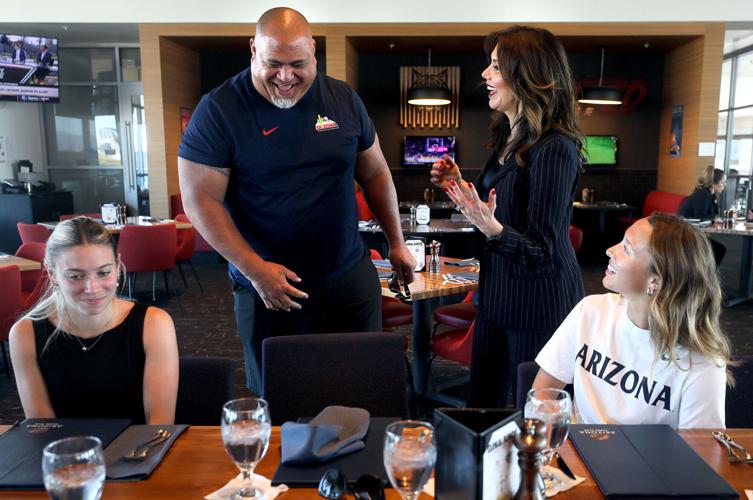
Arizona athletic director Desireé Reed-Francois, right, shares a laugh with UA assistant football coach Joe Salave'a during a regular lunch with student-athletes on Feb. 4, 2026. Seated are Laina Friedmann, far left, and Tylee Shires, far right.
(Reed-Francois’ fun fact is that she once swam from Alcatraz Island to Aquatic Park Cove in the San Francisco Bay.)
The student-athletes are aware of my presence and the understanding that specifics and personal matters will remain confidential. Across the board, food and on-campus parking are prominent topics of discussion.
Reed-Francois’ concluding message is about the importance of “The 50” — the 50 years after most athletes’ playing days are done.
“What I genuinely care about is your life after you stop playing,” she says.
That’s what being a student-athlete is really supposed to be about, right?
1 p.m.
Reed-Francois is participating in a Division I Cabinet subcommittee videoconference. If ever there was a time to hop on the treadmill, this is it.
She has two screens going, plus a laptop. She also has access to a thick packet of papers.
The videoconference runs shorter than expected, giving Reed-Francois a chance to visit with Jackson, who pops into the office about 1:05. While waiting for Reed-Francois to finish up, Jackson and I talk about his foray into coaching and which members of the UA men’s basketball team are the best at golf and table tennis. (The answer to both: Anthony Dell’Orso.)
Mother and son briefly discuss his law-school application. She wants to read it before he submits it.
2:15 p.m.
Reed-Francois has a short Zoom interview with a woman applying for a job in the football program.
Reed-Francois talks to every person who seeks employment in the UA athletic department. She doesn’t give a definitive yes or no on any candidate, but she does provide her impressions.
She asks every candidate about their work ethic and how they make others around them better.
The woman applying for this job lands it. Lauren Benjamin, a UA grad, is now the football team’s coordinator of internal operations.
2:30 p.m.
This is the most consequential item on Reed-Francois’ calendar — a meeting with 10 members of her executive team.
Extra chairs are lugged into her office, and the big screen is fired up. The game-day experience at home football and basketball games is one of the prominent topics. Many charts and survey results are displayed and dissected. Fan feedback is an integral part of the process.
About three weeks later, some of the proposed enhancements for Casino Del Sol Stadium become a reality: The UA announces plans for a new sound system, video boards and lighting.
4 p.m.
Rachel Shedd, associate athletic director, sports psychology, stops by Reed-Francois’ office to give an update on mental-health initiatives.
All UA coaches must complete an online mental-health certification program. Shedd describes it as “CPR for mental health.”

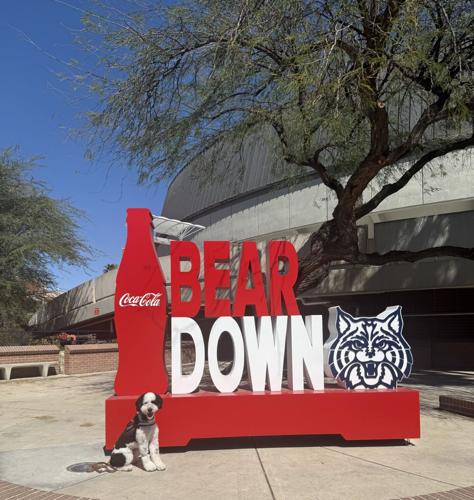
Bennett, the University of Arizona athletic department's therapy-dog-in-training, was among the visitors to UA athletic director Desireé Reed-Francois' office on Feb. 4, 2026.
Every student-athlete, meanwhile, takes a mental-health screening every semester.
Shedd leaves briefly and returns with a special guest — mini Bernedoodle Bennett, a therapy dog that she’s training.
Reed-Francois and husband Josh have a dog, Winston, who’s half-German shepherd, half-Belgian Malinois; and a black cat named Knox whom Reed-Francois rescued from a casino parking lot. Winston is the latest in a line of Reed-Francois’ dogs who were named after world leaders, following Lincoln, Teddy and Sandy (Sandra Day O’Connor).
4:25 p.m.
We head downstairs to the Lapan Memorial Sunshine Foundation Academic Lab for a meet-and-greet with UA professors and family members who will serve as honorary guest coaches during the women’s basketball game that’s tipping off a little after 6.
Student-athletes’ academic performance is the thrust of this conversation. Marisol Quiroz, Jennifer Mewes and Mary Hartman of C.A.T.S. Academics participate in the discussion. Reed-Francois touts the department’s record-setting 3.41 GPA for the fall semester, calling it “an incredible source of pride.”

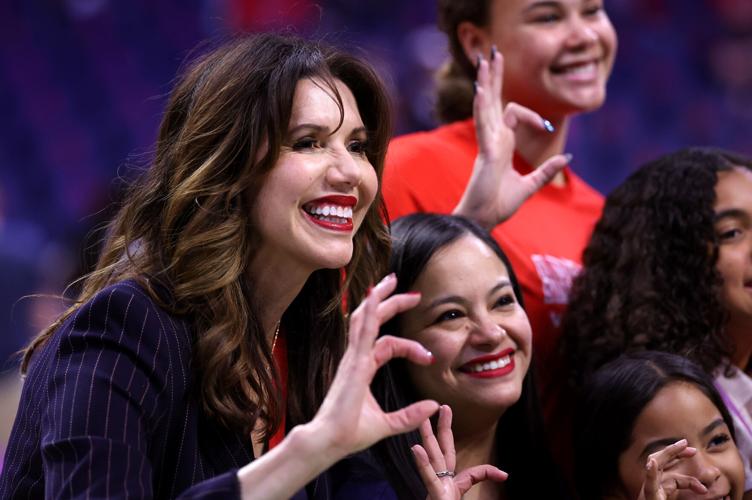
Arizona athletic director Desireé Reed-Francois speaks to UA volleyball players, right, and members of the Mini Poderosas youth group, left, before a women's basketball game vs. Kansas State at McKale Center, Feb. 4, 2026.
“The 50” is brought up again. Reed-Francois explains how being a student-athlete prepares those young people for life after sports. They must budget their time, handle failure and work with diverse populations.
“What we care about is how you can impact the world,” she says.
4:45 p.m.
We cross the street to meet up with the Mini Poderosas, a group of elementary, middle and high school girls that Reed-Francois connected with a couple of years ago. The organization’s founder, Azucena Bravo, believes Reed-Francois, who’s of Mexican-American descent, sees herself in the girls, who are mostly Latinas.
Reed-Francois exchanges handshakes and hugs with the girls’ moms and the older girls whom she’s met before. A 7-year-old is prodded to remove her gray pullover and show Reed-Francois her T-shirt that features the face of a sparkly, silver and red Wildcat.
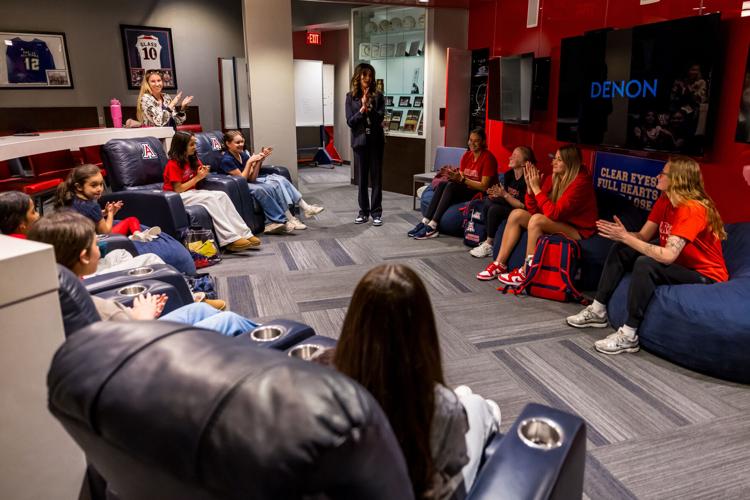
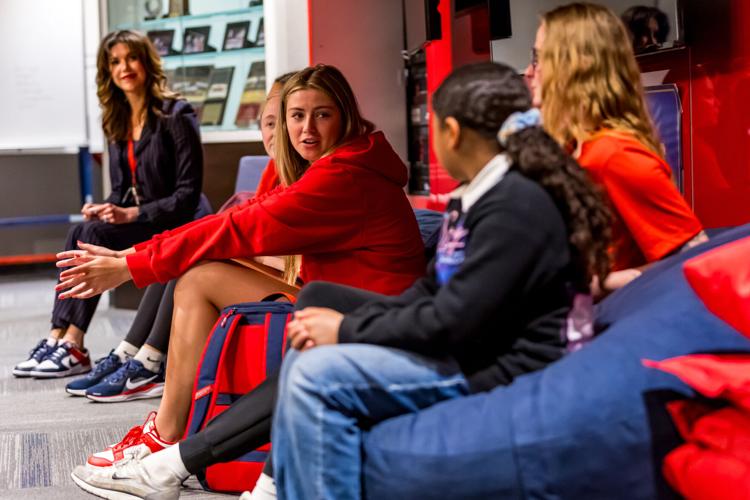
The Mini Poderosas are Reed-Francois’ guests for the UA women’s basketball game vs. Kansas State. But first, they will meet with four members of the women’s volleyball team in a lounge outside their locker room. The four share fun facts about themselves and answer this question: “What’s something you wish you knew as a kid that you know now?”

Payton Woods (in red hoodie) and other members of the Arizona volleyball team speak with UA athletic director Desireé Reed-Francois, far left, and the Mini Poderosas youth group before a women’s basketball game at McKale Center, Feb. 4, 2026.
Sophomore Maya Flemister goes first. “Asking for help is not a weakness,” she says.
Once the players are done, members of Reed-Francois’ executive team participate. Then it’s the girls’ turn. Reed-Francois reminds them to project, pull their shoulders back and make eye contact.
The kids had to read a book in advance, “Keeping Pace” by Laurie Morrison, and today they’re sharing what they liked, learned and remember about it. Reed-Francois is a voracious reader.
Next comes a group photo on the McKale hardwood, followed by a reception just outside the tunnel where the women’s basketball team will enter the court. The girls and their moms enjoy a nacho bar and tres leches in a cup.
“I love it,” Reed-Francois says of her involvement with the Mini Poderosas. “I love hearing their stories and their daughters’ future plans.”
As tipoff approaches, Reed-Francois makes sure the girls clean up after themselves. After they’ve left for their seats, she picks up trash and offers water bottles to the servers.
The Wildcats take an early lead over Kansas State, whom they eventually will beat. Reed-Francois is reluctant to enter the arena; she doesn’t want to jinx them.
Her last act is toting a box of pom-poms, T-shirts, water bottles and other goodies back to her office, where, about 12 hours later, another day will begin.
Contact sports reporter/columnist Michael Lev at mlev@tucson.com. On X (Twitter): @michaeljlev. On Bluesky: @michaeljlev.bsky.social
Michael Lev
Sports Reporter/Columnist


 On Jaden Bradley’s case for Big 12 POY, why Noah Fifita is No. 1 and more | Michael Lev