

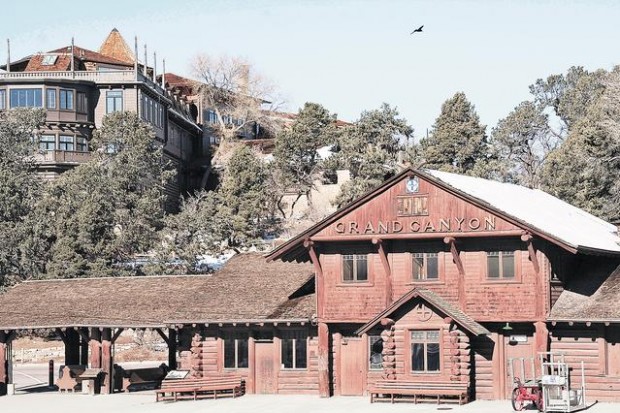
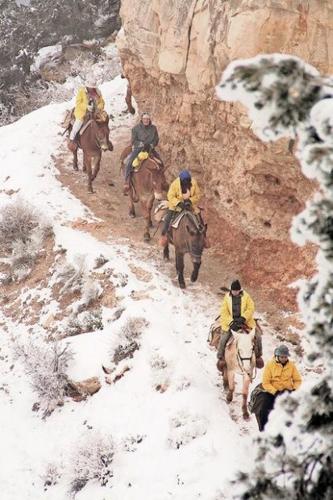
GRAND CANYON NATIONAL PARK — It doesn't have to snow here to make it gorgeous. If you haven't been to the Grand Canyon, for sure you've seen pictures of the place. Awesome pictures.
Snow in the pictures? Not usually.
But. . . .
With the exception of the Grand Canyon in summer — and the "exception" part is debatable — there is no grander scenic wonder in the United States than the Grand Canyon in winter.
When there's snow.
Indeed. Look at these pictures . . . and at what precipitation in higher elevations can bring to us all.
Comparing the Grand Canyon in winter to the Grand Canyon in summer is a little like comparing two very different kids you love equally. The joy in just being here and looking down at it from the Rim, or up from the canyon floor, or up and down from anyplace in between, in any season, is unconditional.
People are also reading…
Well, one condition, especially in winter: Dress correctly.
Casey Murph is in charge of the mules that, year-round, carry people into the Grand Canyon and, in a perfect world, back out of it. On this barely post-dawn December morning, in a light snow, he was addressing a dozen or so would-be riders who had paid significant amounts of cash (from $139) for the privilege of sitting astride a famously stubborn mammal for several hours in temperatures that would freeze vodka.
"Everybody going to be prepared for this?" Murph asked in his most insistent drill-sergeant screech. "Are you all dressed warm enough? You all have appropriate gloves, something to keep your ears warm? Warm clothes, right?
"Folks, do not underestimate what you're getting yourselves into. . . ."
That goes for pedestrians as well. If you're dressed properly, the Grand Canyon in winter is close to being the Grand Canyon in summer. But when the elements happen fortuitously, it's also marvelous — snow-flocked trees and snow-lined pathways, frosted canyon walls, visible breath, lacy glistening ice sculptures, fresh animal tracks, elk so close you could almost touch them — and something else.
"It's more peaceful and quiet," says National Park Service ranger Dawn Majewski. "It can get very busy on the Rim in the summer."
Un-busy as it is in hard-freeze conditions, don't expect it to be just you and the Canyon. The world won't let that happen.
Sure, close to 20,000 daily visitors can flood the park in July — but even on a frigid day in early December or any time in January, you'll likely have 4,000 or so scattered about.
On this visit, among those enjoying the white-trimmed magnificence were the Panozzos, Canyon veterans from Cary, Ill.
"I love it," said Margaret Panozzo of the wintry-ness. "It adds that extra dimension."
"The colors are better, too," said husband Bob. "I don't know why I think that."
Artists, professional outdoors photographers, decorators and others who play with light and color for a living could probably explain the phenomenon, and vividly. Amateurs like travel writers bored easily by technicalities are left to spout what they see: impossibly clear air plus brilliant natural hues set against startling whiteness, all of this made even more pleasing when remnant clouds move out and the sun brightens absolutely everything.
And at night, when the moonlight hits the snow . . . oh, my.
Other weather-related practicalities have to be mentioned here.
Paved trails along the Rim are cleared of snow when practical, making leisurely, scenic ambling easy for most folks. But the unpaved switchback trails into the Canyon that date to long-ago mining operations — including Bright Angel, the trail hikers share with the mules (and the stuff left by those mules) — are something else.
An attempt one morning to walk a few dozen yards down that trail, with its sheer drop-off, in inappropriate shoes brought one normally fearless travel writer literally to his knees lest he go over the side or, worse, see his company-owned camera crash into an unsuspecting mule.
"There may be a little snow at the top of the trails," concedes another NPS ranger, David Smith, "but in general, so long as you're prepared — so long as you have some crampons (spikes favored by mountaineers) or traction devices for your feet — you're fine going down into the Canyon."
Now, the Canyon doesn't fill up with snow. That's a big hole we're talking about.
The whiteness can stick to the upper walls and complicate trails for a mile or so — but when temps are in the teens up at 7,000 feet on the Rim, it can be in the 50s down at the bottom by Phantom Ranch. The Colorado River, which contributed mightily to creating the Grand Canyon, never gets ice-clogged down there; it's why though warmer months are prime rafting season, winter raft trips through the Canyon aren't unheard of.
And even up on the Rim, snow "melts a lot quicker than it does back home," says ranger Majewski, originally a Michigander.
Also most of the time: Aside from Thanksgiving weekend and Christmastime, no matter what the weather, from November well into February, crowds will be down, noise will be down, parking will be easier, and, unlike the way it is in July and August, chances of suffering from dehydration and other heat-related ailments will be (like the temperatures, sometimes) close to zero.
For sure: Snow or not, barring the odd fog or something else freakish, the Grand Canyon will be grand.
But if you really luck out. . . .
IF YOU GO
Temperatures on the South Rim of the Grand Canyon average a high of 45 degrees and a low of 21 degrees in February. Average precipitation for the month is 1.5 inches, giving visitors a pretty good chance of catching some snow during their stay. As of last week, the South Rim had received almost 4 feet of snow since Jan. 1.
The South Rim, which is open all year, is 335 miles from Tucson. The North Rim closes in winter.
Bus service to the park is available from Williams and Flagstaff (www.flagstaff express.com/, 1-800-563-1980; www.openroadtours.com/, 1-877-226-8060); and special tour-train service (via the Grand Canyon Railway, www.the train.com/; 1-800-843-8724) is offered out of Williams.
• Getting around: Even in nasty weather, roads within and to the park generally are kept clear; parking, often a hassle in summer, is a breeze in winter, both in lots and at overlooks. Free shuttle buses run every 15-30 minutes — but in most cases some walking will be required to get to Rim viewpoints.
• Staying there: The best option is staying within the park; one central booking office (1-888-297-2757; www.grand canyonlodges.com/), under the Xanterra umbrella, handles all accommodations.
The 102-year-old El Tovar Hotel, practically on the Rim, is the classic experience. Rooms (doubles $142 and up, subject to change) are nice, well-equipped but not Ritz-Carlton posh, and there's no elevator. And the rooms can be small.


