

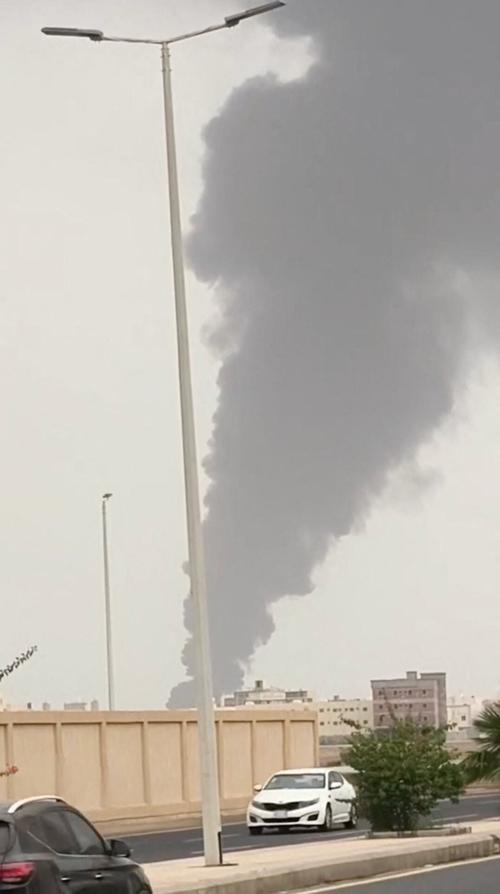
WASHINGTON — Signs of the Iran war's spread emerged this weekend despite a pause in U.S. strikes, as Yemen's Iran-aligned Houthis attacked Saudi oil installations along the Red Sea coast and Iran accused Ukraine of targeting an Iranian vessel in the Caspian Sea.
The U.S. military said Saturday that its naval blockade against Iran "remains in full effect" but did not explain why it halted a streak of 13 nights of escalating strikes. Asked about the pause, a senior official in President Donald Trump's administration said Trump "has always been clear that his preference is diplomacy, but he has shown Iran what will happen if they fail to come to the table in a serious way.”
There were also no reports Saturday of attacks from Iran on neighboring countries, like those that took place daily in response to the U.S. attacks.
Despite the lull in the Persian Gulf, fighting between Iran's Houthi allies and Saudi Arabia indicated the war, which already disrupted energy supplies through the Strait of Hormuz, could affect a second major shipping route and reignite Yemen's civil war.
People are also reading…
Iran's Foreign Ministry accused Ukraine of attacking an Iranian commercial vessel in the Caspian Sea, saying it resulted in an explosion that killed a sailor and injured another.
Earlier, Ukrainian President Volodymyr Zelenskyy in a social media post praised the results of "long‑range strikes" in the Caspian Sea, alluding to vessels shipping military cargo, but did not identify the nationality of the targets.
Houthi military spokesperson Yahya Saree said the group struck sites belonging to Saudi state oil company Aramco in Jizan and Yanbu. Video shared on social media and verified by Reuters showed a large column of smoke rising from the direction of the Aramco refinery in Jizan.
Two Asia-based trading sources said they had been informed of potential damage to fuel and oil storage sites at Jizan. Aramco did not respond to requests for comment.
In Yanbu, two ballistic missiles aimed at oil installations were intercepted by a U.S.-made Patriot battery operated in Saudi Arabia by the Greek military under an agreement with Riyadh, Greek security sources said.
Yanbu, Saudi Arabia's main Red Sea oil port, became a key route for Saudi oil skirting the Strait of Hormuz, which Iran blockaded. Up to 400,000 barrels can be processed daily at the oil refinery in Jizan, a city on the Red Sea close to the Yemeni border.
In Yemen, the air force of the Saudi-backed, internationally recognized government struck Houthi launch sites and arms depots in the Marib and al-Jawf provinces, Yemeni officials said.
Earlier, the Saudi-led military alliance said it bombed Houthi military positions Friday in the Red Sea port of Hodeidah.
The Yemeni officials said both sides in Yemen's civil war were mobilizing forces along the front.
Saudi Arabia led an Arab coalition battling the Houthis for more than a decade since the Iran-aligned fighters captured Yemen's capital, Sanaa.
The Saudi-led coalition said it would continue taking necessary measures to protect its ships and Saudi Arabia's interests, and would respond "uncompromisingly" if the Houthis continue hostile actions.
The Yemeni civil war, during which hundreds of thousands of people died from fighting and famine, was paused in 2022 under a ceasefire. That truce broke down this month, with the Houthis effectively joining the wider war their Iranian allies waged since being attacked by the U.S. and Israel on Feb. 28.
The Houthis declared a naval blockade of Saudi Arabia over the past week, and Houthi leader Abdul Malik al-Houthi said all Saudi oil facilities could be targets. On Thursday, the Houthis struck two Saudi tankers in the Red Sea.
American forces recently resumed their own blockade on Iranian ports. U.S. Central Command, whose coverage area includes the Middle East, said it disabled a ship whose crew attempted to run the blockade despite "repeated warnings" Friday in the Gulf of Oman.
An interim truce effectively collapsed two weeks ago, with U.S. forces striking targets in southern Iran in response to Iranian disruption of shipping in the Strait of Hormuz.
On Friday, Trump said the U.S. and Iran were in talks to negotiate an end to their conflict, but repeated that Tehran was not yet ready for a deal.
Iran’s Oil Minister Mohsen Paknejad said the country sold $11.5 billion worth of oil during the war and a further $6.5 billion during the ceasefire, when lower risks to tanker traffic helped increase exports and enabled the sale of part of about 100 million barrels of stored crude oil and gas condensate. The sales generated more than 60% of the oil revenue forecast in Iran's annual budget, he said.
Meanwhile, Zelenskyy said Ukraine noted Russia passed on its satellite observations in the Middle East to Iran to enable it to direct strikes in the region. "Since the beginning of July, we have recorded active Russian satellite surveillance of the Persian Gulf states and U.S. military facilities located there. These images subsequently appear in Iran," he said on social media.
"At the same time, there is a clear correlation between Russia’s satellite imagery of these sites and Iranian strikes — both before the attacks, in preparation for them, and afterward, to assess the damage inflicted," he said.


 Analysis: These 9 TUSD schools are at highest risk of merging or closing