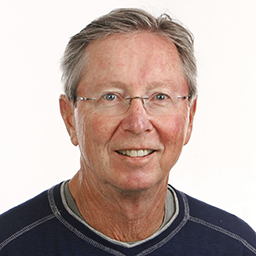

University of Arizona golf coach Rick LaRose, right, and the 1992 golf team in September, 1992, at Tucson National. From left, Ted Purdy, Manny Zerman, Jason Gore, David Howser and David Berganio Jr. Photo by Ed Compean / Arizona Daily Star
June 5, 1992: Arizona wins NCAA men’s golf championship
Arizona was ranked No. 1 a total of 13 times in Rick LaRose’s 34 years as the school’s golf coach, but perhaps the most unlikely season for Arizona to win the NCAA championship was 1992.
That was when the Wildcats ran into Phil Mickelson, playing his final event as an amateur, shooting a 63 in the first round as Arizona State jumped to a 10-stroke lead over the Wildcats.
The quotable LaRose didn’t leave reporters with an empty notebook that day in Albuquerque. “For all practical purposes, this tournament is over,” he said. “The rest of us are playing for second place.”
Whether LaRose had his fingers crossed or gave a noticeable wink to those who reported his comments has been forgotten.
On the second day of the four-day championship, Mickelson shot 65. The Sun Devils’ lead was cut to six strokes by No. 1-ranked Arizona, but LaRose didn’t change tactics.
People are also reading…
“Our little team is playing nicely,” he said.
The ’92 Wildcats were not a “little team.”
Manny Zerman had twice reached the finals of the U.S.Amateur (losing to Mickelson, of course). David Berganio won the U.S. Public Links championship. Harry Rudolph, who was at his best during the ’92 NCAA finals, would ultimately finish second to Mickelson, shooting rounds of 71-69-66-72 (or 10 under par).
It wasn’t until Round 3 that Arizona’s depth was manifest, and the Wildcats took the lead. Rudolph shot a 66, Zerman 67, Berganio 71 and senior Jim Furyk 71. That’s how good the Wildcats were; Furyk, a future U.S. Open champion, was the No. 4 player in Arizona’s 1992 lineup.
Entering the final round, Rudolph was paired with Mickelson, who had won the PGA Tour’s Tucson Open a year earlier, an amateur beating all the pros.
“I’d have to shoot 52 to beat Phil,” Rudolph told the Star, “so I’m thinking about the team.”
Unexpectedly, Mickelson double-bogeyed the first hole. Rudolph got a par, extending Arizona’s team lead to eight strokes. Even though the Sun Devils got as close as one stroke after 14 holes, Mickelson did not play well. He shot 74.
Berganio, who would ultimately become a PGA Tour regular until a back injury scuttled his career, made birdie putts at 16 and 18 to clinch it for Arizona. The Wildcats finished on top with 1,129 total strokes. ASU was second with 1,136. No other team was within 14 strokes.
“All we needed was a little leadership,” said LaRose, who was inducted into the Golf Coaches Association of America Hall of Fame in 2002. “Manny and Harry stepped up.”
Zerman, now a teaching pro in Miami, said: “I’ve been on great teams for three years. I knew we could win it, but when? It was so hard to get here.”
LaRose’s team finished third in the 1990 NCAA finals; he later coached the UA women’s team to the 1996 NCAA championship.
Where are they now? Rudolph played on the Asian, Canadian and Web.com tours for about 10 years. He now operates Harry’s Restaurant in La Jolla, California, a family institution that dates to the 1950s. Berganio played in 151 PGA Tour events, earning $1.79 million.
How they did it: The Pac-10 was so good in the early ’90s that Stanford won the 1992 league championship behind current TV analyst Notah Begay, but Arizona had the most depth. Furyk and Rob McIvor often rotated in the No. 4 and No. 5 spots.
Photo: University of Arizona golf coach Rick LaRose, right, and the 1992 golf team in September, 1992, at Tucson National. From left, Ted Purdy, Manny Zerman, Jason Gore, David Howser and David Berganio Jr. Photo by Ed Compean / Arizona Daily Star