

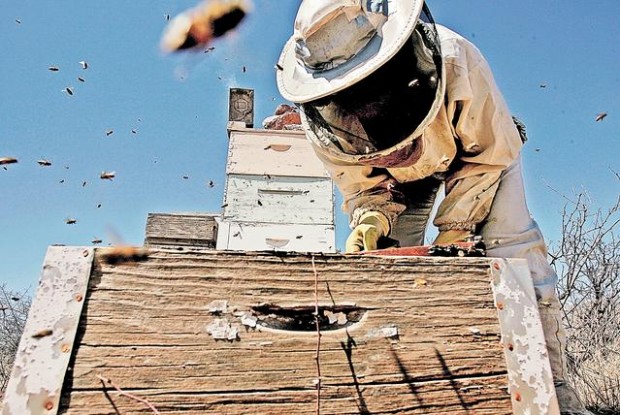
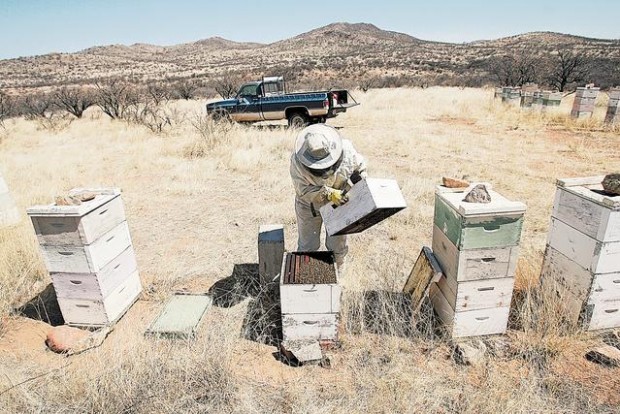
State agriculture officials say a mysterious disorder that has killed off half the commercial bees in some parts of the country is now in Arizona.
It hasn't yet been reported in Southern Arizona, but a positive side effect has been.
One Tucson commercial beekeeper reports the price paid by California almond growers for use of a standard commercial hive has soared to as much as $160, up from $45 as recently as three or four years ago.
So far, a federal bee-research official said, there is no conclusive evidence of what's causing the die-off, known as colony-collapse disorder.
There's not much evidence, period, not even dead bees, said Jeff Pettis, the bee-research leader at the U.S. Department of Agriculture's Bee Research Lab in Beltsville, Md.
He said beekeepers open their hives and find a few bees, the rest apparently having flown off and not returned — presumed dead.
People are also reading…
Mites, fungus, viruses, pesticides and even genetically modified crops have been mentioned as possible causes, but federal, state and local officials and experts are not placing blame — even in naming things that might be investigated as potential causes — for the disorder.
The concern in the agricultural community is understandable, particularly in California, where Pettis said half the nation's commercial bees — 1.2 million of the nation's 2.5 million commercial hives — are put to work each February and March pollinating the state's almond groves, the source of most of the world's supply. And almond acreage is projected to expand dramatically in the next five years, Pettis says.
Many of those hives are shipped cross-country for the almond pollination season, then shipped home or to other parts of the country where they're needed. But so far, Pettis said, there's been no move to limit interstate movement of hives to and from areas with colony-collapse disorder because so little is known about the cause.
In Southern Arizona, at least so far, its only effect has been to drive up the price for hives rented out to California growers.
Frederick Miracle, awaiting two flatbed semis returning from the California almond groves with 800 of his Tucson-based company's 1,000 hives Wednesday afternoon, says the prices he's been getting for hives has gone up and he hopes to expand his operation.
"Colony rental (prices) have basically tripled since 2001," said Miracle, going from $45 for a standard-sized colony or hive — those tall, rectangular white boxes seen in fields — to $140 to $160 for a colony, including delivery and pickup, this year.
Miracle and wife Suzanne run the Miracle Honeybee Co. out of Tucson. Frederick says he's read quite a bit about colony-collapse disorder in bee-industry journals, but so far they haven't suffered any increase in hive losses.
"You always lose bees," says Frederick. "It's just the nature of the business. The moment you pick up a hive and start moving it you put it under stress. It affects the interaction of the bees in the colony," he said.
Arizona crops that need bees include melons, apples and the state's small but lucrative vegetable-seed crops, says Peter Ellsworth, a University of Arizona entomologist at the Maricopa Agricultural Center.
"Arizona is the No. 1 producer of broccoli and cauliflower seed in this country," says Ellsworth. "If there's broccoli being planted anywhere in this country, that seed was probably produced in Arizona." And it was pollinated by bees.
Cotton, long Arizona's No. 1 crop, is mostly self-pollinating. Almonds are not grown in Arizona, but melons, like almonds, are heavily dependent on bees, says Ellsworth.
And while melon acreage is relatively small compared with some crops, it is a high-value crop. Ellsworth says some Arizona melon growers are growing for the lucrative Japanese custom-melon market.
"Some are so valuable," said Ellsworth. "Flawless, packaged in a Japanese grocery store (they sell for) the equivalent of $60 apiece."
Yuma melon farmer T.T. Havins said he "absolutely" depends on bees for pollinating 1,200 to 1,400 acres of cantaloupes a year.
"I don't know if you could substitute any other insect on the melon crop," says Havins.
He contracts with a Mesa-based commercial beekeeper, Apis, to place one to 1.5 hives per acre on his blossoming melons. That work starts next week, Havins said.
Fortunately, his melons need bees just as they're getting done with their annual peak-demand duties in the almond groves across the border in California.
"It's a supply-and-demand thing," says Havins. "When they get out of the almonds is when I get them down to the cantaloupes in Yuma."
The prices for bees in Arizona — delivered and picked up by commercial beekeepers — have gone up from $25 a colony about eight years ago to $40 a hive now, Havins says.
"I hope we don't get into the competition where we have to pay that much, too," says Havins, referring to the peak prices during the almond-grove pollination peak.
"Margins are slim," Havins says of the melon-raising business. But he says the bee business is hard work, even without the die-off problems.
Pollinating melons is hard work for the bees, too, says Havins. To produce a melon, Havins says, a cantaloupe typically requires six to 10 visits by a bee. He says watermelons take even more, as many as 12 visits.
Did you know...
Wild Africanized bees were first detected in Arizona in 1993.
There's no easily detectable, visible difference between Africanized "killer bees," common wild honeybees and commercial lines of European honeybees, shown here. Africanized bees are slightly smaller and are mainly identified through their behavior, which beekeepers say is notably more defensive, aggressive and persistent.


 Tucson's newest Shake Shack gets neighbors

