

In the 1960s, Raymond Burr, better known as television’s Perry Mason, visited Tucson several times. During his stays, he participated in a variety of local events, including a talent show and a symphony.
[photo moved to image asset]
Star file photo
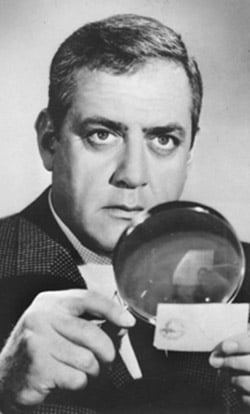
Raymond Burr as Perry Mason.
One of Burr’s first trips here was in 1959. His good friend, Ivan Rosequist of Rosequist Gallery, lived in Tucson and the actor stopped off to visit him following a trip to Texas. While here, Burr purchased two paintings, one by Ross Stefan and another by Paul Dyck. Both were Arizona artists.
There had been several earlier trips to town. But, as the Star story explained it, those visits had been accomplished without anyone noticing.
People are also reading…
The University of Arizona’s Newman Foundation’s “Chaplain’s Talent Review” in 1960, had a very distinguished emcee, for not one, but two evenings. First, Burr oversaw the talent show on a Friday night in October. The next night, he presided over the fund raising dinner, show and ceremony for the winners of the event.
Another Tucson friend, Richard Grand, arranged for Burr to speak before the State Bar of Arizona, at a luncheon. That was in Chandler in 1961.
That same year, Burr served as judge for the third annual Colossal Cave Contest. This was a photography competition open only to professional photographers. There was a $200 grand sweepstakes prize and $100 for first place in both color and black and white.
[photo moved to image asset]
1962 Star files
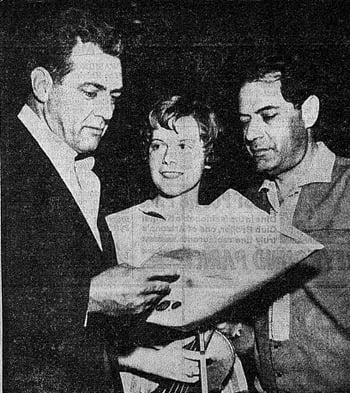
Prior to the concert, Burr, left, looked over the script with Davetta Caughey, a guest artist, and Frederic Balazs, the symphony conductor.
“Peter and the Wolf” brought Burr to Tucson in 1962. He narrated that work, as well as the “Lincoln Portrait, at a concert by the Tucson Symphony Orchestra on February 18. It was the first family concert by the TSO and drew 1,200 children and adults.
The Star reviewer praised the symphony for attempting to draw a younger audience, but said the concert was too long to retain their interest. She was not all that impressed with Burr’s narration, either. His Lincoln was “devoid of emotion, his enunciation not clear.” As for his rendering of Peter his “undramatic technique … removed the exciting suspense that makes this composition a favorite with children.”
Raymond Burr died, on Sept. 12, 1993, of metastatic cancer of the liver. He was 76.


 Tucson's having a big fast-food reshuffle
