

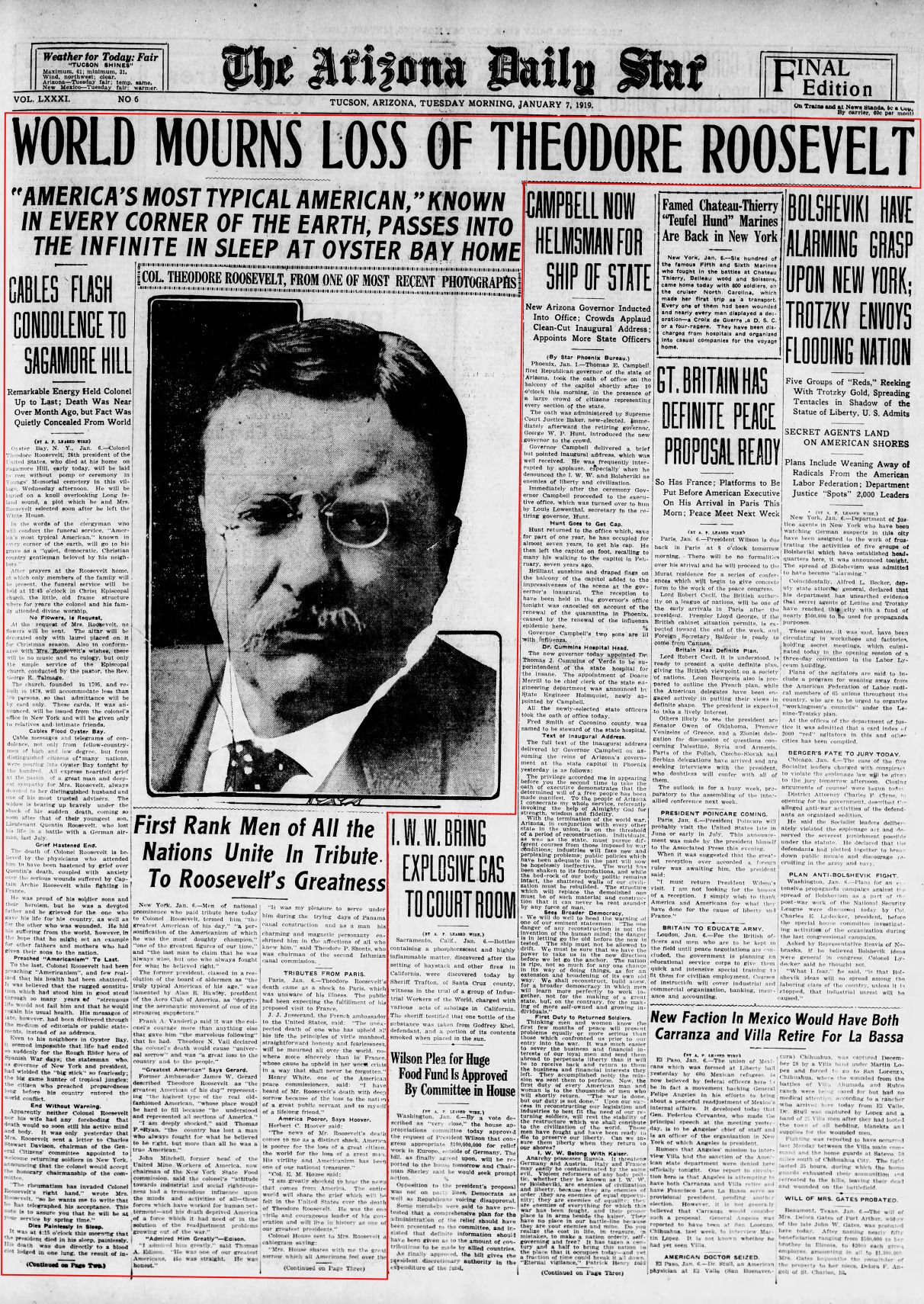
WORLD MOURNS LOSS OF THEODORE ROOSEVELT
"AMERICA'S MOST TYPICAL AMERICAN," KNOWN IN EVERY CORNER OF THE EARTH, PASSES INTO THE INFINITE IN SLEEP AT OYSTER BAY HOME
CABLES FLASH CONDOLENCE TO SAGAMORE HILL
Remarkable Energy Held Colonel Up to Last; Death Was Near Over Month Ago, but Fact Was Quietly Concealed From World
(By A. P. leased wire)
Oyster Bay, N. Y., Jan. 6. ─ Colonel Theodore Roosevelt, 26th president of the United States, who died at his home on Sagamore Hill, early today, will be laid to rest without pomp or ceremony in Youngs' Memorial cemetery in this village, Wednesday afternoon. He will be buried on a knoll overlooking Long Island sound, a plot which he and Mrs. Roosevelt selected soon after he left the White House.
People are also reading…
In the words of the clergyman who will conduct the funeral service, "America's most typical American," known in every corner of the earth, will go to his grave as a "quiet, democratic, Christian country gentleman beloved by his neighbors."
After prayers at the Roosevelt home, at which only members of the family will be present, the funeral service will be held at 12:45 o'clock in Christ Episcopal church, the little, old frame structure where for years the colonel and his family attended divine worship.
No Flowers, Is Request.
At the request of Mrs. Roosevelt, no flowers will be sent. The altar will be decorated only with laurel placed on it for Christmas season. Also in conformance with Mrs. Roosevelt's wishes, there will be no music and no eulogy, but only the simple service of the Episcopal church, conducted by the pastor, the Rev. George E. Talmage.
The church, founded in 1705, and rebuilt in 1878, will accommodate less than 500 persons, so that admittance will be by card only. These cards, it was announced, will be issued from the colonel's office in New York and will be given only to relatives and intimate friends.
Cables Flood Oyster Bay.
Cable messages and telegrams of condolence, not only from fellow-countrymen of high and low degree, but from distinguished citizens of many nations, were pouring into Oyster Bay tonight by the hundred. All express heartfelt grief at the passing of a great man and deepest sympathy for Mrs. Roosevelt, always devoted to her distinguished husband and one of his most trusted advisers. The widow is bearing up bravely under the shock of his sudden death, coming so soon after that of their youngest son, Lieutenant Quentin Roosevelt, who lost his life in a battle with a German airman, last July.
Grief Hastened End.
The death of Colonel Roosevelt is believed by the physicians who attended him to have been hastened by grief over Quentin's death, couple with anxiety over the serious wounds suffered by Captain Archie Roosevelt while fighting in France.
He was proud of his soldier sons and their heroism, but he was a devoted father and he grieved for the one who gave his life for his country, as well as for the other who was wounded. He hid his suffering from the world, however, in the hope that he might set an example for other fathers and mothers who had given their sons to the nation.
Preached "Americanism" To Last.
To the last, Colonel Roosevelt had been preaching "Americanism," and few realized that his health had been shattered. It was believed that the rigged constitution which had stood him in good stead through so many years of "strenuous life" would not fail him and that he would regain his usual health. His messages of late, however, had been delivered through the medium of editorials or public statements, instead of as addresses.
Even to his neighbors in Oyster Bay, it seemed impossible that life had ended so suddenly for the Rough Rider hero of Spanish War days; the statesman who, as governor of New York and president, had wielded the "big stick" so fearlessly; the big game hunter of tropical jungles; the citizen who preached preparedness long before his country entered the world conflict.
End Without Warning.
Apparently neither Colonel Roosevelt nor his wife had any foreboding that death would so soon still his active mind and body. It was only yesterday that Mrs. Roosevelt sent a letter to Charles Stewart Davison, chairman of the General Citizens' committee appointed to welcome returning soldiers in New York, announcing that the colonel would accept the honorary chairmanship of the committee.
"The rheumatism has invaded Colonel Roosevelt's right hand," wrote Mrs. Roosevelt, "so he wants me to write that he has telegraphed his acceptance. This note is to assure you that he will be at your service by spring time."
