

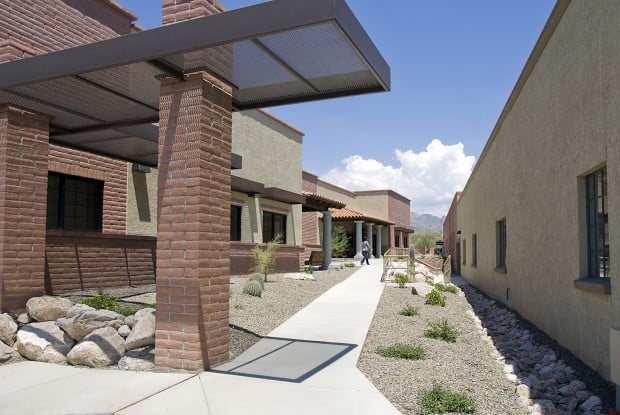
One of Tucson's largest hospices has a new administrative campus that's been more than 10 years in the making and cost nearly $3 million to build.
Casa de la Luz now has nearly 18,000 square feet of office space. When it began in 1998, the hospice worked out of a 600-square-foot office.
The northwest-side site at 7740 N. Oracle Road, which celebrated its opening last week, consists of three buildings, one of which already stood on the property but was redone.
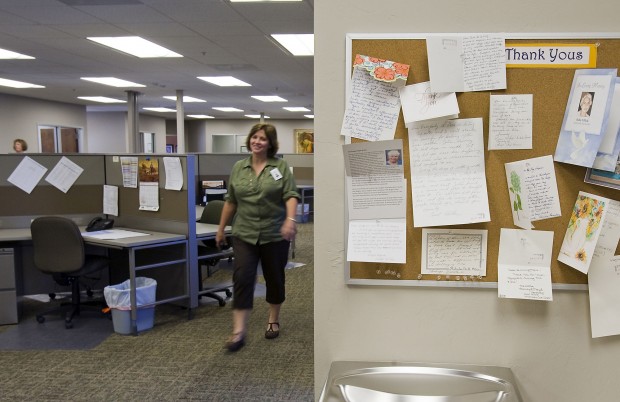
Before the move to the new campus, the hospice's administrative staff was split between five different offices. Now people who are all working with the same patient are in one location.
There are no patients on the campus.
The only employees who won't be on the new campus are those at the hospice's inpatient unit and residential hospice home. Kanmar Place, the residential hospice home, is off of Oracle Road north of River Road, and the inpatient unit is adjacent to Northwest Medical Center.
People are also reading…
Many of the hospice's patients are cared for in their own homes. About 300 inpatients and outpatients are served by Casa de la Luz at any given time.
Lynette Jaramillo, CEO and co-founder, and Agnes Poore, chief clinical officer and co-founder, started the business in Jaramillo's home using a $150,000 loan and another $100,000 that Jaramillo charged to her credit cards.
The hospice is for-profit and has a nonprofit branch, the Casa de la Luz Foundation, which assists patients financially with some things insurance doesn't cover, such as funeral arrangements or a plane ticket so a loved one can say a last goodbye, said communications specialist Carrie Bui.
The hospice accepts most insurance, including Medicaid and Medicare.
The hospice began as a three-person operation when it hired Dr. David Jaskar. He's still with the hospice today as medical director, but now Casa de la Luz has 200 employees and 125 volunteers.
"I believed we could do it, but I surrounded myself with people that helped me achieve it," Jaramillo said.
Rob Caylor, of Caylor Construction Co., bought and developed the new property and is leasing it to Casa de la Luz. Casa de la Luz had leased from him previously, and he said he likes that the hospice is "community-minded" and has a nonprofit element.
The property cost just under $3 million, Caylor estimated, and took about a year and half to finish.
"In this economy, to find a developer that would believe in what we do and our work and our mission - for him to build this facility for us is remarkable in today's economy," Jaramillo said.
The patients aren't the only people for whom Casa de la Luz cares. A large portion of the hospice's work is focused on bereavement, Jaramillo said.
The hospice follows families 13 months after a death even though reimbursement stops when the patient dies, she said.
"I believe in it because I needed it myself," Jaramillo said.
It took her 10 years to be able to say her mother's name after she died in 1971, she said.
"No one ever identified that I was grieving my mother," Jaramillo said.
"End of life is so special, and yet, the people that are the survivors, the people that go on living, need as much support and care as people who are dying."
DID YOU KNOW?
Casa de la Luz is Spanish for "house of light."
Bethany Barnes is a University of Arizona student who is an apprentice at the Star. Contact her at starapprentice@azstarnet.com or 573-4117.