


Prisoners have long served as a pool of cheap labor, but now they are doing surprising jobs while paying part of the cost of their incarceration and training.
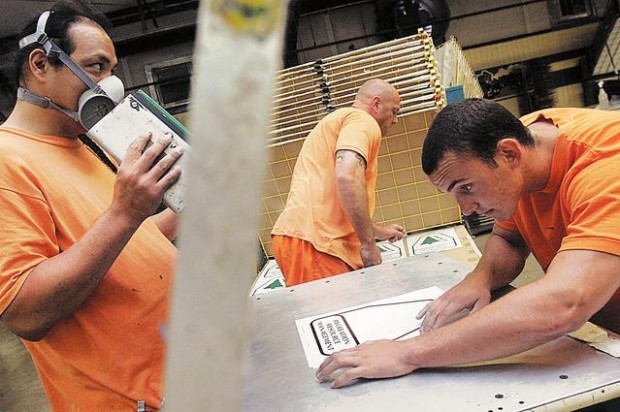
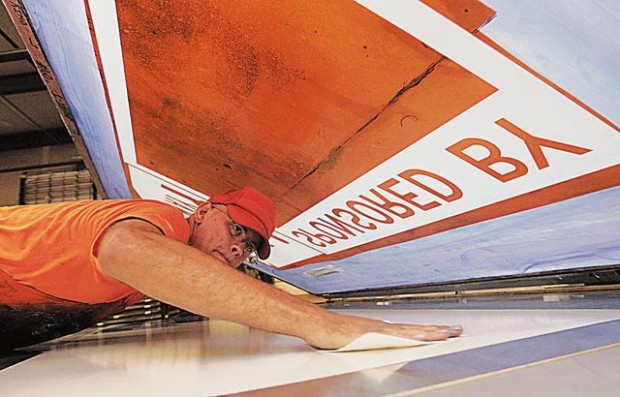
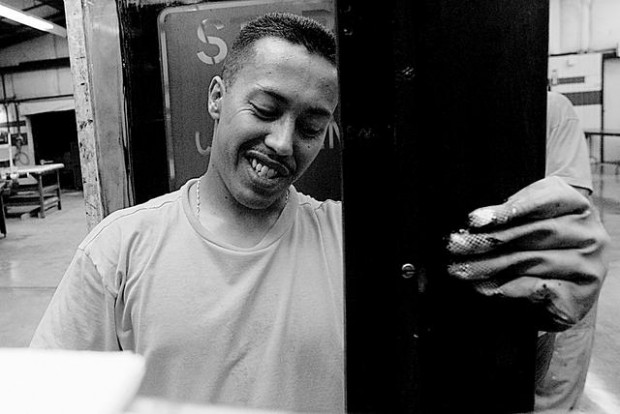
On a typical day, about 6 percent of Arizona's 34,000 inmates are working for Arizona Correctional Industries, the business arm of the Arizona Department of Corrections' Workforce Development Bureau. They work at call centers, build furniture, make skylights and tend chickens at a private farm.
They still make license plates, but they also make purses from old license plates.
Prison labor is more profitable than ever. ACI, which doesn't use taxpayer money, reported sales of products made by inmates reached a record-high of $25.6 million in fiscal year 2005, an increase of 28 percent from 2004, according to its annual report. The company expects to reach a similar sales level this year, said administrator Charles Flanagan.
People are also reading…
And all of ACI's owned-and-operated businesses combined were profitable for the first time in fiscal year 2005, recording $457,000 profit after an $870,000 deficit the previous year.
In addition to the workers, another 25 percent of inmates are in job-training programs through community college partnerships at prisons. Some are training in high-demand jobs to help soften labor shortages once they are freed. They too get paid for their work as they learn.
Most importantly, the state is investing in work and work training as a way to lower future prison populations, said Kathy Hayden, superintendent of education at the Department of Corrections.
"Research says 30 to 60 percent of ex-offenders will return within three years if they aren't literate, employable, sober and civil citizens," she said.
Low wages, more workers
The Corrections Department's job-training program moves a willing inmate from unskilled to skilled work to employment at a prevailing wage, Hayden said.
At the lowest level, inmates work inside the prisons, getting 10 to 50 cents an hour. At the next level, they are paid about 50 cents an hour for picking up litter or fighting wildfires.
Once working for ACI, an inmate starts at 85 cents an hour in the company's businesses or in jobs secured by governmental agreements. Some answer calls for the state Motor Vehicle Division, build steel furniture for parks, or bake food for inmates and the prison staff.
ACI also contracts with private companies. Some workers in Tucson spin bobbins of string that tomato vines will grow on in Eurofresh greenhouses near Willcox. They make $2 an hour. Others work at Televerde call centers in Phoenix for the U.S. minimum wage of $5.15 an hour.
At the highest level, inmates labor in a few federally certified programs, making $5.15 to $7.15 an hour building doors and skylights for Solar Industries Inc. in Tucson and building homes for ESB Modular Manufacturing Inc. in Marana.
ACI is employing more inmates than ever before, with a monthly average of 1,870 workers, 275 more than in 2004.
"Absolutely excellent"
Companies that contract for ACI labor often face labor shortages in their industries.
"It's an absolutely excellent program, and they're not taking jobs anybody wants, believe me," said Jack Dixon, owner of LBJ Farms in Picacho. Dixon said he hires as many as 60 inmates at a time to harvest watermelons in his fields.
"It's hard to get people to do field labor any more," he said. "The prisons have a lot of people that need work, and it works out fine for both of us."
Solar Industries, 2201 E. Medina St., has a core of civilian workers but turns to inmates when business surges, said Mike Parvis, the company's vice president and general manager.
"When we need to ramp up, we send work to the prisons. When we need to slow down, we keep work in-house," he said.
Outside prison, some of the former inmates are using their training. Tarnya Waggoner, 34, of Tonopah, was part of a job-training program in Perryville before she was released. She said it took her about two weeks to land a job as a framer for a Buckeye-area home builder.
One of the company's managers used to teach at one of the prison programs, she said. "He said, 'Show up, fill out the application and go to orientation,' " Waggoner said.
Before she was convicted of auto theft, she had been a skilled auto mechanic, she said. Now, because of high turnover and a labor shortage in the construction industry, she's her foreman's most tenured worker.
Now she has to work much faster and produce more than in prison, she said. But she earns $12 an hour.
Learning to make a living
Through a partnership between the state prison and Pima Community College, about 500 local inmates a year take job-training classes, said Jeanine Hixon, the college's director of prison programs.
They also get real-world experience, earn a small wage and keep prison costs low. Inmates in auto-repair training work on vehicles in the state fleet. Those in wastewater classes run the plants on the prison campus.
Statewide, about 16,000 inmates completed a training class and 7,000 earned professional certificates last year, Hayden said. There are inmates on waiting lists for some programs, she said.
Perhaps because a diploma or GED is required for working or taking classes, more inmates are earning diplomas, too. The Corrections Department has seen a 300 percent increase in the number of inmates earning GEDs, from 791 in 2003 to 3,125 in 2005, Hayden said.
Arizona's programs even impress a strong critic of prison industries. Tom Petersik, an economist and research professor at George Washington University in Washington, D.C., said state-run businesses such as ACI should give way to a free-market alternative.
"We would all be far better off employing inmates in competitive industries, paying market wages and demanding market productivity," he said via e-mail. But, he added, "My impression is that Arizona may have one of the more exemplary prison industries systems."
Array of deductions
An inmate doesn't see much of the money he or she earns. Besides victims' compensation, the state deducts family support payments and room and board. Some money also goes to inmate job-training programs. What's left is in an account available upon the prisoner's release.
Perryville inmate Sandra Cremonese, 34, of Phoenix is learning construction skills though a Rio Salado College program while serving a 4.5-year sentence for forgery.
Besides classes, Cremonese, a mother of four, has helped build homes for Habitat for Humanity and has done some commercial work. She said she imagines she'll teach her kids some skills and maybe have her own family business one day.
"Being a felon, it's really hard to get a job when you get out," Cremonese said. "I know when I get out, I absolutely have the possibility of being an electrician."
Rene Guerrero, 45, trained himself for a job while in prison but struggled for a couple of years after his release to find meaningful work.
Guerrero was serving a 10-year drug-conspiracy sentence when he earned his paralegal degree in three years, spending most of his time working in a prison law library for 10 cents an hour. His studying paid off when a judge accepted his petition and freed him.
He started looking for jobs in law offices and government offices, but "everybody was closing doors," he said.
"The judge didn't sentence me to unemployment," he lamented. His library and paralegal skills weren't much use to him outside prison, he said.
His job interviews went well, and when asked about his conviction, he'd say he paid for a mistake, but employers weren't willing to take a risk on him, he said.
"I felt like I couldn't use my knowledge," he said. "I couldn't go back to working at a Lube Pit." That's what he did before he was arrested with a pound of cocaine in his car.
Guerrero gave up, started drinking and served two more years for drunken driving.
In 2005, he had his civil rights restored and got a bail bonds license. He started helping other people make bail by putting liens on their houses. But after four months, a competitor complained, and his license was revoked.
After months of lobbying, it took a new law to get his license back — Gov. Janet Napolitano signed a bill into law in May that makes it possible for an ex-offender convicted of a nonviolent crime to have a bail bond license.
Someday, he'd like to start a program that would help ex-felons fill out papers to have their civil rights restored at a lower price than going to a lawyer, he said.
"You've got a right to be happy," he said.
What is Arizona Correctional Industries?
Phoenix-based ACI is part of the Arizona Department of Corrections. It is both a job program and a for-profit business. For more information visit aci.az.gov.
Who contracts for ACI labor?
ACI provides inmate workers for private businesses facing labor shortages. In some cases, ACI must be able to show it is not taking jobs from others who want them, said administrator Charles Flanagan.
● Some of the private companies that contract with ACI are:
Eagle Milling Co. Inc. in Casa Grande
ESB Modular Manufacturing Inc. in Marana
Eurofresh Inc. in Willcox
LBJ Farms in Picacho
Solar Industries Inc. in Tucson
Southeast Arizona Medical Center in Douglas