

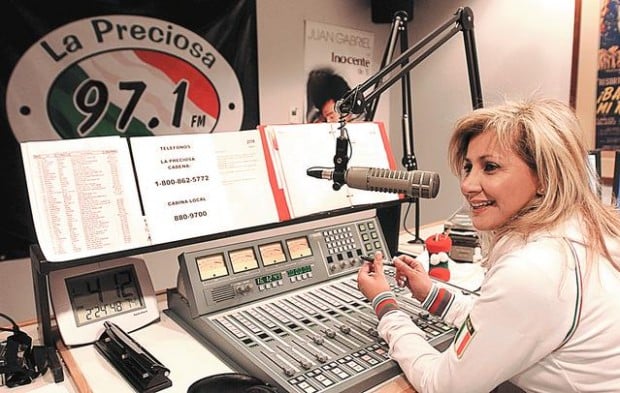
Spanish-language radio has come a long way from the days when ad reps couldn't even get through the doors of local car dealers and grocery store chains.
In Tucson and the rest of the country, the rising Latino demographic and Latinos' particular way of listening to radio is attracting advertising from all sectors, said Bob Feinman, director of Hispanic operations for Clear Channel Radio Tucson, and a veteran of local Spanish-language radio for three decades.
In the latest Arbitron ratings, one local Spanish-language station — La Caliente KCMT (102.1-FM) — ranked fourth among Tucson's 30 commercial stations, regardless of language. It consistently ranks in the top five.
In fact, Spanish-language radio has been the star of the Arbitron ratings nationally and regionally.
Arbitron tracks radio formats and groups them into 15 larger categories such as "rock," "country," "Spanish," and "adult contemporary." Since the winter of 1998, the share of listeners in all but four of those categories has declined. The "Spanish language" category shows the most marked increase among the 15, from a share of 6.7 in 1998 to 10.2 for fall 2005.
People are also reading…
For the "Mountain" region that includes Arizona, the numbers are even more dramatic: a 5.0 share for Spanish-language stations has grown to 14.2 over the same period.
Courting listeners
Despite increasing listenership and a ranking in the top third of all Tucson stations, the second-highest-rated Spanish language station has just changed its format to attempt to pull in even more listeners.
What had been a "Spanish contemporary" format with Que Suave KTZR (97.1-FM) transformed last week into the "Spanish variety" format of "La Preciosa," or "the precious one," said Debbie Wagner, market manager of Clear Channel, which owns KTZR and another Spanish-language station, Radio Tejano KXEW(1600-AM).
"We were actually doing quite well with the contemporary format, but Clear Channel launched the new variety format two years ago and it's just been a remarkable success," Wagner said.
Clear Channel's version of Spanish variety is the brainchild of Monterrey, Calif.- disc jockey Alex Lucas, who developed a style that combines music of the '70s, '80s and '90s with Hispanic family values, Wagner said. The "La Preciosa" format stands in stark contrast to what had been the dominant trend —"blue Spanish radio," essentially Howard Stern in Spanish.
"A lot of Spanish stations usually have more of a blue morning show, and that kind of evolved to where it carried on throughout the day with those sort of double entendres," she said. "Spanish variety is totally the opposite of that kind of blue programming, and that's why I think it has done so well."
"La Preciosa" stations have won "books,"or Arbitron ratings periods, in several markets, and rank consistently in the top five radio stations in cities such as San Jose, Monterrey and Bakersfield, Calif., Dallas and Greensboro, N.C., Wagner said.
"Gratifying" change
That's a far cry from the late 1970s, Feinman said.
"Back then, the only revenue was locally owned businesses in the Spanish community," he said. "You just couldn't go to car dealers or corporate grocery stores and sell ads, so it's been interesting and gratifying to see the way Spanish-language radio has taken off in this country."
While the rise in Latino demographics has obviously played the major role in the growth of Spanish radio, advertisers are also attracted to the loyalty of listeners and the amount of time they tune in.
Demographics for English-language formats like adult contemporary and alternative often spike at a certain age and take steep drops from there, Wagner said.
Spanish stations have much larger demographics — "from birth to death"— said Carlos Gonzales, marketing and promotion director for Arizona Lotus Corp.'s La Caliente KCMT (102.1-FM) and ESPN Deportes KTKT (990-AM), Tucson's first Spanish sports-talk station.
"We do our promotions and we have everyone from the small child in the house to the grandmother," Gonzales said.
Those loyal listeners also spend a lot more time tuned in than the average English-language listener. An Arbitron study released a year ago showed that the average listener spent 3.5 hours with a Spanish-language station, about three times the average for English-language stations.
"With the Hispanic culture, it seems like the first thing you do when you get up on Saturday is turn on the radio, and it's left there on that station, and that's it," Gonzales said. "It's not like, 'Oh, there's a commercial,' or 'I don't like this song,' and you're changing it all the time."
"Mexican regional"
The most popular format for Spanish-language radio in is known as "Mexican regional," a mix of banda, norteño, mariachi, and cumbia, said Raul Nuñez, promotions director for La Tricolor KZLZ (105.3-FM), which is owned by Entravision Communications Corp.
Described by Nuñez as "upbeat, happy music," the accordions and trumpets of Mexican regional contrast with the newest trend of Spanish radio in large metropolitan areas. "Hurban" (Hispanic urban) features rap and other contemporary styles of modern Latino music, Nuñez said.
But even formats as traditional as Spanish oldies and Mexican regional are incorporating more contemporary aspects, he said.
"I think traditionally a lot of Spanish-speaking people in the U.S. came from rural areas in Mexico and other countries, but now a lot of people from the cities are emigrating to the U.S., and I think they want more of a contemporary style," Nuñez said.
The family-based format that Monterrey's Lucas has masterminded, which includes reading autobiographical anecdotes from childhood and stories that are somewhat similar to the telenovelas so popular on Spanish-language television, strike Feinman as a case of a medium coming full circle, he said.
"It's funny, because I remember back at KEVT in the '70s we did a lot of different things like reading poetry on the air at sunset and doing little segments for children," Feinman said. "And that's kind of the sentiment behind this Spanish variety format, proven hits of the '70s, '80s, '90s, along with family values and nostalgia."
● Seven of the 30 commercial radio station in the Tucson area are Spanish-language stations. Arbitron ratings data is for the fall 2005 period by share, the percentage of people listening to the radio in a given metro area who are listening to a particular radio station.
Station: KCMT 102.1 FM "La Caliente"
Owner: Arizona Lotus Corp.
Format: Mexican regional
Arbitron share: 6.4
Local rank: 4
Station: KTZR 97.1 FM "La Preciosa"
Owner: Clear Channel Radio
Format: Spanish variety
Arbitron share: 2.0
Local rank: 13 *
Station: KXEW 1600 AM "Radio Tejano"
Owner: Clear Channel Radio
Format: Tejano
Arbitron share: 1.6
Local rank: 17
Station: KZLZ 105.3 FM "La Tricolor"
Owner: Entravision Communications Corp.
Format: Mexican regional
Arbitron share: 1.1
Local rank: 22
Station: KTKT 990 AM "ESPN Deportes"
Owner: Arizona Lotus Corp.
Format: Spanish news/talk
Arbitron share: 0.4
Local rank: 27 *
Station: KQTL 1210 AM
Owner: MultiCultural Radio Broadcasting
Format: Spanish variety
Arbitron share: n/a
Local rank: n/a
Station: KEVT 1030 AM "La Raza"
Owner: One Mart Corp.
Format: Spanish oldies
Arbitron share: n/a
Local rank: n/a
*Arbitron share and rankings were for a previous format.
Source: Arbitron Ratings and Media Research Information for Fall 2005