


Auto dealers are learning what buyers long have known: It's crucial to scrutinize big promises and small type in ads for vehicles.
During the past 15 months, three local car dealers have agreed to pay the state more than $275,000 after the Attorney General's Office filed lawsuits and claimed the dealers' ads misled consumers.
As Attorney General Terry Goddard's office has intensified its enforcement, local auto dealers — most of whom have faced no public complaints from the state about their ads — are using more tools to safeguard their ads.
Dealers are paying ad agencies, lawyers and independent ad critics to determine whether their ads comply with rules for fair advertising.
"They have become more and more stringent in upholding those rules and regulations," said Cheri DeMaio, president of Ad Dimensions in Tucson, "and we have to be careful, because they're fining big money."
People are also reading…
The oversight makes ad agencies' job more difficult, since auto ads are designed to get consumers out of their living rooms and onto dealership lots, said Tom Collier, president of the Better Business Bureau of Tucson and Southern Arizona. Important details sometimes take a back seat.
Ethics rules draw the line, he said, at using false pretenses to lure consumers. Arizona law forbids false, deceptive or misleading advertising.
The CEO of one of the dealerships sued by the state said the rules are too complicated to understand, and that the state exploits that ambiguity to collect money from the dealers.
"They wanted money," said Dave Aufmuth of Aufmuth Motors. "It had nothing to do about consumer protection. There were no consumer laws broken."
But Steve Christy, president of Steve Christy Chrysler/Jeep, said following the rules is simple.
"Every dealership is fully aware of guidelines involving advertising," Christy said. "There is really no excuse for any dealership to be outside those guidelines. They are made excruciatingly clear."
Proverbial auto ads
Collier offered consumers a proverb about ads for cars: Big headlines giveth, and little type taketh away.
In other words, the deal looks great — until you read the fine print, where the terms and conditions often lurk.
Dealers run into problems, he said, when customers can draw one conclusion from the big type and a different conclusion from the small type.
● In September 2004, the attorney general sued Precision Toyota of Tucson, claiming that August 2004 newspaper and television ads promised 50 percent off manufacturer's standard retail price, or MSRP, on every new Toyota in stock.
In the newspaper ad, the deal was followed by an asterisk, and said in small type, "See dealer for details." According to the attorney general, the 50 percent discount on the car was available only after the buyer first leased the new car for six years.
Under the deal, a Toyota Avalon with MSRP of $29,942 would have cost the customer $30,331, the Attorney General's Office said. That's 1 percent more than MSRP, not 50 percent off.
In January 2005, Precision Toyota agreed to pay $152,000 to the attorney general's consumer protection division. Representatives of Precision Toyota declined to comment.
● In November 2005, the attorney general sued Aufmuth Inc., claiming Aufmuth Motors, in multiple advertisements, offered free items that were not free.
According to the lawsuit, one deal offered customers a four-day vacation to San Francisco, a satellite dish and a refrigerator with each auto purchase. Aufmuth added the cost of the items to the sticker price of the car, the lawsuit said.
In November 2005, Aufmuth agreed to pay $50,000 to settle the suit, but Dave Aufmuth still disputes the allegations. He said the dealership never claimed it was giving away a free vacation, satellite dish and refrigerator with a car purchase. Those items were listed on the sticker, he said, and consumers were given the option of buying some, none or all.
Andrea Esquer, spokeswoman for Goddard, said the attorney general stood by the consent judgment in the case.
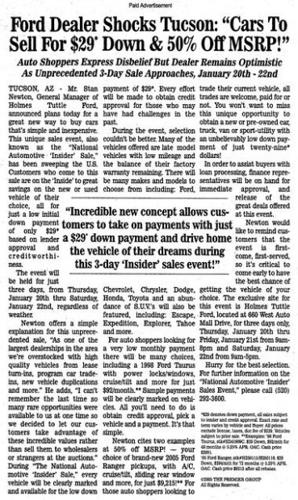
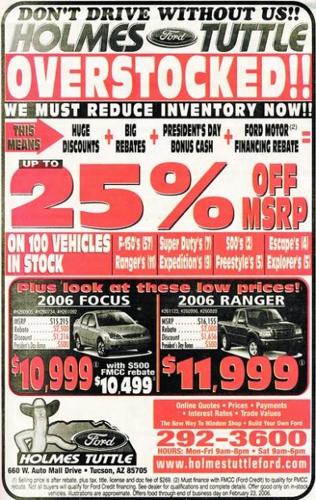
● In December 2005, the attorney general sued Holmes Tuttle Ford Inc., claiming that a January 2005 newspaper ad misleadingly promised 50 percent off MSRP.
According to the lawsuit, the 50-percent-off sale involved just two trucks, both of which were sold by 8:30 a.m. on the first day.
Holmes Tuttle agreed to pay $75,000. The dealership's general manager could not be reached for comment.
The dealers did not admit any wrongdoing or violation of state law in any of the three lawsuits.
Since January 2005, the attorney general has sued just one car dealer outside Tucson for deceptive advertising, Esquer said.
What makes an ad false
While state law forbids false, deceptive or misleading advertising, it does not spell out exactly what makes an ad false or deceptive. The attorney general issues guidelines to help dealers understand the differences between legal ads and illegal ones.
Those guidelines form one of the safeguards Arizona car dealers use to help ensure advertising is legal and ethical.
The Arizona Automobile Dealers Association, a trade group, hires the Better Business Bureau to review auto ads after publication and look for potential problems, said Bobbi Sparrow, the association's president.
The Better Business Bureau warns dealers when ads are unethical, Collier said, and is authorized to report problems to the attorney general.
The Arizona Automobile Dealers Association offers annual seminars to help dealers keep up with advertising laws, Sparrow said. Some dealers hire advertising agencies that help interpret the guidelines.
"It's our responsibility to make sure the auto dealers are following the rules. We're the ones that are designing the ads for them," said DeMaio, of Ad Dimensions, whose clients include O'Rielly Chevrolet, O'Rielly Mitsubishi and Steve Christy Chrysler/Jeep.
DeMaio said her firm attends a class the Attorney General's Office holds every year to help businesses understand advertising guidelines.
Newspapers that accept advertising work with advertisers to help ensure accuracy, said Sandra Riggins, who manages the department that handles auto dealer advertising for Tucson's Newspapers, the business arm of the Arizona Daily Star and Tucson Citizen. Car dealers increasingly use lawyers to check their ads, Riggins said, to ensure they comply with the laws.
Three sets of ad guidelines
The Arizona Automobile Dealers Association, attorney general and Better Business Bureau each issues its own set of guidelines for car ads, Christy said. With three sets of advice, and more help available by phone, he said, the rules are easily followed.
"They're very fair and forthright, and should be easily followed," Christy said.
Dave Aufmuth faulted how the Attorney General's Office enforces rules, saying the investigation of his company's car ads lasted almost two years and cost him about $200,000 in legal fees. He said the investigators never told him precisely what they were looking for or what the problem was.
"I didn't even know these guidelines existed until we got into this thing," Aufmuth said. "They're the most ambiguous things you've ever read."
He said the state lacks clear, concise consumer advertising laws, and it knows car dealers are an easy target.
"Let's face facts," Aufmuth said. "Nobody really cares if a car dealer's ox gets gored."
Guidelines for distinguishing the good from the bad in auto advertising
● In settling lawsuits against three Tucson-area car dealers, the Arizona Attorney General's Office has offered these guidelines for how to make a car ad clear and understandable:
In newspaper ads, type should be large enough that customers don't overlook important details about terms and conditions. The attorney general suggests a minimum of 10-point type (about the same size as these letters).
When an announcer reads an ad, terms and conditions should not be read at a volume that's quieter than the rest of the advertisement. Terms and conditions should not be read faster or less intelligibly than the rest of the ad.
If a television ad displays fine print about terms and conditions of a deal, the fine print should be legible, and remain on the screen long enough for a viewer to read it all.