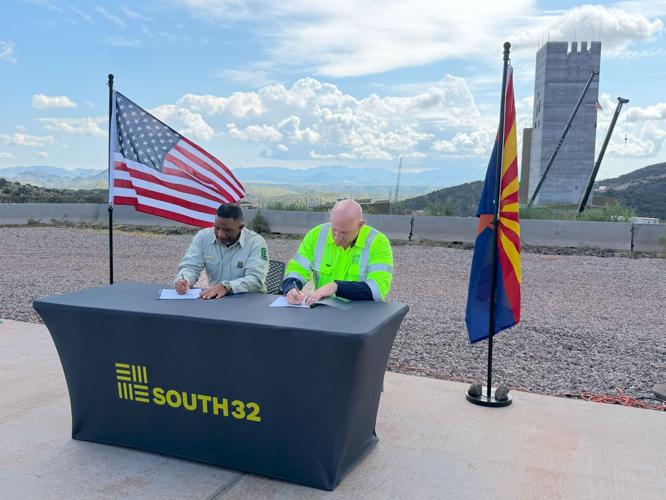
During a ceremony at the Hermosa critical minerals mine site in the Patagonia Mountains on Wednesday, Coronado National Forest Supervisor Kerwin Dewberry, left, and South32 Hermosa President Pat Risner sign the final documents approving expansion of the project onto adjacent Forest Service land.
Federal regulators have granted final permission for a proposed critical minerals mine in the Patagonia Mountains to expand onto surrounding U.S. Forest Service land, as expected.
The last of the necessary documents was signed Wednesday during a ceremony at the Hermosa Mine project site about 75 miles southeast of Tucson.
Australia-based global mining giant South32 is now free to build a power line, an access road and other support infrastructure across portions of Coronado National Forest adjacent to the roughly 200 acres of private land on which most of the underground zinc, silver and manganese mine is being developed.
Company officials said they plan to begin conducting geotechnical surveys and moving dirt on public land in the coming weeks.
People are also reading…
“This is the moment when years of planning, environmental study, consultation and permitting turn into action,” said South32 Hermosa President Pat Risner.
The Forest Service previously approved the project’s offsite infrastructure in July, when it issued a record of decision marking the completion of a National Environmental Policy Act review of the mine that began in 2024.
All that remained was for officials to sign off on Hermosa’s final Mine Plan of Operation.
“USDA and the Forest Service are committed to permitting projects on businesses’ timelines, not government’s,” said U.S. Department of Agriculture Deputy Secretary Stephen Alexander Vaden on Wednesday. “Projects such as the Hermosa project advance our national security objectives by making our country less reliant on others for critical minerals.”
The record of decision, final environmental impact statement and other documents are available on the Forest Service’s Hermosa Critical Minerals Project webpage.
Construction is more than halfway finished on the mine, which is expected to begin operations in late 2027 and start churning out zinc from its onsite processing plant in the first half of 2028.

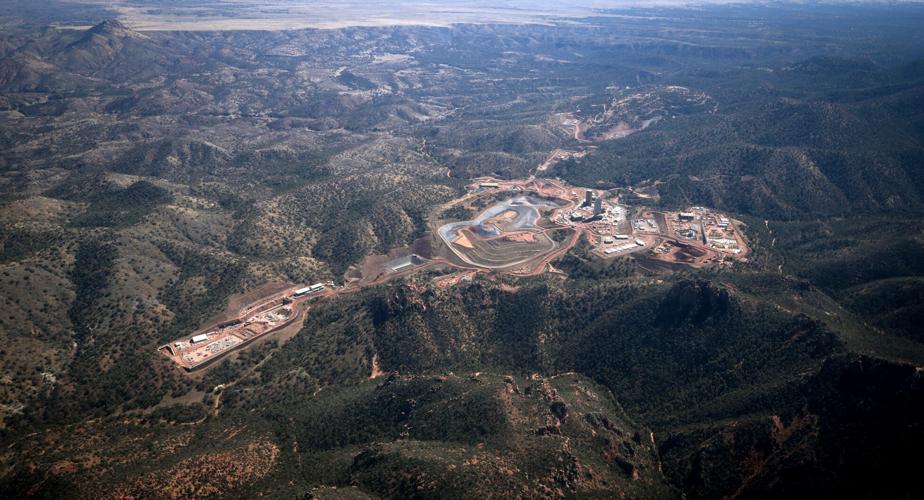
The South32 Hermosa mining project in the Patagonia Mountains, as seen from the air during an EcoFlight tour on March 3. The mine is about 75 miles south of Tucson.
South32 has said the site in the Patagonia Mountains and its remote operations facility in Nogales will employ up to 900 people and nearly double the tax base in Santa Cruz County, while producing domestic supplies of as many as five critical minerals.
Over the past two years, though, Hermosa has been hit with construction delays and cost overruns, mostly due to inflation and Trump administration tariffs that have driven up the price of steel, concrete, pipes and other building materials. In April, the South32 board of directors had to approve an additional $1.1 billion for the project, pushing its overall development costs to $3.3 billion.
With Wednesday’s signing, Hermosa becomes the first mine to be approved under the Fixing America’s Surface Transportation Act, or FAST-41 for short, an Obama-era initiative aimed at streamlining the federal permitting process for what is considered critical infrastructure.
FAST-41 helped South32 secure all of its necessary approvals in roughly three years, while other proposed mines in the region have languished in the traditional permitting process for a decade or more.
Now some members of Congress are trying to expand the program to make all mines eligible for expedited review, not just critical mineral projects.
A bill to that effect, called the Protecting Domestic Mining Act, was passed by the U.S. House of Representatives on Thursday over the objections of 201 lawmakers, including Rep. Adelita Grijalva.
The Democrat from Tucson tried unsuccessfully to amend the bill to require direct consultation with affected communities and tribes before a mine could qualify for FAST-41.
“At a time when we should be strengthening environmental protections, respecting Tribal sovereignty, and ensuring communities have a meaningful voice in decisions that affect their land and water, this bill moves us in the wrong direction,” Grijalva said in a written statement after Thursday’s vote.

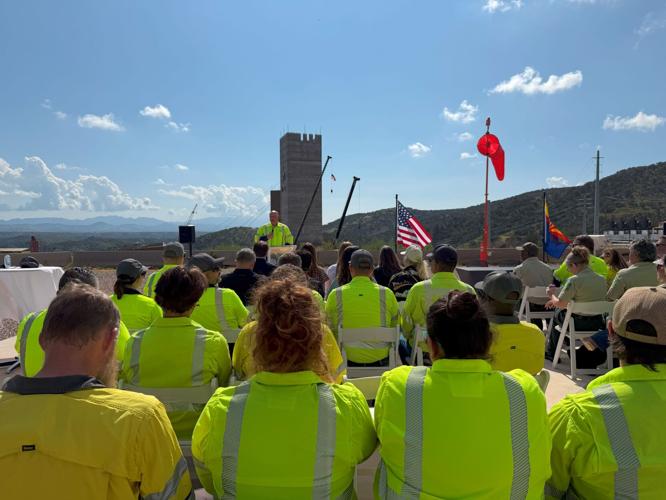
South32 Hermosa President Pat Risner speaks before a group of mine employees, Forest Service officials and others during a ceremony at the project site Wednesday marking the end of the federal review process.
In an Aug. 7 op-ed in the Patagonia Regional Times newspaper, Grijalva wrote that local leaders and residents in the community closest to the mine have raised “serious concerns about their drinking water, their health and the long-term sustainability of their aquifers.”
But Hermosa was fast-tracked anyway, even with some of those questions unresolved, she wrote.
“The bottom line is that the Forest Service should never have allowed this project to move forward until the input of affected communities, Tribal leaders, and local residents were fully addressed,” Grijalva wrote. “Unfortunately, the flawed approval process for the Hermosa Mine is just a preview of what is to come in other parts of the country if there are not serious reforms to FAST-41.”



 Forest Service signs off on southern Arizona mine as cost skyrockets