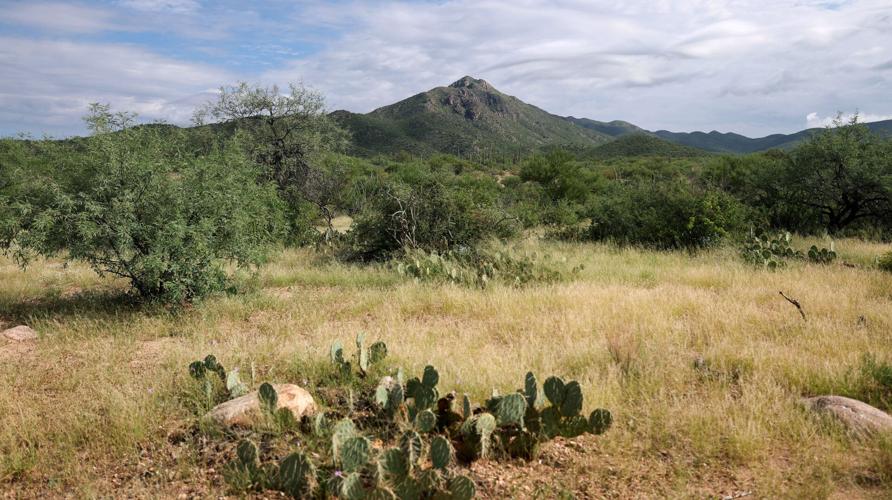
TOHONO O'ODHAM NATION — After weeks of soaking monsoon rains, the land along the southern boundary of the Tohono O'doham Nation is gleaming with lime-green saguaros and lush, towering ocotillos that cast swaying shadows over prickly pears and chollas.

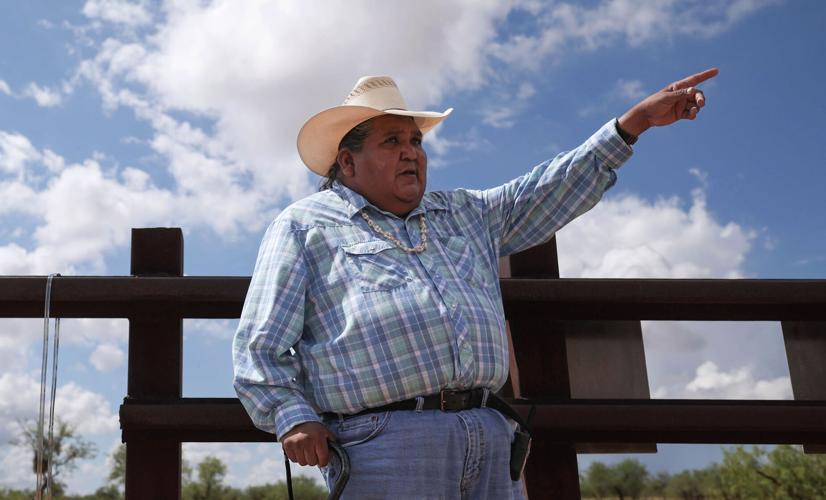
Tohono O’odham Nation Chairman Verlon Jose speaks Thursday to reporters at the San Miguel Gate on the Tohono O'odham Nation's border with Mexico. "This wall is a political stunt. There is no real reason why a wall should be built," Jose said. "To the American people, when are you going to wake up and realize this? It's a waste of your money."
Standing Thursday near a low-lying, rust-colored vehicle barrier, just north of the U.S.-Mexico border, Tohono O'odham Tribal Chairman Verlon Jose said he often comes to a spot near here, where the cacti forest is thickest, and sits among the saguaros, which the Tohono O'odham tribal council recognized as people in 2021.
Jose, 59, said he comes alone to meditate among these "brothers and sisters" and to ask for guidance. The saguaros answer him, he said.
But after unauthorized border-wall contractors spent five days here in late August, escorted by armed, masked agents with U.S. Customs and Border Protection, many of those saguaros, as well as large ocotillos, are now tagged for removal to make way for two planned 30-foot-tall steel border walls.
People are also reading…
Tribal leaders say the construction plans — advanced without meaningful tribal consultation, Jose said — are not only a violation of tribal sovereignty, but are also costly and unnecessary.
"This wall is a political stunt. There is no real reason why a wall should be built," Jose said Thursday to reporters gathered on the Tohono O'odham Nation's land. "To the American people, when are you going to wake up and realize this? It's a waste of your money. It's a waste of taxpayers' money."
The 30-foot-tall barriers will do incalculable damage, Jose said, dividing in two the Tohono O'odham's ancestral lands, which stretch south to Hermosillo, Sonora and west to the Sea of Cortez in Mexico, while destroying sacred sites and irreplaceable living beings in their path.
The U.S. government's actions today, in continuing to take and "destroy" Native lands, are an extension of U.S. founders' original theft of land and bloodshed of Native Americans, Jose said.
"They can never repay us for what they've done to us," he said. "There ain't no money in this world that can compensate us for what they're doing. You can never heal the wound across my heart that has been caused by this thing they call the international boundary."
Since the "One Big Beautiful Bill" allocated $170 billion to the U.S. Department of Homeland Security and its sub-agencies last year, including more than $50 billion for border-wall construction and other CBP facilities, CBP has announced plans to close gaps in the 30-foot-tall primary border wall, as well as add a second line of border wall, parallel to the first, along the entire U.S.-Mexico border — a plan critics say proves the first wall doesn't work.
Those plans are moving forward even where natural barriers already exist, such as in Big Bend National Park in Texas, and where migration is vanishingly rare, including in Southern Arizona's San Rafael Valley about 60 miles east of the Tohono O'odham land, environmentalists say.
On the Tohono O'odham Nation, tribal leaders have worked closely with CBP over the past two decades to use the latest technology, and limited physical barriers, to bolster border security, tribal leaders say.
The tribe has allowed the Border Patrol to build forward-operating bases on its land and to install low-lying vehicle barriers and 11 integrated-fixed surveillance towers. The Border Patrol had been looking into adding motion-activated linear ground detection technology, Jose said.
Modern security strategies have allowed the Border Patrol to effectively surveil the region and helped reduce border crossings by 95% since a post-pandemic spike in migrant arrivals in 2023, Jose said.
"We've bent over backwards to work with the federal government on border security," Jose said. "We believe that the technology is working, by their own numbers. ... But there's only so much that we would agree to. And a wall is not the answer."

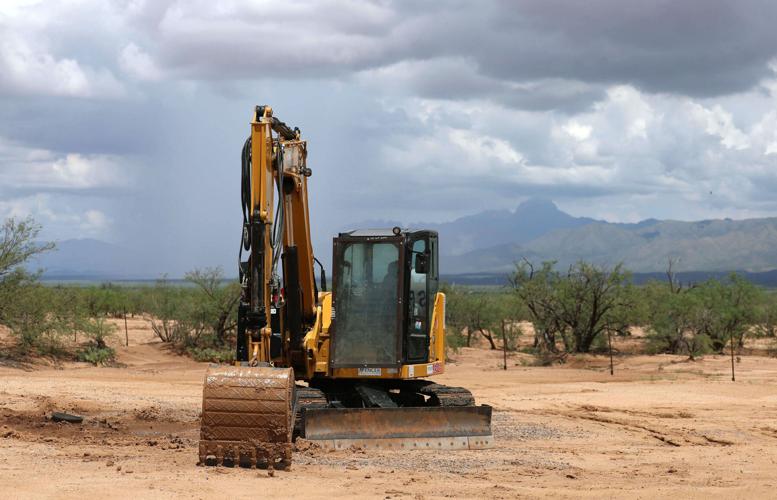
Border wall construction equipment, pictured Thursday on the Tohono O’odham Nation near the international border, is idle for now. But on Aug. 25, at 4 a.m., tribal members witnessed dozens of masked and armed CBP agents escorting contractors to the area around San Miguel Gate where they began pre-construction activities on the border wall planned on the Nation's boundary with Mexico.
CBP did not respond to the Star's request for comment on Friday. But CBP Commissioner Rodney Scott defended the agency's move to escort contractors onto the Nation without authorization in an emailed statement earlier this month.
CBP "is moving forward with a 62-mile project to close a longstanding border security gap in southern Arizona, known as the Tucson 5 project," Scott said in the statement. "The project will close one of the most dangerous smuggling and trafficking corridors on the Southwest border: remote desert that has facilitated decades of drug loads, migrant deaths, and cartel activity. Congress funded this work, a Federal court has affirmed it, and CBP is carrying it out under the legal authorities that apply."
Traditional crossings at risk
CBP's aggressive construction has degraded the formerly collaborative relationship the agency had with the Tohono O'odham Nation, Jose said. In the past, CBP used to voluntarily work to respect tribal traditions, despite having used its waiver authority to override environmental laws requiring such consultation, he said.
Under President George W. Bush, CBP worked with the nation to avoid sacred sites or plants while building the vehicle barriers that currently line much of the Tohono O'odham Nation's southern boundary, and to respectfully handle human remains found there, Jose said. Those accommodating "zig-zags" in the vehicle barrier are still evident, but CBP's actions today are a "betrayal" of that earlier spirit of collaboration, Jose said.
Speaking near the San Miguel gate — one of three traditional crossings that CBP built into the existing vehicle barrier on the Nation's southern boundary — Jose said those gates are critical links to the Nation's enrolled tribal members living in Mexico. They account for 3,000 of the Nation's 37,000 members.
While Jose hopes any new wall construction would maintain the crossings for tribal members, he said it's unlikely. CBP Commissioner Scott told tribal leaders that if the tribe filed a lawsuit against DHS's plans for the border wall, "those 'courtesy gates' are going away," Jose recalled.
"I take that as a threat," Jose said.
In June, the Nation filed its lawsuit against DHS's double border wall plans on the Nation's land.
If CBP refuses to install crossings for tribal members, tribal members in Mexico would be forced to travel long distances to and from official ports of entry, and since not all have passports or enhanced tribal IDs, they'd face additional barriers to entry, Jose said.
West of the San Miguel Gate, the existing vehicle barrier now stops near the base of what Jose called Horse Peak Mountain, a source of sacred songs and stories that are "embedded in us through our oral tradition," he said.
Contractors will have to bulldoze and dynamite their way through the thick vegetation and hills here in order to build the wall, Jose said.
"They're going to have to destroy this mountain. They're going to have to destroy the sacred sites," he said. "When you tear apart this, you're tearing apart my family."
Republicans alarmed
DHS's rapid spending on border walls has alarmed even some Republicans in Texas, who have joined environmentalists to oppose border-wall plans in Big Bend National Park. At Big Bend, sheer cliffs act as a natural barrier, and recreation along the Rio Grande is a massive draw for tourists and locals.
DHS recently agreed to pause border-wall construction in Big Bend National Park until mid-September, following opposition from environmentalists and ranchers, as well as Republican sheriffs, lawmakers and Gov. Greg Abbott, who argued for a combination of technology and personnel, instead of the wall.
Those are the same strategies that have long been in place along the Tohono O'odham's border with Mexico, tribal members say.
"We already have all that. We have decades of all those different layers of security," tribal member Amy Juan said Thursday. "What makes Big Bend the exception, versus all the sacred places, all the beautiful places, all the parks and all the communities that lie along the entire border?"
CBP's concession in Texas highlights the irrationality of CBP's insistence on wall construction through the Tohono O'odham Nation, Jose said.
"Everything they're saying to do in Texas, we're already doing here," he said. "Why is it so different here? Is it because they look at us as second-class citizens, or no citizens at all?"
The media visit to the Tohono O'odham reservation came one day after CBP contractors, building secondary border wall, approached Quitobaquito Springs in Organ Pipe Cactus National Monument, east of the reservation lands. The spring is sacred to the O'odham people and was already damaged by construction of the first border wall there, tribal leaders say.
"This is a natural environment that the Creator has given us that is being destroyed. Why? Because of someone's political agenda," Jose said. "They build that first wall. Why are they building the second one? Obviously, that first wall didn't work."
'No trust'
CBP's request for proposal on its 62-mile project on the Nation included "two walls, lights, roads, the whole shebang," Jose said. In June, the contract for the so-called "Tucson 5 project" was awarded to Texas-based SLSCO LTD to build a primary border wall along the Tohono O'odham Nation's southern boundary with Mexico.
After the RFP went out, Scott, the CBP commissioner, told the tribe CBP really planned to only build one 30-foot wall.
"I don't believe a word they say," Jose said. "How many times have I heard your forked tongue? How many times has the U.S. government told us something, and went against that? I don't have to tell you. History can tell you for itself how many times they told us something and did the complete opposite. So we don't trust anybody. Trust is something that is proven by your actions."
CBP says it will build the double walls within the 60-foot stretch of federal land that runs along the U.S.-Mexico border, a strip known as the Roosevelt Reservation. DHS has waived dozens of federal environmental and cultural-heritage laws to fast-track its border-wall projects.

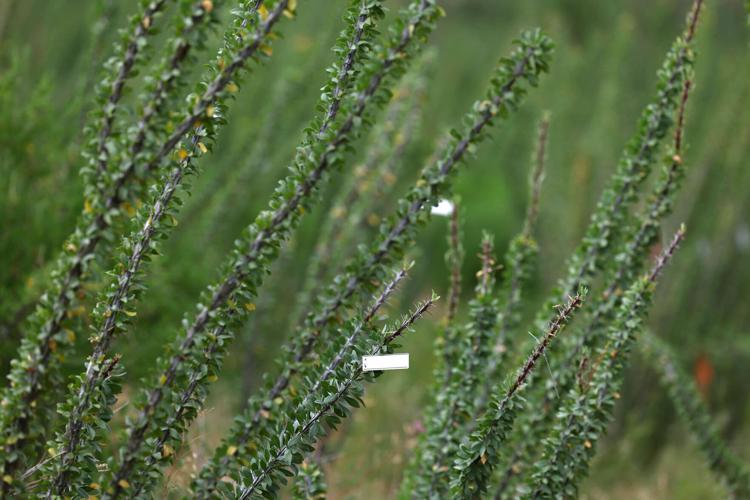
Ocotillo plants are tagged for removal on the Tohono O’odham Nation, where U.S. Customs and Border Protection is building a 30-foot-tall border wall despite the vehement opposition of the tribe. "There ain't no money in this world that can compensate us for what they're doing," Tohono O'odham Tribal Chairman Verlon Jose said Thursday. "You can never heal the wound across my heart that has been caused by this thing they call the international boundary."
The tribe argues in its legal complaint against DHS that wall construction will diminish the size of the reservation, established through executive order starting in 1917, which can only be done through an act of Congress.
"Our position is the Roosevelt boundary does not exist on the Tohono O'doham Nation," Jose said. He said DHS acknowledged in earlier agreements with the tribe that the Nation extends all the way to the US.-Mexico international line.
But a federal judge disagreed, rejecting the tribe's request for an injunction that would have immediately halted construction.
Jose said the Nation has appealed that decision, and that the legal fight is far from over.
"When we win this litigation, if that wall is built, we will tear that wall down," Jose said.
Contractors 'unauthorized'
In the weeks following the judge's Aug. 14 rejection of the tribe's injunction request, CBP contractors began trying to enter Tohono O'odham land to begin pre-construction surveys.
About seven of those contractors were turned back by Tohono O'odham police earlier in August. But on Aug. 25, at 4 a.m., tribal members witnessed dozens of masked and armed CBP agents escorting the contractors to the area around San Miguel Gate.

The mountains on the Tohono O’odham Nation are lush and green after recent monsoon storms. "When you tear apart this, you're tearing apart my family," the tribal chairman says, as U.S. government contractors are preparing to construct border wall.
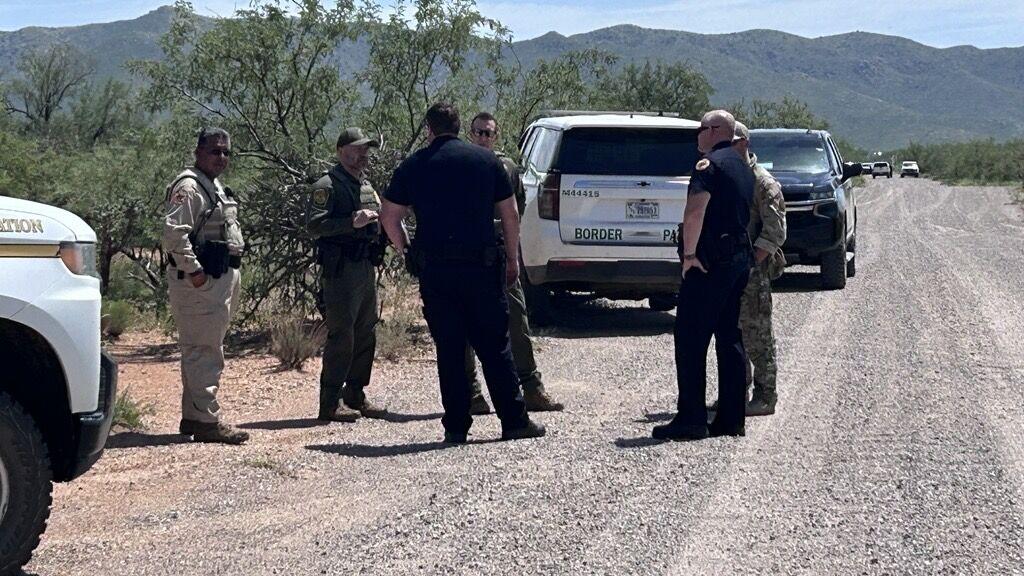
For the next five days, CBP agents protected the contractors — and blocked tribal police from citing or removing them — as they engaged in pre-construction activities like surveying and drilling for soil samples, tribal officials said. Contractors left the Nation on Aug. 29, Jose said.
When contractors were on site, Jose encouraged tribal members to avoid anything to escalate the situation or put themselves in danger. But he said the situation will have to escalate, if and when contractors return and construction begins in earnest.
"Once we start seeing ground being pushed, once we start seeing heavy machinery rolling, I kid you not, that's gonna be a game-changer," he said. "Don't ask me what, because I'm not going to tell you."
CBP told the Nation they'll return in October to break ground on the wall, but Jose thinks they'll arrive earlier and try to catch tribal members off-guard.
"My thoughts are that they're out there strategizing to try to come full force, with everything they got," he said.
The Tohono O'odham Nation has been building a coalition of support, and has received an "outpouring" of solidarity from Native and non-native supporters near and far, including leaders of cities, offering to come and help protest the wall construction, Jose said. He's told them to hold off for now.
"We have to be strategically careful in how we do this," Jose said. "We need to save that fight for when we need it."
Fire keepers' camp
On Thursday tribal member Amy Juan was among several "fire keepers" who have been maintaining a fire and prayer camp site near the San Miguel Gate since the contractors' unauthorized entry Aug. 25. The goal is both to create a space for sharing tribal knowledge and traditions, and also to keep tabs on CBP and contractors' presence, and inform tribal leadership and law enforcement of any unauthorized activity.

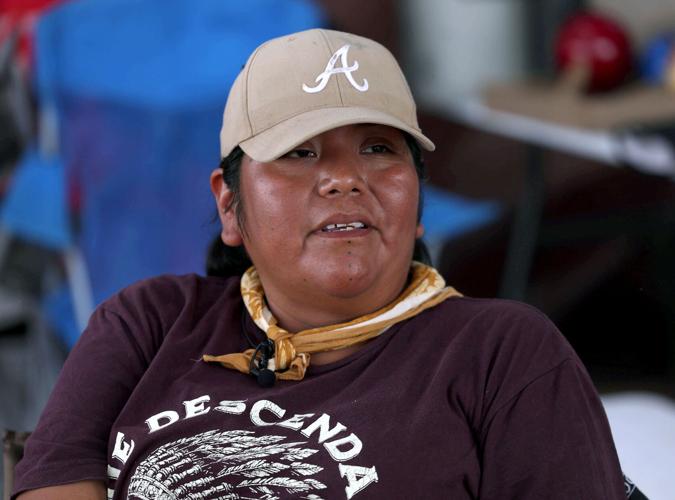
On Thursday Tohono O'odham tribal member Amy Juan was among several "fire keepers" who have been maintaining a fire and prayer camp site near the San Miguel Gate on the international border. "We predate the existence of the United States and Mexico, and we know that. We're proud of that," she said. "Basically that's what we're protecting."
Juan, who is 40, said she "had the best childhood," growing up with her grandfather, who was a rancher and cowboy on the reservation, before the vehicle barrier existed and only barbed wire marked the international line.
"You have this generation of young O'odham who don't know their family history or the history of the borderlands," Juan said. "We predate the existence of the United States and Mexico, and we know that. We're proud of that. Basically that's what we're protecting."
Her younger cousins don't remember the days before the vehicle barrier was installed and before border militarization surged, she said.
"Now it's our responsibility, my generation, 40-year-olds who remember the times before Border Patrol, now it's our responsibility to share those memories and share those teachings with the young generations and also to encourage our elders who are still here to share those stories," Juan said. "All of those things have happened here at the camp. It's brought those people back together."
Jose said if the U.S. were truly focused on border security, rather than "political stunts," it would invest in drug-rehabilitation centers to help Americans "kick their drug habit" and to reduce the demand for fentanyl, which largely comes through U.S. ports of entry, according to CBP.
"We're spending billions and billions of dollars on this wall. Why don't we build rehabilitation centers?" he said. "Whenever there's demand, there's going to be supply."
Jose is hoping that if Democrats take control of the U.S. Congress after the November midterm elections, a new Congress will finally work on comprehensive immigration reform, rather than focusing solely on enforcement.
"We want this to stop," he said. "They're trying to erase the Native Americans from this country. Not on our watch."
Tohono O’odham Nation Chairman Verlon Jose speaks Thursday to reporters at the San Miguel Gate on the Tohono O'odham Nation's border with Mexico. "This wall is a political stunt. There is no real reason why a wall should be built," Jose said. "To the American people, when are you going to wake up and realize this? It's a waste of your money."
Contact reporter Emily Bregel at ebregel@tucson.com. On X, formerly Twitter: @EmilyBregel

Emily Bregel
Border reporter


 Plans for border walls on Tohono O'odham land a 'betrayal,' chairman says