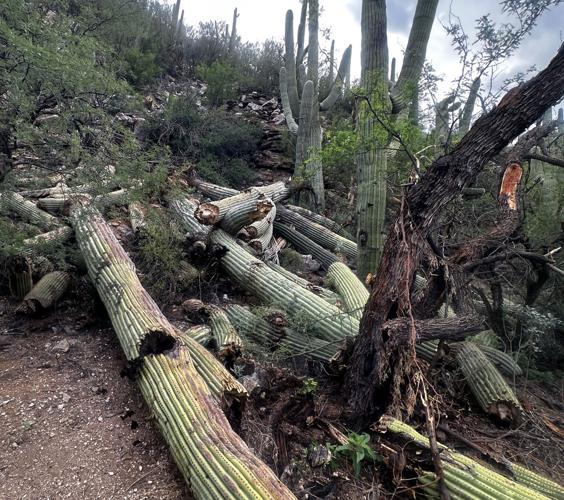
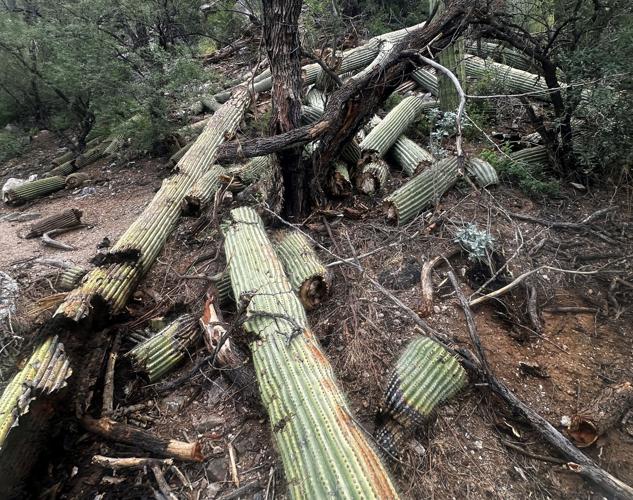
After the storms that wrapped up Tucson's 26th-wettest August on record, several saguaros were found toppled near the Phoneline #27 hiking trail in Sabino Canyon Recreation Area.

Downed saguaros as seen Sept. 3 along the Phoneline Trail in Sabino Canyon, after the storms that wrapped up Tucson's 26th-wettest August on record.
"It is more than likely weather related," Coronado National Forest spokesperson Starr Farrell said of the collapsed cacti. "As the saguaros get a lot of water, they get heavy, and they can topple more easily."
Overall, this year's monsoon, which stretches from June 15 through Sept. 30, has had minor impacts on Sabino, Farrell said.
While there has been some flooding, it's been "nothing outside what we would consider normal for this time of year," she said.

Downed saguaros as seen along the Phoneline Trail in Sabino Canyon on Sept. 3.
As of Sept. 3, Tucson has received 4.96 inches of monsoon rainfall, which is 0.4 inches above the 4.56 inches of normal Tucson rainfall during that same period from 1991 through 2020, data from the National Weather Service shows. By that same point last year, Tucson had only seen 1.99 inches of total rainfall.
People are also reading…
"We are just above normal for the monsoon season," said Kiera Malarkey, a meteorologist with the National Weather Service. "This past rain shower that we got here Monday helped put us over the edge."
But with just less than a month of monsoon left, there's still a good chance of more storms to come in September, bringing up the total rainfall, Malarkey said.
"Right now, the climate prediction center is forecasting for us to be leaning above normal for precipitation," she said.