

A Swiss drug maker's buyout of Southern Arizona's largest biotech firm means big pharmaceutical companies are gathering in Tucson, validating the region's future as a biotech center, local experts said Tuesday.
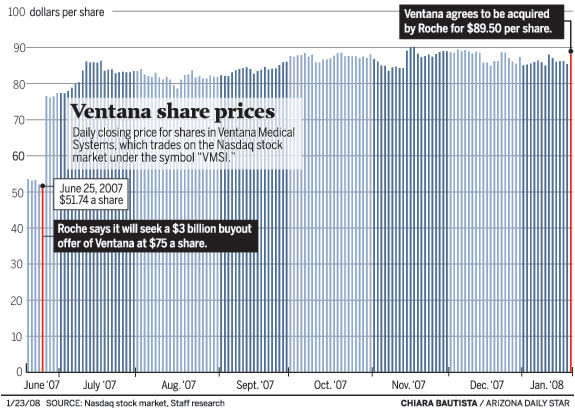
The $3.4 billion deal between Roche Holding AG and Oro Valley-based Ventana Medical Systems, announced Tuesday, ended a long-running hostile-takeover bid. After offering $75 per share for Ventana in June, Roche extended that same offer five times before agreeing to pay $89.50 per share, a price Ventana accepted.
Roche officials said Tuesday that Ventana will remain in the area and will continue expanding at its Oro Valley site.
Nina Ossanna, chair of the Bioindustry Organization of Southern Arizona, said the purchase "validates the quality of companies we have," in light of investments by two other global companies. Merck & Co. made a multimillion-dollar investment last October in Tucson-based High Throughput Genomics Inc., and Sanofi-Aventis began an expansion of its Oro Valley facility in fall 2007.
People are also reading…
"That's got to make people notice us," she said.
Joe Snell, president and CEO of Tucson Regional Economic Opportunities Inc., said the merger "simply validates the notion that Southern Arizona and the Tucson market are a growing market for biotech companies, that this region can successfully incubate and grow those firms."
Experts say biotech firms are important for the Tucson area because they draw in high-paying jobs and strengthen research ties with the University of Arizona.
Ventana, founded by UA pathologist Dr. Thomas Grogan in 1985, specializes in cancer- tissue testing. It employs more than 600 people here.
"Roche has made it very clear that one of their most important objectives is to accelerate the value of our new products," Ventana CEO Christopher Gleeson said in an interview Tuesday. Gleeson will remain as Ventana's chief executive and join the board of Roche's diagnostics division.
Roche first announced in June 2007 that it would make a $3 billion bid for Ventana, a move that was met favorably on Wall Street: Ventana's shares closed the next day at $76.43, up nearly 50 percent, in trading on the Nasdaq exchange.
What followed were several tender offers for Ventana at $75 per share, which the company called inadequate.
That changed after Roche examined confidential information that Ventana agreed to hand over in November. The examination "confirmed the positive business momentum of Ventana's business," said Severin Schwan, the CEO of Roche's diagnostics division, during a phone interview Tuesday from Basel, Switzerland. "It is reflective of a strategic fit."
In the end, Roche raised its offer by about 19 percent per share. Ventana's stock price closed Tuesday at $89.04, up $3.71 or 4 percent compared with Friday's close.
The deal still awaits shareholder and regulatory approval.
What also matters in the deal, industry watchers said, is the growth of so-called personalized medicine, in which patients receive individualized drug therapies.
"It's a very aggressive move on the part of Roche to pave the way for what we believe is the future of medicine," said Edward Abrahams, executive director of the Washington-based Personalized Medicine Coalition, a non-profit group that works to advance the adoption of personalized medicine.
Roche's acquisitions of smaller firms aren't rare. Last year, Schwan said, Roche purchased three companies, including Branford, Conn.-based 454 Life Sciences, which specializes in high-capacity DNA analysis.
"Ventana is proven to be a success story — that you can build a diagnostics company in Tucson," said Tim "TJ" Johnson, the CEO of High Throughput Genomics and a former Ventana executive.
Ventana said Tuesday that its board of directors will recommend that shareholders tender their shares to Roche.
In December 2007, before this recent announcement, Roche said it would seek to replace Ventana's current board members with its own nominees at Ventana's annual stockholders meeting in June. Now, executives of Roche and Ventana are looking at the merger as "friendly," promising to build on medical advancements from an idea born and bred in Tucson.
"These are not only very big companies, but they are critical parts of big companies," said Dr. Raymond Woosley, president of Tucson-based Critical Path Institute, a public-private partnership with the Food and Drug Administration.
"It's remarkable that these two companies are really some of the leading innovators of the medical-development process," he said.
Find more coverage of Southern Arizona business at AzStarBiz.com.
Public companies
If Roche's buyout of Ventana is approved, Tucson will lose one of its five locally based, publicly traded companies.
The other Tucson-based companies traded on major exchanges are UniSource Energy Corp., the only locally based company traded on the New York Stock Exchange, and Nasdaq issues Providence Service Corp., Ionatron Inc. and ImaRx Therapeutics Inc.