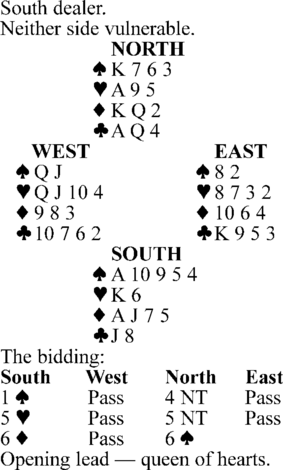
Assume you're in six spades and West leads the queen of hearts. You win with the king and return a trump to dummy's king, on which West plays the queen. You next lead a trump from dummy, East following low, and the question is whether to play the ace or the ten.
If you are familiar with the theory of restricted choice, you know that after West produces the queen on the first spade play, the odds favor finessing the ten. But before blindly attempting the finesse, you should first consider the hand as a whole. If you try the finesse and it loses, and if East has the king of clubs, you will go down one. Unlucky, but down one nevertheless.
The other side of the coin, however, is that if you play the ace of spades at trick three instead of finessing the ten, you can't go down regardless of who has the jack! As it happens, the jack falls and you make the slam, later losing only a club to East's king.
People are also reading…
What would have happened had West shown out on the ace of trumps? In that case, you would have cashed the ace of hearts, ruffed a heart and then started to run your diamonds. East might ruff at any stage, but that would merely hasten his demise.
If he did not ruff, you would next put him on lead with a trump, forcing him to return a club or yield a ruff-and-discard. Either way, the slam would come waltzing home.
In this deal, therefore, the answer to how to handle the trumps is a very simple one. Playing the ace guarantees the contract, come what may, while finessing the ten does not. That makes the ace the right play, even though the percentages would indicate otherwise.