
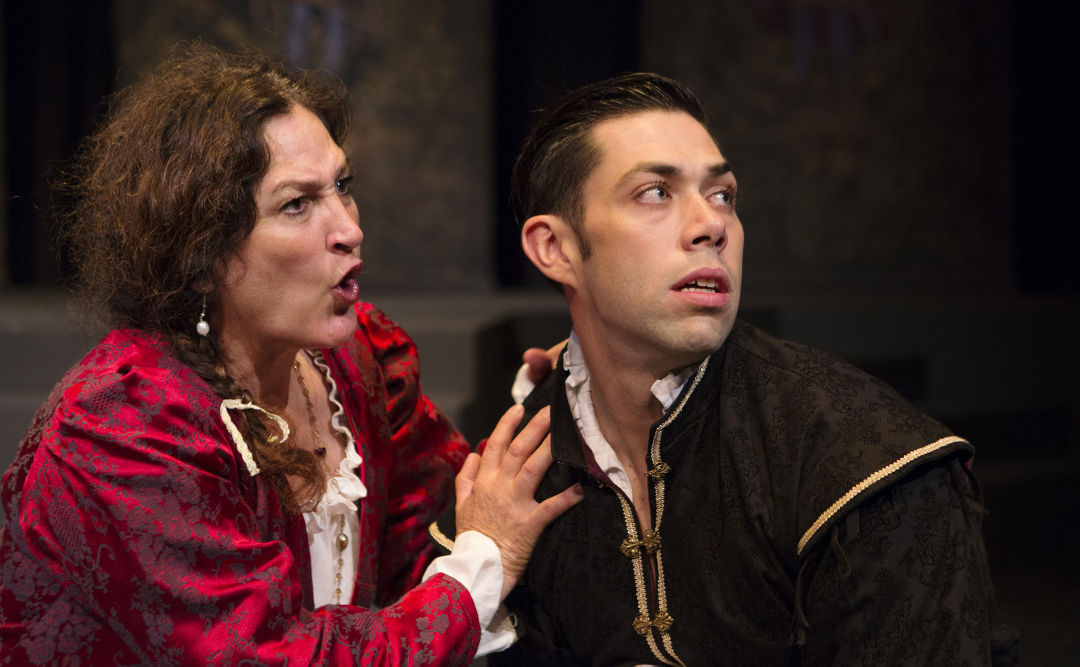
Surely Matthew Bowdren must feel the pressure.
Bowdren plays the title character in The Rogue Theatre’s compelling production of “Hamlet,” in repertory with Tom Stoppard’s “Rosencrantz and Gildenstern are Dead.”
It’s a role that the great Simon Russell Beale brought to Tucson in 2001. Kenneth Branagh gave us a terrific Hamlet on film. John Gielgud became the benchmark for the character in the last century. Richard Burton, Jonathan Pryce, Laurence Olivier — they all played Hamlet.
Those are big doublets to slip into.
And Bowdren slipped into them with gusto.
His Hamlet was haunting and haunted. He seems mad one moment, simply cunning the next. He is consumed with revenge but has tender moments. His sorrow and his passion are palpable.
People are also reading…
Watching this “Hamlet,” knowingly directed by Cynthia Meier, you get the sense that while Hamlet hears his father’s ghost when no one else can, speaks in riddles that seem to underscore his madness, and is wildly mercurial, he is crazy like a fox. There’s not much indecision in Bowdren’s Hamlet — once convinced that his uncle, Claudius, killed his father to marry his mother and gain the power of the throne, his every move seems calculated to confuse as he plots his revenge for his father’s murder. Bowdren kept us glued to his actions and words, anxious to see where he would go to — and he would always go someplace interesting.
Next to Hamlet the prime role in this play is Polonius, father to Ophelia — the woman Hamlet loves but destroys — and advisor to the king. He is full of sound advice and is a blowhard at the same time. Like Hamlet, Polonious can be a character with questionable motives. He could be a smooth, calculating politician or just an obsequious fop. A man devoted to his children, or just devoted to how his children can reflect on him. David Morden plays him as a bit of a buffoon who loves his children but is eager to be in the king’s good graces. Though it’s the gravediggers who are usually the clowns in “Hamlet,” Morden’s Polonious gave us plenty to chuckle about. The character is the first to be killed — come on, that can’t be a spoiler; just about everyone is killed in “Hamlet” — which is kind of a shame. Morden made him a fun character to watch.
Kathryn Kellner Brown has a majestic countenance and pay-attention voice, which gave her Gertrude — Hamlet’s mother — a strength not often seen in the character. Sure, she’s oblivious — she can’t believe that Hamlet is deeply troubled that she married his father’s brother less than two months after the king had died. And vain. Shallow, even. But she is passionate and committed. Kellner Brown’s portrayal made the tragedy of Gertrude clearly understood.
This production flew with seamless scene changes and an intensity that built to the tragic bloodbath at the end. A trio of tapestries — replicas of the 16th century tapestries from Denmark’s Kronborg Castle — served as the backdrop for a stage that is most often bare of accouterments. The emphasis here is on the words and the story.
Sure, there were some uneven performances. We can live with that.
What we can’t live with is a “Hamlet” that is treated cavalierly. Meier and her players would have none of that. “Hamlet” is a rich, stirring and disturbing play, and The Rogue Theatre brought it to vivid life.