

Even academics like to engage in retail therapy at the gem show.
Karl Flessa, a paleontology professor and the head of the Geosciences Department at the University of Arizona, says he likes to go scrounging for ammonites and other treasures.
"Sometimes I've taken some undergrads along on the trips," he says.
Whether you're looking for fossil furniture (like a wine rack containing long-shelled orthoceras fossils) or a paperweight made from amber, the gem show has you covered.
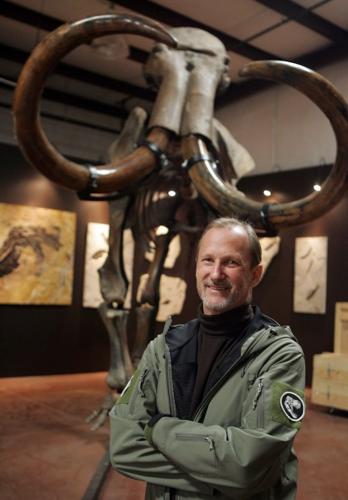
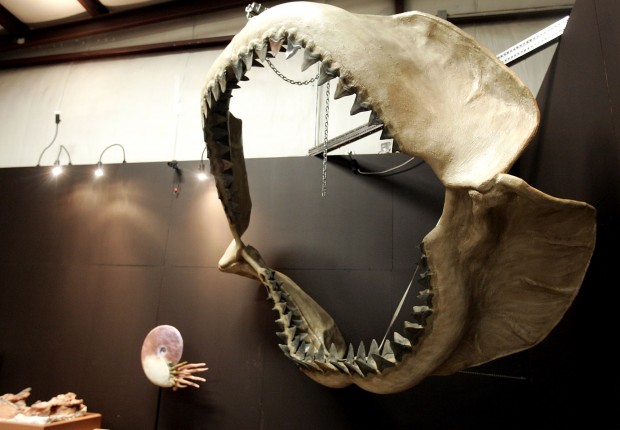
At GeoDecor, in the Mineral and Fossil Co-op, 1635 N. Oracle Road, you'll find one of the largest privately owned meteorites in the world ($650,000), one of the most mammoth woolly mammoth skeletons ($500,000), and the fossilized jaws from a megalodon, a prehistoric shark ($1 million).
Tom Lindgren, who owns GeoDecor, says some people think megalodons still exist.
People are also reading…
"There's speculation that they live in the really extreme depths," he says.
Also at the Mineral and Fossil Co-op, you can peruse Bill Barker's trilobites -fossils of extinct marine arthropods. Barker is known as "Doc Fossil," and he runs the Sahara Sea Collection, whose treasures all come from Morocco. In addition to trilobites, he also has a large collection of fossilized crinoids, which resemble underwater flowers, as well as the aforementioned wine racks.
Both the Sahara Sea Collection and Geo Decor are part of the Mineral & Fossil Co-op Show, which is listed as a wholesale show (because it offers discounts to wholesalers) but welcomes the public. Moreover, both businesses are open year-round, by appointment only. Call 617-0207 to make an appointment.
The Madagascar Minerals Gem Show, 201 W. Lester St., has fossilized shells and wood from Madagascar. One of their fossilized sand dollars retails for $7. Fossilized squids, called ammonites, are 135 million years old and cost anywhere from $2.50 to millions of dollars. Norcross-Madagascar, the company that runs the Madagascar Minerals gem show, is open year-round from 8:30 a.m. to 4:30 p.m. Mondays through Fridays, at the same location.
The Tucson Gem & Mineral Show (at the Tucson Arena, Feb. 11-14) will boast a baby dinosaurs exhibit, featuring a small flock of Psittacosaurus and Maia-saur duckbill dinos, along with an adult skull of the Maiasaur and a fossil of the duckbill brain.
Finally, the Black Hills Institute of Geological Research (BHI) will sell its fossils at the Arizona Mineral and Fossil Showcase, which has four locations at the gem show.
BHI will display a cast of Leonardo, one of the most complete dinosaur fossils ever found, in the Copper Ballroom at the Hotel Tucson City Center, 475 N. Granada Ave. In addition to possessing rare skin impressions and being one of only four existing brachylophosaurus specimens uncovered to date, he is the first fully articulated subadult ever found and is believed to have been about 3 or 4 years old when he died.
"Our cast of Leonardo is kind of an interesting cast, because it's done from a scan and then that scan was digitized," says Peter Larson, president of BHI.
BHI will also display two casts of T-Rex skulls and a giant round sloth, also at the Hotel Tucson City Center.
For a list of all the shows that offer fossils, visit the Tucson Convention & Visitors Bureau Web site, visittucson.org.


