
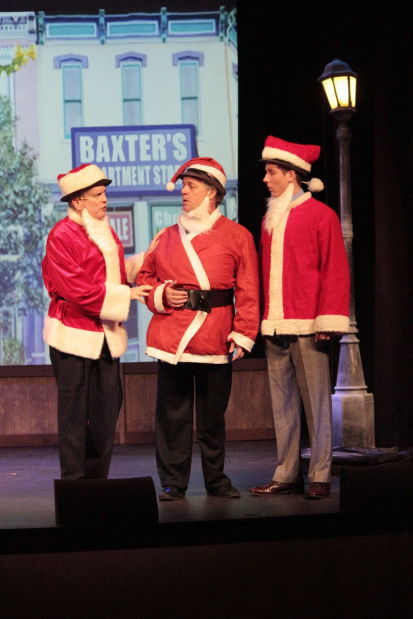
Great American Playhouse has done a bit of time travel for its holiday show.
“We’re No Angels,” penned and directed by Nick Seivert, borrows from 1950s stories, takes place in the 1930s and is given an ageless spoofiness.
The story outline — and title — are lifted right out of the 1955 comedy “We’re No Angels.” And clearly there’s plenty of influence from the 1950s musical “Guys and Dolls.”
But this is most definitely GAP’s play. You know: silliness, over-the-top villains, and songs that surprise and sometimes move.
“We’re No Angels” isn’t filled with slap-your-knee humor, and it seemed the actors actually knew their lines, so, at Sunday’s performance anyway, the ad libs are kept to a minimum.
The story begins as three crooks, disguised as Santa, mix a bit of bookie business with their bell-ringing pleas for help for those in need.
People are also reading…
Now these three are exactly what the title says — no angels. But when a smarmy really-bad guy comes on the scene, they sure look like angels in comparison. That bad guy, Moose Moran, seems to be extorting about everyone in town, and giving a Christmas Eve deadline for money owed him. Or else. ...
Not even our three can stand by and let that happen.
The cast is packed with talent — Jacinda Rose Swinehart gave a swagger to the brassy dame who has to marry Moose unless she comes up with $10,000. She, Amy DeHaven and Jennifer Ackerley provided some of the most melodic moments, especially when Lawrence and Swinehart did a “Happy Days”/“Get Happy” mash-up.
Stewart Gregory knew just how to play bad with his Moose Moran, and Randy McDonald, one of the three angels, has a Ray Bolger-esque quality to his impressive dancing.
When it comes to music, Great American has made a point of not going for the obvious. Songs that punctuate the story include “Cuban Pete” (the rumba, made popular by Desi Arnaz, was given a very funny rendition by Sean MacArthur) and “Who’s Got the Action,” an old Dean Martin song. That’s one of the wonderful things about the company, and one of the problematic ones — it can be difficult to seduce audiences in this type of production if they don’t have some sort of musical touchstone.
“We’re No Angels” can be slow at times, and it often misses the mark when it comes to humor. At the Sunday performance attended, lots of children were in the audience, and it seems the humor as well as the songs didn’t seem to captivate them. (At one point, a young boy started playing games on a phone, while his father scrolled through messages on his. Shame on both of them.)
But here’s the thing about this troupe: Its members are deeply committed and pour lots of heart into their productions, and even when the humor is hit and miss, the talent never is. It’s easy to cut them some slack.