


Andrew Rush helped fuel a revolution. In the years after World War II, Rush, an artist and founder of Tucson's The Drawing Studio, discovered - along with other artists of his generation - the world of printing.
Burning with excitement about the possibilities prints meant to their drawings and paintings and the creative process, Rush and his fellow artists learned how to engrave images on metal plates or wood and transfer them to print. They also learned how to mix inks and press the images onto paper - either by hand or with a printing press. And they became master printers - highly skilled in all areas of printing.
The result was a new way to make art and a high-energy movement of artists making their own prints. Many of the key artists/ printers from that era have works in The Drawing Studio's current show, "The Rise of the Print: Midcentury Masters of American Printmaking."
People are also reading…
"This was a major movement and made a difference in printmaking," says Rush of that post-World War II revolution.
"It created artists who had enormous influence on artists and art educators. That happened in just 50 years."
It was a time that created such thrilling work that dealer Daniel Lienau concentrates on fine-art prints from that era through his Santa Rosa, Calif., Annex Galleries.
"To me, that was the most exciting time in 20th-century printmaking," Lienau said in a phone interview.
"It was an electric time, and I feel that with the work. There's soul in the work."
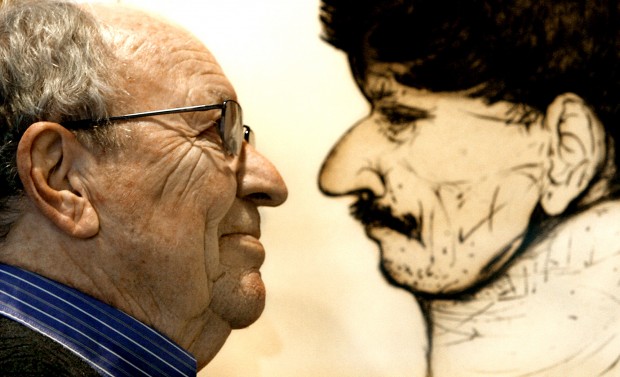
On this winter day, Rush, now 79, is sitting in the library of The Drawing Studio, not looking a lot like a revolutionary artist. He is dressed in blue jeans and a light jacket. What's left of his thinning gray hair sort of floats around his head, and his eyes focus sharply on you when he talks. Beside him is a blackboard containing the sentence, "Live outside the lines," written in red.
"As far as I know, this is the first show to bring together in one gathering this group of mostly artists/teachers," he says as he suggests a stroll through the gallery.
"I have a very respectable cross-section of the major artists in this genre."
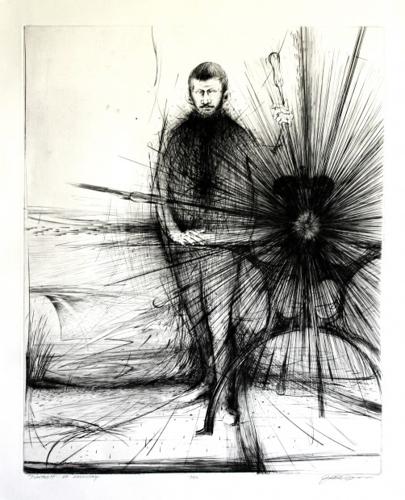
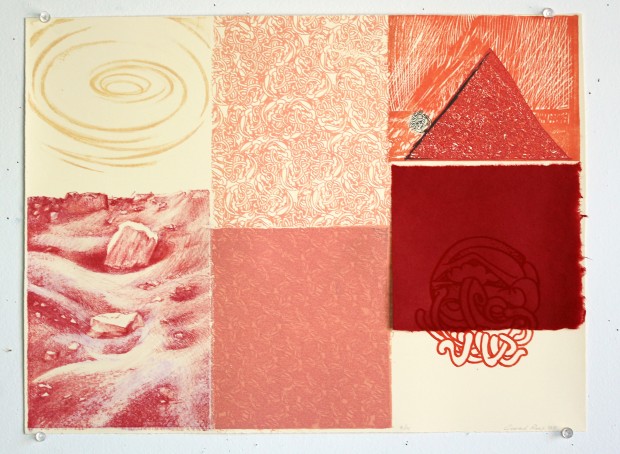
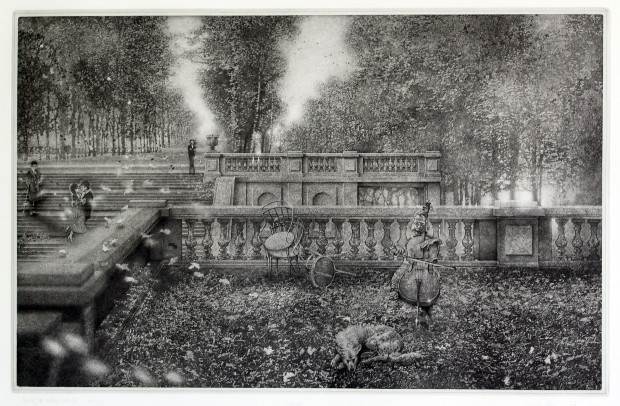
The exhibit is a study in the variety of printing methods and styles. The walls of the small gallery are packed with figurative works, abstracts, landscapes and Surrealist images realized in lithographs, engravings and etchings - different methods used to produce the final design that is transferred to print.
There's Richie Lasansky's black-and-white engraving of a monkey's face that draws you in not only because of its knowing look, but because of the incredible detail of the work.
And Surrealist Maximino Javier's "Tio Vivo," a color lithograph of a circusy character on top of an oversized and out-of-proportion hobby horse with trains running through it and a cat underneath.
And Jack Orman's copperplate engraving "Portrait of Lasansky," a mixture of figurative and abstract black-and-white images that is an homage to his teacher, Mauricio Lasansky.
Everywhere you look, the walls are covered with prints that draw you in, amaze, confound and fascinate.
Most of those with works in the exhibit are teachers as well as artists, as is Rush, who in the 1960s taught the first print classes at the University of Arizona's art school.
The idea for the show grew out of a casual conversation Rush had with fellow artist Orman.
They were discussing the resurgence of print post-World War II, and it occurred to both men that there hadn't been a major exhibit.
Rush saw a double opportunity: a show by major printers/artists and a fundraiser for the nonprofit Drawing Studio, devoted to "cultivating the skills of visual intelligence," as its mission statement says. The Drawing Studio sponsors lectures, demonstrations and art classes for everyone, regardless of artistic ability.
"I got on the Internet, e-mail and phone and contacted artists," Rush recalls.
"I told them what I was doing, and would they be interested in giving a print to The Drawing Studio? Half of them I knew through school and by reputation, or we had all exhibited at the same shows."
Much to Rush's surprise, 95 percent of the artists responded and donated a print to The Drawing Studio, which will use all proceeds to bolster the studio's classes, teachers and scholarship programs.
"The mission of The Drawing Studio played a huge part in their donating the art," said Rush.
"It was a perfect match for them."
Experimentation hallmark of post-WW II printmaking
The latter half of the 20th century gave rise to an abundance of experiments in print - which is part of what adds to the print movement's import, says Lee Karpiscak. As curator and assistant director of the University of Arizona Museum of Art, she was responsible for the purchase of many of the prints in the museum's holdings.
"Experimentation keeps art alive," says Karpiscak, who retired in 1990 after 13 years at the UA. "Rather than staying in the same mode forever, we see all the growth that takes place because of experimentation."
Daniel Lienau, owner of the Annex Galleries in Santa Rosa, Calif., which specializes in prints, says the experimentation and new discoveries were what drove the master printmakers of the era.
"The concern wasn't making 50 identical prints that were perfect and could sell for the biggest price," he says. "The whole idea was to experiment with printmaking and follow your love of that medium."
At the time, printmaking wasn't spoken of with much reverence from art critics and collectors, he says.
No matter.
"In the art world, print was probably at the bottom rung of the ladder," he says. "They weren't selling then. Paper was expensive, material was expensive. So they would do small editions, 10, 20, and move on. . . . It was all about stretching and using new materials and trying new things."
How they did it
The prints in The Drawing Studio's current exhibit are created through one of the following methods:
• Intaglio - The design is printed from the recessed areas of a metal plate. Engraving, aquatint, mezzotint and etching are among the intaglio methods.
• Relief printing - What is cut away from the surface of the plate does not print; what is left on the surface prints. Wood engraving, woodcut and linoleum block use this process.
• Planographic - Printing on a flat surface. A design is drawn with a greasy substance onto a porous stone, such as limestone. The artist then wets the stone with water and pours on an oily ink, which holds onto the greasy design and bypasses the wet parts of the stone. Lithography uses this method.
What is an original print?
The original prints in The Drawing Studio show are different from the posters or prints that are produced in mass quantity, driving the price and exclusivity down.
Original prints like those in "The Rise of the Print" are created and printed by hand by the artist or an assistant.
Plate, block, stone or stencil are used to create the image, which is then transferred by hand or press to paper.
The finished product looks vastly different from the plates the artist uses originally - as a result, the finished product is not a copy or reproduction.
Because the printing process reverses the image, the artist has to think backwards.
"It's slow work," says Andrew Rush, adding that if a mistake is made, you incorporate it, go in a different direction, or start all over.
Each print is more than just an image, says Rush.
"Because it takes anywhere from a month to a year to make one print, you're living with an image. It forms a language and it engenders a kind of philosophic artist conversation. It teaches about composition and what an image is. That's why I still teach it."
Though printed in multiples, each print is, technically, a unique work. Artists sign and number each.
Meet Some of the artists
A sampling of the close to 30 artists with works in The Drawing Studio exhibit.
• Mauricio Lasansky - Lasansky was a key figure in the emergence of fine-art print. He established the printmaking program at the University of Iowa, where many of the master printers in this show studied, and then went on to teach elsewhere. Lasansky's self-portrait in the show is one that The Drawing Studio's Andrew Rush assisted him in making.
• Richie Lasansky - At 40, Richie is the youngest printmaker in the show. He studied biology in college, and when he graduated he immediately apprenticed himself to his grandfather, Mauricio Lasansky, and became a fine-art printer. He makes all his own inks and does his own printing. Rush included him in the show to indicate where the future of printmaking is headed.
• Lee Chesney - The artist studied with Mauricio Lasansky at the University of Iowa. His prints are in galleries and museums around the world. He is professor emeritus at the University of Hawaii-Manoa.
• Evan Lindquist - Lindquist taught at the University of Arkansas and Arizona State University. The oft-awarded artist works primarily in engravings. His works are in collections around the world.
• Eric Avery - Avery went to medical school in Texas after he graduated with a B.A. in art from the University of Arizona. He was the medical director in a refugee camp in Somalia and is currently clinical associate professor of psychiatry and behavioral sciences at the University of Texas-Galveston. He works primarily in woodcuts and often addresses medical issues in his art. Among the museums that have Avery in their permanent collection are the Boston Museum of Fine Arts, the Whitney Museum and the Philadelphia Museum.
• Peter Milton - Milton's etching and engravings are detailed Surrealistic images that demand you return again and again to study them. He works only in black and white - a decision he made after he discovered he had a red-green color blindness. He is a graduate of Yale University, a teacher, author and internationally acclaimed artist.
• Sidney Chafetz - Chafetz is considered the greatest living woodcut artist today. He started the printmaking program at Ohio State University in 1959. Among the museums with Chafetz holdings are the Museum of Modern Art in New York City and the Smithsonian.
• Andrew Rush - Rush is a co-founder of Rancho Linda Vista, the artists' colony in Oracle. He taught printing at the University of Arizona and founded The Drawing Studio. In Tucson, he is well known for his public-art works, including the rammed-earth monoliths he created with a group of artists at the northwest corner of West Congress Street and Interstate 10, in Sentinel Plaza. Rush hasn't done fine-art printing in about 20 years, but he still is known around the country for his works.
Buy art, support The Drawing Studio
These are not the prints you buy at the bookstore and slap on your dorm room wall. Fine-art prints are in a whole different category.
The works in The Drawing Studio exhibit can be purchased for $400 to about $3,000 each.
If you go
"The Rise of the Print: Midcentury Masters of American Printmaking"
• Where: The Drawing Studio, 33 S. Sixth Ave.
• When: Through Feb. 26. Gallery hours are noon-4 p.m. Tuesdays through Saturdays.
• Cost: Free.
• Information: 620-0947 and www.thedrawingstudio.org
• Et cetera: Andrew Rush will give a printmaking demonstration from 4 to 6 p.m. next Sunday. It's $20 for The Drawing Studio members; $25 for nonmembers.
Contact reporter Kathleen Allen at kallen@azstarnet.com or 573-4128.


