

This summer, the Star is taking a look at Tucsonans who teach the arts. Today: glass blower Karl Taylor.
Flickering flames fascinated Karl Taylor when he was a young boy. But not in a dangerous way.
"I had very supportive parents who were understanding and kept an eye on me," he says.
That fondness for fire continues today.
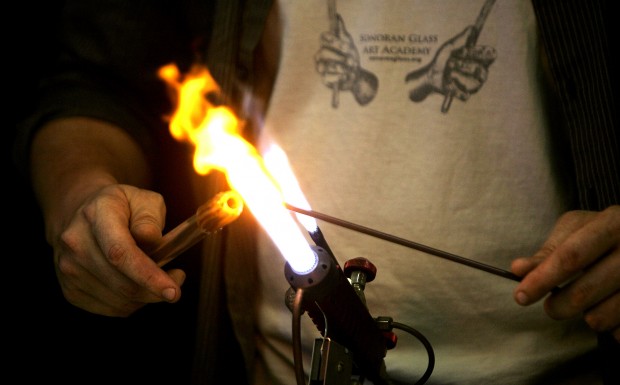
Taylor, 26, teaches flame-working at Sonoran Glass Art Academy and uses a torch to teach others how to produce pendants, jewelry, marbles, perfume vessels and goblets from glass.
Painting, charcoal and other forms of art piqued his interest as a child, but his fascination with fire couldn't be put out.
He bought a basic torch to experiment with when he was in high school and attempted to take lessons with a man he met in his Tucson neighborhood.
People are also reading…
Taylor paid the man $2,000 to teach him to make jewelry, but the man ran off with his money.
"That was just about everything I had. . . . Even getting ripped off still wasn't enough to deter me from wanting to pick it up more."
He taught himself what he could on his basic torch before finding Sonoran Glass Art Academy, 633 W. 18th St.
"I got into it and I hung around until they gave me a job about four or five years ago," he says.
***
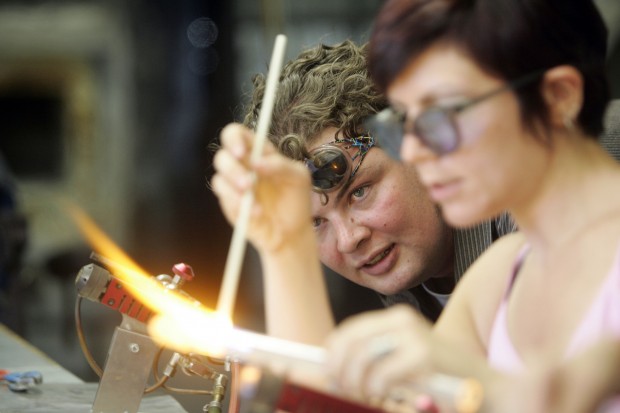
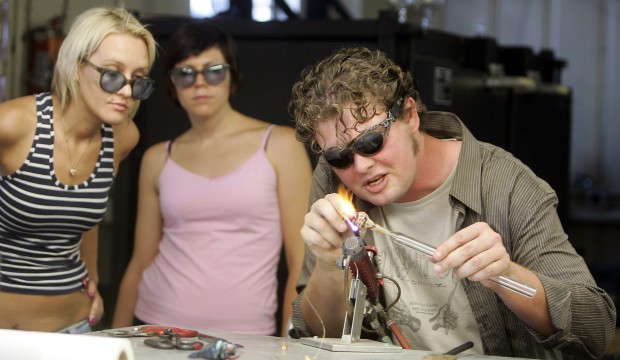
Glass tubes and rods are scattered across Taylor's work space as he prepares to teach a beginning-blowing class in the Flame Shop at Sonoran Glass.
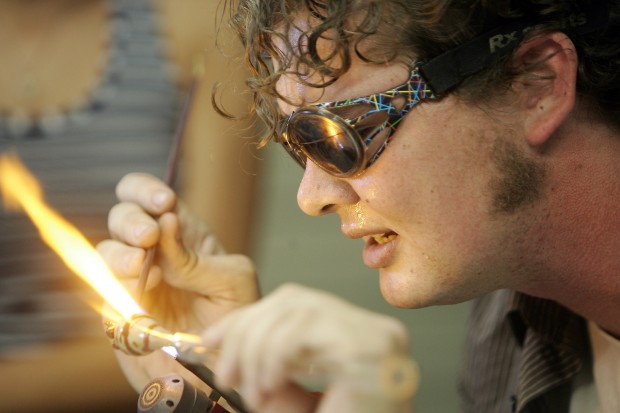
He grabs one of the tubes, slides his safety glasses over his eyes, pulls a red cigarette lighter out of his pocket and lights his torch.
Beads of sweat quickly start to build on his forehead and nose as he shows his students how to spin glass over a flame.
Italian flame workers rotate glass with the tips of their fingers. Other traditional styles call for using the whole hand, Taylor explains.
"It doesn't matter how you get there. You need slow and consistent rotation," he says to his four students.
Between lessons on safety and rotation, Taylor transitions to the first project of the night: blowing a bubble off the end of a glass tube.
To blow consistent, even bubbles into his glass tube, Taylor relies on small puffs of air.
Not all of his students catch on immediately.
"You're doing something new, and if you're doing something new, you don't always get it right the first time," he tells them.
Vanessa Phillips is an art teacher at Kino School, and she admires Taylor's relaxed teaching style.
"He will do a demonstration and let us do our own thing and help when needed," says Phillips, who took beginning-blowing classes with Taylor last week.
She has also had him as an instructor in beginning- bead-making classes, and Taylor is always willing to offer more personalized instruction to Phillips.
She wanted to go beyond beads, and Taylor showed her how to create flowers.
"He's always happy to do more of what the students want (rather) than have a set lesson plan," she said.
***
If Taylor had not found glass when he did, he would have pursued an electrical-engineering or computer-programming degree.
He took classes at Pima Community College after earning a high school diploma from a charter school, but he left college to devote himself to glass.
"I am already doing exactly what it is I want to be doing. I want to be teaching. I want to work on my own stuff," he says.
Plus, glass will never stop challenging him, as there are always new things to experiment and play with.
Glass "has a life of its own," he says. "It's not just you manipulating a medium. It's you interacting with it. When the glass is hot, it's moving. There are certain things you might really want the glass to do, but you can't force it. It's almost like a partnership."
Some of his current work sits in a glass case in the Flame Shop, which he manages.
Taylor isn't committed to one style and can start something one day and not pick it up again for five or six months.
He's proud of his more original work, such as the hollow "geos" sitting in the glass case.
Hollow geos, as Taylor calls them, look like geodes - those hollow rocks with sparkling crystals tucked inside.
Taylor transforms glass tubes into colored bubbles and then works for hours to shape small chunks of meteorite glass into crystal-sized pieces that he builds up into the hollow bubbles to form his hollow geos.
His work, like the work of other glass artists, isn't always explicit, and some artists consider glass one of the last true forms of magic.
"It's something so commonly not understood in terms of the process," he says. "No one knows how it's done, for the most part, so it still retains that magical element."
***
Earning a teaching certificate could persuade him to return to college one day, but for now he'll make his living teaching at Sonoran Glass Art Academy and selling his jewelry at galleries around town and at arts-and-crafts shows.
Henry Taylor, who teaches art in elementary schools, has enjoyed watching his son find teaching.
When his son was in high school, he encouraged him to consider a career in the film industry as the person who sets up explosions and balls of fire for scenes in movies.
"It's a neat surprise to see the teaching side come out of him," Henry Taylor says. "That was pleasing."
The younger Taylor has enjoyed developing his teaching style, which he says involves a mathematical and scientific approach to glass.
And he finds great pleasure in sharing his knowledge with budding glass artists, who teach him a thing or two as well.
"Teaching is one of the more advanced forms of learning," Karl Taylor says. "It's mutually beneficial."
Summer classes
Kiln-forming and flame-working classes are being offered this summer at Sonoran Glass Art Academy. Go online to www.sonoranglass.org to see the class schedule, or call 884-7814 for more information.
Contact reporter Andrea Rivera at arivera@azstarnet.com or 807-8430.


