

Luis Jimenez died last week in his New Mexico studio.
But his art guarantees that he'll live on.
Tucsonans who want to see firsthand the impact he has made on the artistic world have a few opportunities: the University of Arizona Museum of Art has pulled some of the artist's works out of storage and placed it in the main lobby in tribute, and the Tucson Museum of Art has some of Jimenez's work on permanent display.
Jimenez was killed June 13 when part of a massive sculpture he was working on came loose during a move and pinned him against a steel support. He was 65.
His death reverberated throughout the art world, especially in Tucson, where his work has been shown in galleries and museums and where he has many friends.
The innovative artist taught art at the UA during the 1980s and '90s.
People are also reading…
His art, which chronicles the working class and Mexican-American experience, resonates with many in the Old Pueblo and across the country.
What you can see:
University of Arizona Museum of Art, UA Fine Arts Complex, North Park Avenue and East Speedway (621-7567):
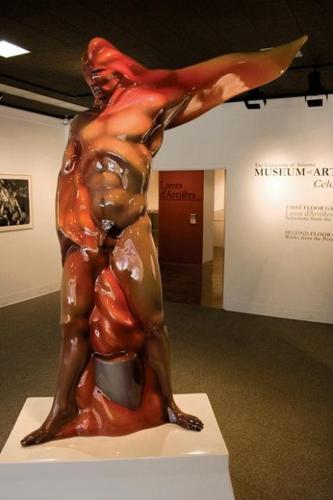
● Jimenez had said the dramatic, monumental "Man on Fire," a 1969 molded fiberglass sculpture more than 7 feet high, was inspired by the Buddhist monks in South Vietnam who burned themselves in protest of the Vietnam war. He also said it was informed by the story of Cuauhtemoc, the last emperor of the Aztecs, tortured by the Spaniards when they held his feet to fire. Today, Cuauhtemoc is venerated throughout Mexico.
● "Chula" shows a muscular bird in all its finery. According to the latinoartcommunity.org Web site, the 22-by-30-inch 1987 lithograph on paper is a "paradoxical image, one in which Jimenez cleverly pits the verbal against the visual. Chula, a Spanish word that refers to the attractiveness of a person or object, is here assigned to the image of a menacing, beady-eyed cholo bird, a common sight in Mexico and South America. A visual pun, it at once challenges and usurps language and heritage."
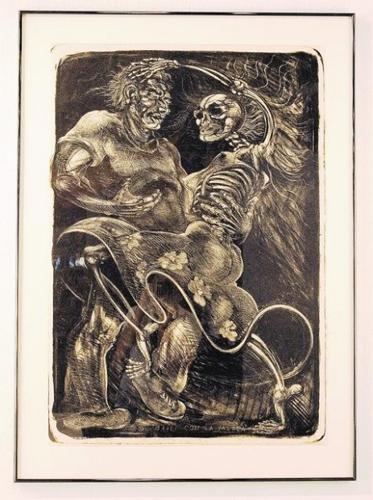
● "La Baile Con La Talaca" — dance with death — is a 39-by-27-inch lithograph on paper done in 1984. It depicts a burly working man in the arms of a grasping, festive and almost shimmering death. There's a strength in this picture — you can imagine him fighting her off — that's matched by a seductiveness — he can't resist going with her.
● In "Illegals," a 27-by 38-inch 1985 lithograph, a group of refugees purposely forge their way into this country as a stingy moon teases them with barely enough light to guide them — or maybe it's a wise moon, providing a path without shining so bright that it will reveal their flight. Car lights in the distance rumble toward them, perhaps to reach them and take them right back where they started from.
Tucson Museum of Art, 140 N. Main Ave. (624-2333):
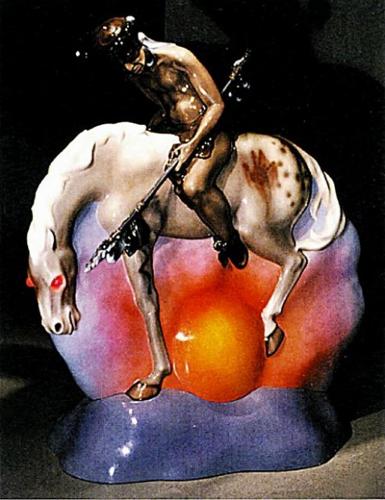
● Jimenez's "End of the Trail with Electric Sunset" sits in TMA's west lobby. The 1971 fiberglass, resin and epoxy sculpture is 81 by 71 1/2 inches. The base and the eyes light up, and the energy in the horse and the Indian gives the sense that the sculpture's about to take off.
● Self Portrait, a 1995 lithograph, shows an introspective, almost intimate side of the artist. The full face is thoughtful and inviting — as though the artist were willing you to get to know him. The 51 1/2-by-37 1/2-inch litho is in the Tucson Museum of Art's main lobby.


