America has a pig problem, and Arizona is stuck in the mud right along with everyone else.
According to federal regulators, feral hogs now roam the landscape in at least 28 states, including our own.
The non-native animals are responsible for at least $3.4 billion in property damage each year, mainly by rooting, wallowing and stomping their way through agricultural crops, natural areas and even suburban neighborhoods in certain parts of the country.
“They also pose a disease risk for livestock, and in some cases, people,” said Tanya Espinosa, spokeswoman for the U.S. Department of Agriculture’s Animal and Plant Health Inspection Service, or APHIS.
Espinosa said the USDA no longer tracks the total feral pig population, only the number of counties where they are found, but as recently as 2019 the agency estimated there were at least 6 million of the animals living in the wild.
People are also reading…
Wild boars have expanded their range significantly since the USDA began cataloging them in 1982. The agency has referred to the species’ rapid spread as a “feral swine bomb.”
Though the highest concentrations are found in the southern half of the country, the animals have also been documented in Michigan, New Hampshire, North Dakota, Ohio, Oregon, Pennsylvania and the Hawaiian Islands.
The problem is especially bad in Texas, Florida and the Southern states in between, where wild pigs are present in nearly every county.
Just four counties in Arizona — Cochise, Mohave, Navajo and Yavapai — show up on the USDA’s 2025 feral swine distribution map, but wild pigs have also been spotted in recent years along the San Pedro River in Pima and Pinal Counties, northeast of Tucson.
Hogs, not javelinas
Late last month, the popular HBO show “Last Week Tonight” devoted an entire episode to feral hogs, with comedian-commentator host John Oliver describing them as “one of the most destructive species in the country.”
They’re also difficult to control, because they are smart, adaptable and quick to reproduce, with few natural predators.
Espinosa said wild hogs can survive in “nearly every sort of habit or climate,” and they start breeding at about 6 months old, producing litters of 6-10 piglets once or sometimes twice a year.
They feed on almost anything, including crops, native plants, reptiles, small mammals and the eggs and chicks of ground-nesting birds. They’re also known to attack larger animals such as fawns, calves, lambs and even vulnerable adult animals during birthing.
Attacks on humans are extremely rare, but a 2023 study found that wild boars kill about eight people a year worldwide, making them statistically more deadly than sharks.
Pigs are not native to North America. The feral hogs found here today are the descendants of domestic animals that were brought to the continent, starting with the first Spanish explorers in the 16th century, then escaped or were released on purpose for hunting.

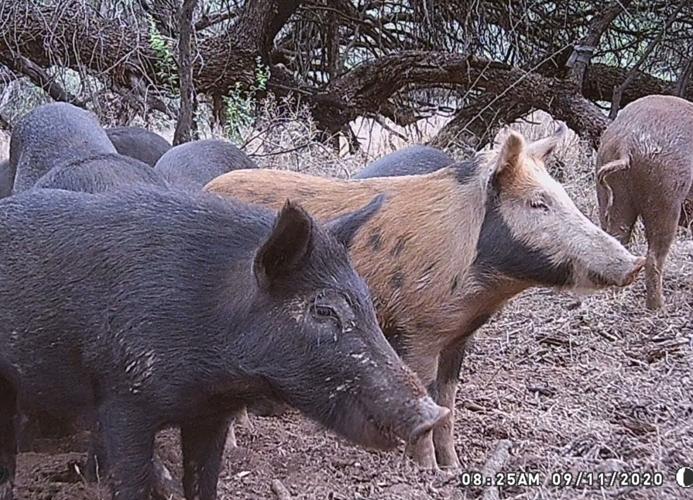
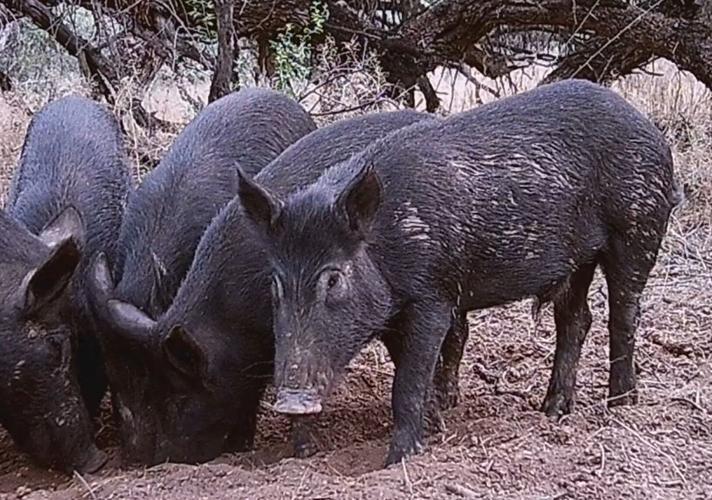
Wild boars near the San Pedro River northeast of Tucson.
“They are primarily hybrids of the Eurasian or Russian wild boars,” Espinosa explained. “Feral swine often look similar to domestic hogs but are generally thinner with thicker hides of coarse bristly hair and longer tusks. Because of crossbreeding, they vary in color and coat pattern.”
Wild hogs bear no relation to Arizona’s smaller, native javelina, which are pig-like but famously not pigs. The two species don’t even belong to the same family of mammals.
Espinosa said the USDA’s Wildlife Services program works to reduce feral swine damage by providing technical assistance to property owners and conducting so-called “removal operations” upon request.
Funding for the work is provided by APHIS’ National Feral Swine Damage Management Program and other cooperating entities at the federal, state and local level. Last year’s so-called One Big Beautiful Bill allocated $105 million for wild hog eradication efforts through 2031.
Hard to hunt
The animals can be difficult to hunt or capture. They will come up with clever and collaborative ways to escape from traps or switch to being nocturnal to avoid hunters during the day. It’s important to catch or kill the entire herd at once, Espinonsa said, or the remaining hogs will become “trap shy, making them harder to remove.”
Wild pigs are not considered wildlife, so the Arizona Game and Fish Department doesn’t regulate or protect them in any way, said spokesman Mark Frieberg. They’re fair game all the time.
“Because they are invasive and not native wildlife, there are no closed seasons, bag limits or tag requirements,” Frieberg said, though private landowners can set their own rules about hunting on their property.
“Last Week Tonight” highlighted a few of the more outlandish efforts to control pig populations, including guide businesses in Texas that take hunters up in hot air balloons or helicopters nicknamed “pork choppers” to shoot hogs from the air.
But the popularity of boar hunting has also made the problem worse, as landowners in other parts of the country import swine for private hunting preserves, only to see the animals escape through the fences.

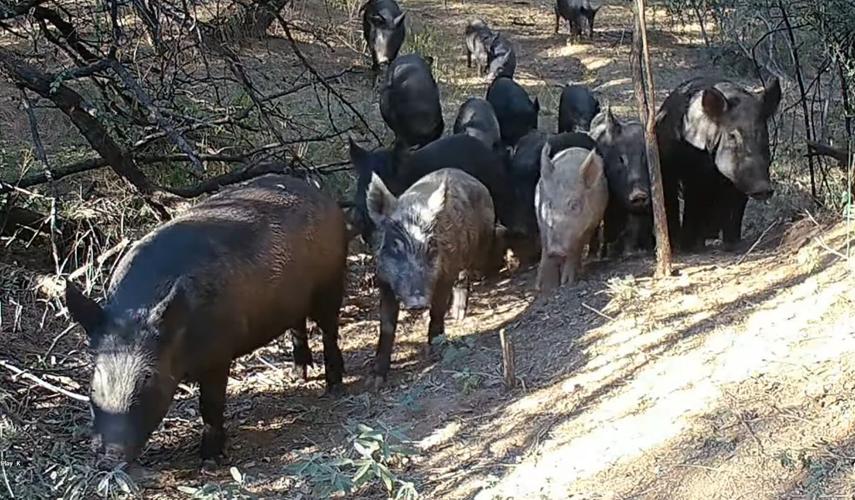
A group of feral hogs, known as a sounder, moves through the San Pedro River floodplain in a screenshot from a trail camera video.
That’s what may have happened along the San Pedro River between Benson and Mammoth. The wild pigs living there now are thought to be the descendants of boars brought in by a local rancher decades ago.
Other spots around Arizona known to have hogs in the past include parts of Cochise County near Bowie and Willcox; the Virgin River in the far northwest corner of the state; Sycamore Creek east of Interstate 17 in central Arizona; the Havasu National Wildlife Refuge on the Colorado River and the Buenos Aires National Wildlife Refuge near the U.S.-Mexico border at Sasabe.
Ultimately, what may help keep Arizona’s wild pigs in check are the wide stretches of dry desert throughout much of the state. As resilient as they are, feral hogs can’t survive the Sonoran Desert summer without access to at least some standing water.
Camera man
Vail wildlife videographer Jason Miller encountered his first feral hogs in Southern Arizona a little over 25 years ago, while he and his wife were hunting javelina on the northeastern flank of the Catalina Mountains, about a mile from the San Pedro.
“When I first saw them, I didn't even know what they were. I thought they were somebody's domestic pigs up in the hills,” Miller said. “Then when I started just doing trail cameras and gave up hunting, I decided to go back and set a bunch of cameras and see if they were still up in there. Sure enough, they were.”
He’s been collecting footage of feral hogs in and around the river north of Redington ever since.

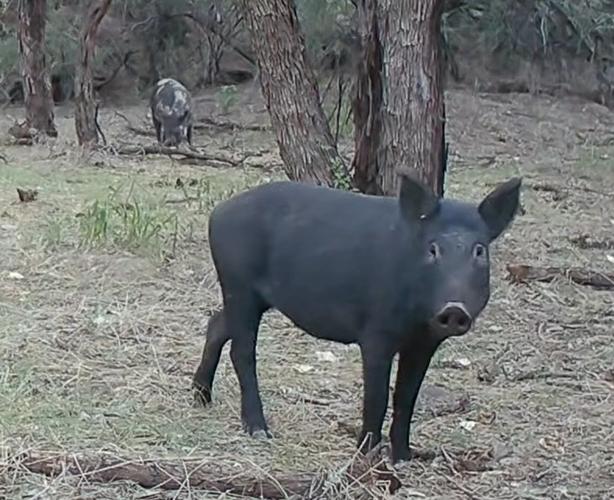
A screenshot from a trail camera video shows feral pigs rooting in a mesquite forest along the San Pedro River northeast of Tucson in 2020.
“Sometimes I'll get two or three or four, and then I'll get 20 plus,” said Miller, whose desert wildlife videos on YouTube have earned him more than 24,000 subscribers. “Every now and then, I get a big herd, but for the most part they're just in small pockets.”
His most dramatic video is a four-second clip that opens with a puff of dirt and the dark colored streak of a pig running past, followed a few beats later by a large black bear in hot pursuit.
Miller has also had a few in-person encounters with wild hogs. It’s “an adrenaline rush” each time, he said, but none of the boars ever charged at him or otherwise acted aggressively. “They behaved like any other wild animal would. If they hear something, see something, they're out of there.”
Miller said he operates anywhere from five to 12 motion-activated cameras on public land along several miles of the river and the surrounding hills north of Redington.
He captures almost all of his hog footage during the summer months. “I don't know where they go when it gets colder, but it's somewhere else,” he said. “I haven't figured that out yet.”
Last year, Miller was contacted by someone from the USDA who had seen his videos and wanted to know more about where he was finding feral hogs.

Feral hogs caught on trail camera near the San Pedro River northeast of Tucson.
He ended up going out into the field with the government hunter more than a dozen times over the summer and early fall, as the guy set up cameras of his own and even managed to shoot a couple of pigs. The man collected blood and other samples from his kills before hauling the carcasses away, Miller said.
But it wasn’t easy.
“The problem is it's so thick down in that boondocks treeline along the river there. It's hard to find them,” he said. “Even that guy from the USDA had a heck of a time.”
Miller knows wild pigs are a non-native species, and he understands the potential damage they can do and why it makes sense to get rid of them. He’s just not sure he buys the doomsday predictions about feral swine overrunning entire ecosystems, at least not along the San Pedro or elsewhere in the unforgiving Arizona desert.
“If they were doing so well, I'd get them a hundred times more than I do. They would be mowing down my cameras,” he said. “I know a lot of people are like, ‘Oh, they're going to spread and take over everything.’ From what I've seen around here, that's not even close.”



 Rescue plan in works for tiny endangered turtle in path of second Arizona border wall