

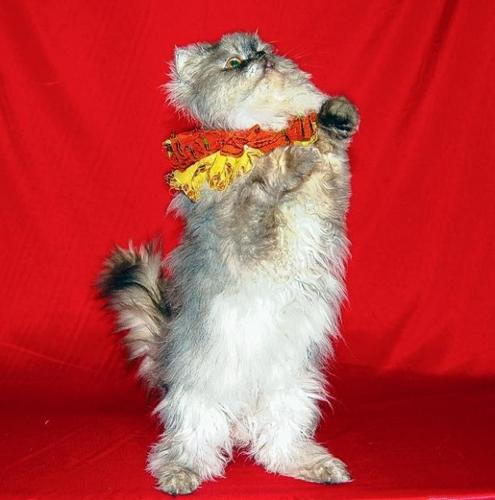
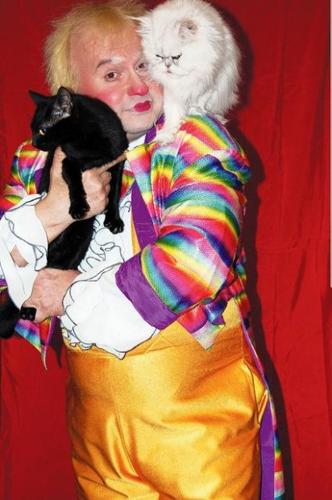
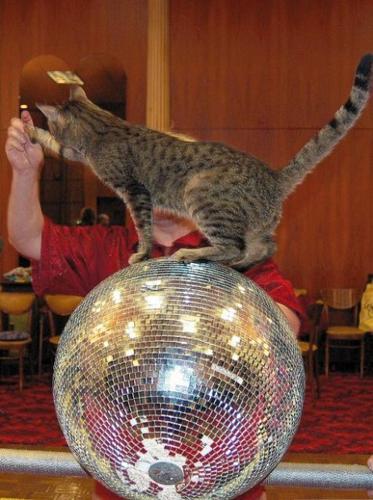
When you hear someone describe Moscow Cats Theater, coming to the Tucson Convention Center Sunday, you might suspect that they're putting you on.
"Well, there's all these cats, you see. And they do . . . tricks. Yeah, they're real cats."
But the show's for real, and it's attracted praise from folks all around the country, including a rave review in The New York Times. It still raises a lot of questions, though, like how exactly do you get cats — notoriously finicky creatures — to perform tricks in front of an audience, anyway?
"There's constant training; it's about two years of repetition, a lot of petting and a lot of treats," says Yanis Gelfman, general manager of Gelfman International Enterprises Inc., which produces Moscow Cats Theater. "We base the trick around their natural abilities. If a cat doesn't like to climb high, obviously we're not going to make it climb a post and jump off of it."
People are also reading…
Gelfman agrees that a big part of the appeal is the novelty of seeing cats performing circus-type tricks.
"We get a lot of people who own cats who want to see for themselves," he says. "Then they come out of the show and think, 'Why doesn't my cat do that!' You never imagine cats doing these things, performing like this; it's basically a mythbuster."
So what kind of tricks are these 35 cats capable of, anyway?
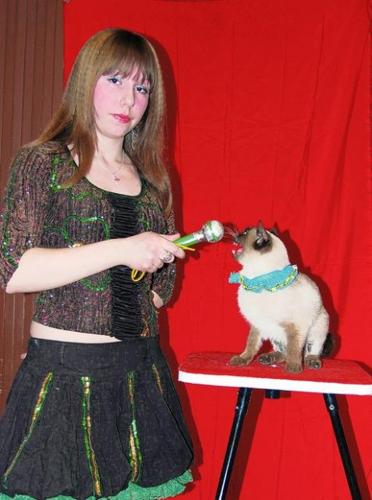
"They climb highposts and then jump on the trainer's back," describes Gelfman. "We have a cat that we put on its back and it juggles a big rubber ball; we have a cat that's on its back and spins sort of a baton-thing; we have a cat that actually hangs on its front paws and pulls itself forward on two poles; we also have different balancing acts, acrobatic acts; and we also have, at the end, a singing cat."
That's right, a singing cat. Sorry if anyone just overdosed on adorable.
"It's basically a cat that comes out, we hold a microphone to it and it meows into the microphone," says Gelfman. "It's a long, drawn out meow. It's pretty funny."
The show has been touring America for three years, but, as the name implies, it originated in Russia. That's where most of the cats are from, too, although many have been adopted from various countries around the world. The 70-minute (no intermission) show also features five clowns (from Russia, and human) and one dog.
"One very confused dog," says Gelfman. "I think the dog thinks it's a cat. It tends to sleep all day." The dog performs basic tricks and also, according to Gelfman, acts as a "cat wrangler," keeping all the cats in check.
It stands to reason that a show like this, which tours cats all around the world, might incur the wrath of animal rights groups.
"We support the ASPCA (American Society for the Prevention of Cruelty to Animals). They come check it out," he says. "We have nothing to hide."
Being cruel to animals would be contrary to their goal, Gelfman says.
"The trainers love these cats," he says. "You can't just train a cat for a week and have it go out on stage, nor can you treat a cat badly and have it perform for you, because it just won't."
Obviously, a show like this is harder to control than one starring, let's say . . . people. So the show varies a bit in each performance.
"I've seen it probably 300 times, and every show is different from the previous one because it all depends on how the cats feel that day," says Gelfman.
Yet, sometimes that unpredictably just serves to up the already dangerously high cute factor.
"When the cat doesn't perform, it's actually more endearing to the audience because they laugh it off," Gelfman says. "We usually have backup cats, so we just let the next one go. But usually when the next one goes, the first one wants to come back to perform the trick — I think they have a sense that the attention's not on them anymore and they try to butt in.'
So cat performers aren't really that different from human ones after all.
• When: 1 and 4 p.m. Sunday
• Where: Tucson Convention Center, 260 S. Church Ave.
• How much: $55.90
• Info: 791-4101 or moscow catstheatre.com.


