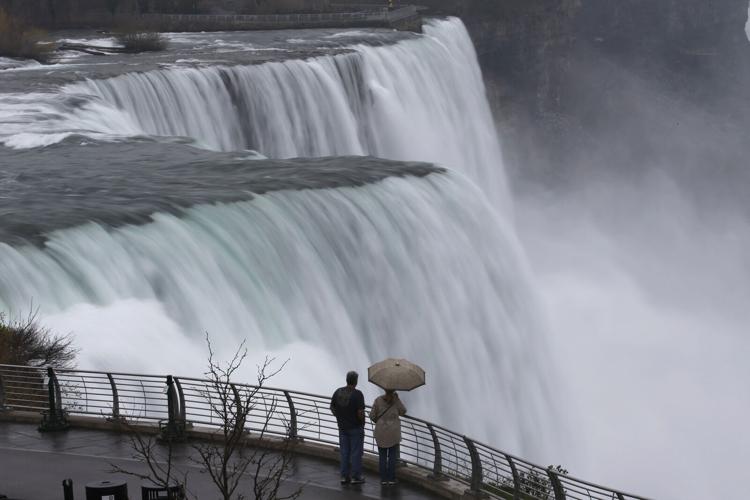
This is a story about the time Leif Eriksson and his fellow Vikings came upon Niagara Falls 1,000 years ago.
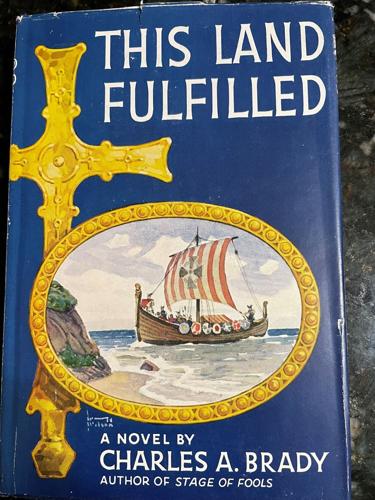
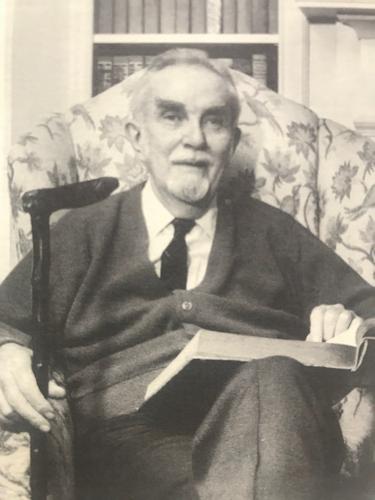
If this is news to you, that may be because it’s fiction. The scene is from “This Land Fulfilled,” a 1958 novel about Eriksson’s adventures in North America. To me, though, the story is familiar — and familial. That’s because the author is my late father, Charles A. Brady.

His book was based on the great Norse sagas written in the Late Middle Ages, which in turn were based on oral histories of Viking voyages, hundreds of years earlier, to lands west of Greenland. Some scholars dismissed those as little more than Icelandic tall tales.
Definitive proof of Eriksson’s settlement would not come until the 1960s, when archaeologists found his old encampments at L’Anse aux Meadows in what is now Newfoundland. That was several years after publication of “This Land Fulfilled.”
People are also reading…
Then, last month, came word of a discovery that put Eriksson and his Vikings back in the news. A scientific study of wooden artifacts found at the old encampments — cut by metal tools not in use by Indigenous peoples — determined that Norsemen lived at L’Anse aux Meadows exactly 1,000 years ago, in 1021.
Researchers could be so precise because they found fragments in the artifacts’ tree rings from a cosmic-ray event that showered the earth with high-energy particles in the year 993. By counting additional tree rings outside the one containing the particles, they were able to identify 1021 as the year that these fir and juniper trees were felled.
All of this would have thrilled my father, who based his historical novel on historical fact. Eriksson converted to Christianity in the years before his voyage, and the novel centers on the tension between belief in the old Norse gods and in this new messiah. (“Vikings,” a recent drama on the History Channel, also played dark notes on this theme.)
The novel’s narrator is Thrand, a member of Eriksson’s expedition. He writes of a journey far south of their encampment that Eriksson takes with some of his compatriots. At one point, many days into their sojourn, they hear a giant rumbling ahead. Here is the passage in which they confront the Falls. (“Karfi” is the name of a small Viking ship; “foss” is an Icelandic word for waterfall.)
“Knowing that some large waterfall must lie ahead, we had moored our karfi on the north bank of the river. But we had not bargained, in our wildest dreams, for a fall so gigantic as this one. What a foss! … This mightiest of fosses fell, with a thundering roar that shook the rocks around it, sheer over a precipice and into the deep gorge between whose walls the lordly river ran.”
These Norsemen have arrived during daylight, on Christmas Eve. The next passage describes the Falls in the deep cold of winter. (“Aurochs” is a long-extinct wild ox.)
“Like a white-shagged aurochs the great foss made its humped bison leap into cold space. The spray froze on our skin coats even as we watched those tons and tons of water fall in a long green wall of glass that shattered into white shards of broken crystal at the foot of the waterfall. It was as if this giant foss were an ice-smith on an enormous scale. Every twig and tree trunk, every rock and jutting piece of earth was armored in a bright ice-mail against which the winter sun splintered its endless spears of glancing light. It was almost as if frost giants had sculpted great chessmen out of ivory.”
Thrand, the narrator, is an old man when he sets down this tale. “Once in my life,” he writes, “have I gazed on the All Father’s unleashed powers unveiled in their naked strength even as Moses saw them in the thunder of the Sinai mount.”
Might Eriksson and his Vikings really have made their way to what we know as Niagara Falls? No physical evidence exists. But we’ll leave you with this:
The sagas tell us that Eriksson named his settlement Vinland for the wild grapes that grew there. But such grapes did not grow plentifully in the climate of L’Anse aux Meadows, so scholars have long believed that these Vikings ventured at least as far south as the St. Lawrence River.
The St. Lawrence begins its flow at Lake Ontario — and the Niagara River flows into the lake. Is it a stretch to imagine that an intrepid explorer like Leif the Lucky might have found his way to the St. Lawrence and then sailed into the great lake, which then could have led him up the river leading to the mightiest of fosses?
Let’s put it another way: Where is the best place in Canada to grow grapes?
Why, the Niagara Peninsula, of course. Think of it as our own latter-day Vinland.
Ice wine, anyone?