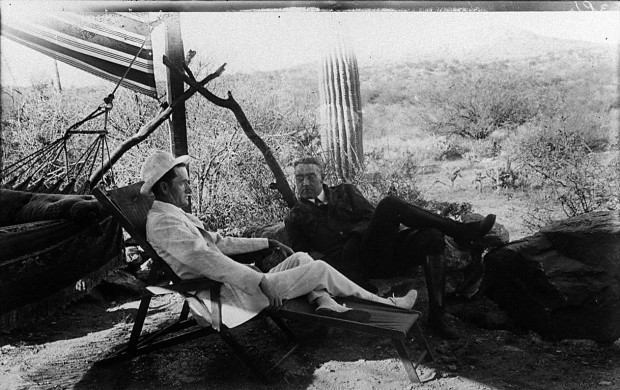
In the first quarter of the 20th century, America's favorite author was undoubtedly Harold Bell Wright, a man who lived in Tucson longer than he lived anywhere else.
He sold more than a million copies each of "The Shepherd of the Hills," "The Winning of Barbara Worth," "The Re-Creation of Brian Kent," "Helen of the Old House" and "When a Man's a Man."
If the titles don't ring a bell, don't feel bad. The author once adored by millions of readers is almost totally forgotten.
And there's not much mystery about why he slid so quickly into obscurity:
Wright's books were considered crummy by critics far and wide.
Time magazine's review of "The Mine With the Iron Door," one of his last novels, ran in August 1923 under the terse headline "Harold Bell Wright turns out another novel."
People are also reading…
"The Canon of Gold was the meeting place for the most oddly assorted groups of characters in all of fictional Arizona," it began. "There the two obtrusively quaint old 'pardners,' Thad Grove and Bob Hill, kept house with their adopted child, Marta Hillgrove, found in somebody or other's cabbage patch in the past and at the time the story opens just budding into radiant womanhood."
"Here, once more," wrote the critic, "was that rara avis, a novel that sells itself.
"The author knows the country of which he Wrights. It is to be presumed that he knows the people also. Taking all of which into account, it is really extraordinary that he should so completely evade transferring any impression of reality to the reader. If it were not for the picture of Mr. Wright among the mesquite on the book jacket, one would be tempted to suppose that he had never been West at all."
Ouch.
"Why has he succeeded so vastly? In the first place, he tells a story, and nearly always an old enough one so as not to unduly tax the public brain. His books are clean, his heroines beautiful and virtuous, his villains black as sin. . . . He writes badly, but directly. He is sincere - he uses his clichés as if no one had used them before."
The New York Times damned "The Mine With the Iron Door" with this faint praise:
"A clean, wholesome story of the sort that thousands delight to read."