

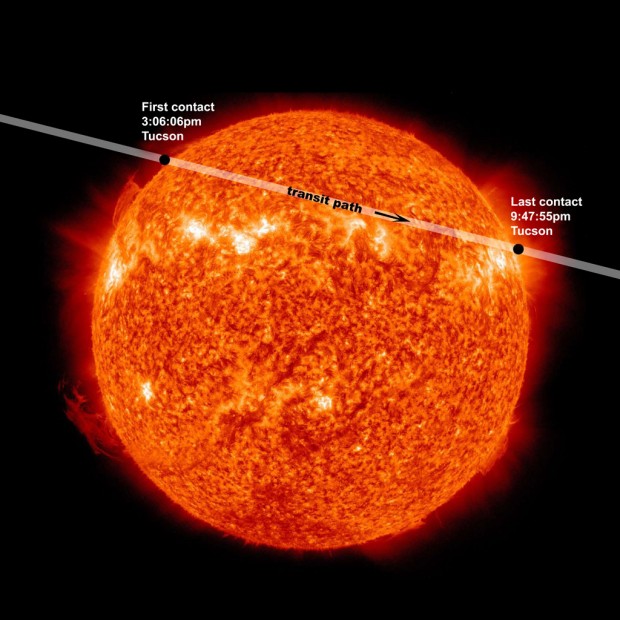
The transit of Venus on June 5 won't happen again for 105 years.
The transit is the movement of Venus across the face of the sun as Venus orbits directly between the Earth and the sun.
From now until June 5, after sunset watch a brilliant Venus move closer to the sun. Soon it will disappear into bright daytime skies as sunset gets later, until it can be viewed crossing the sun.
On June 5, the darkened disk of Venus will glide over the face of the sun for several hours starting around 3 p.m. until the sun sets.
"It's one of the key events for 2012," Sanlyn Buxner, an education specialist with the Planetary Science Institute, who help organize viewing events throughout the Tucson area. "It's a rare spectacle - we're super excited."
Here are some opportunities to see it - safely.
People are also reading…
Biosphere 2
32540 S. Biosphere Road
• When: 3-6 p.m.
• Cost: Free.
• Details: Telescope viewing along with presentations by local astronomers about the importance of this event.
The viewing is supported by the Tucson Amateur Astronomy Association and the University of Arizona College of Science.
• More info: www.b2science.org
Kitt Peak National Observatory
Summit of Kitt Peak off Arizona 86
• When: 2-10 p.m.
• Cost: $55; $50 seniors and active duty military (with I.D.); $25 ages 6-16; free to citizens of the Tohono O'odham Nation.
• Details: Hours of transit viewing, along with stargazing and many other activities.
Andrea Wulf will sign copies of her newest book, "Chasing Venus; The Race to Measure the Heavens" and lecture on the Venus transits of the 1700s.
The program, geared toward beginners and families, includes a boxed dinner and full after-dark observing session to see Mars and Saturn. Complimentary solar-safe viewing glasses will be provided.
• More info: www.noao.edu/outreach/kpvc/venus-transit.php
Loews Ventana Canyon Resort
7000 N. Resort Drive
• When: 3-5:30 p.m.
• Cost: Free and open to the public.
• Details: Guided by astronomy professionals, guests will look through specialized H-alpha telescopes at the sun.
The event will also include live video feeds from NASA and Mount Lemmon SkyCenter, lectures from cultural astronomer Richard Poss and astronomer/child author Steve Kortenkamp, and complimentary solar-filter viewing cards.
It will be followed by a Transit of Venus happy hour in the Cascade lounge at 5:30 p.m., featuring Chasing Venus sauvignon blanc.
• Note: Loews also offers stargazing at 9 on Wednesday and Saturday nights, weather permitting, during the summer, and at 8:30 the rest of the year (Wednesday, Friday and Sunday nights on Memorial Day, July 4th and Labor Day weekends). It's free to guests at the resort and its restaurants and lounge.
Tumamoc Hill
1675 W. Anklam Road
• When: 5-7:30 p.m.
• Cost: Free and open to the public.
• Details: Telescope viewing provided by the Mount Lemmon Sky Center along with other activities presented by the UA College of Science. At 6 p.m., Jarita Holbrook, a cultural astronomer, will talk about the relationship between humans and the sky,
Ua Main Campus
University of Arizona Mall in front of Flandrau Science Center, 1601 E. University Blvd. and Kuiper Space Sciences building, 1629 E. University.
• When: 3-8 p.m.
• Cost: Free.
• Details: Viewing of the sun and Venus transit on the mall, and activities for kids and adults inside the Flandrau Science Center and Kuiper Space Sciences. Also, live video feeds of the transit from observatories all over the world, and presentations by UA astronomers.
Additional night sky viewing will follow at the Flandrau Science Center.
Activities will be supported by staff and volunteers from the UA College of Science, the Planetary Science Institute, the National Optical Astronomy Observatory, Girl Scouts of Southern Arizona, and the Tucson Amateur Astronomy Association.
• More info: flandrau.org
Did you know?
Transits help determine our place in the cosmos. Astronomers now use transits to seek out Earth-like planets around other stars. It won't be seen again until 2117.
Never look directly at the sun
Never attempt to view solar events with the naked eye! You may safely view the solar eclipse and the transit of Venus only if you wear specialized solar-filtershades (not sunglasses); use a proper solar filter over a telescope; or project an image of the sun with a suitable indirect viewing technique.
Source: Sanlyn Buxner Source: NASA.


