Over the past few days, hundreds upon hundreds of comments flowed into a multitude of Facebook sites devoted to Buffalo as it once was, sites where graying correspondents collectively mourned the passing of television’s Tom Jolls.
Many recalled leaving school a solid 50 years ago to hustle home and swallow a peanut butter sandwich while watching “The Commander Tom Show,” starring Jolls. Every now and then, someone would maintain in a trick of blurred Facebook memory what broadcast historian Marty Biniasz said happens often in these comment threads:
“I remember him,” they’d say of Jolls, “on Rocketship 7.”

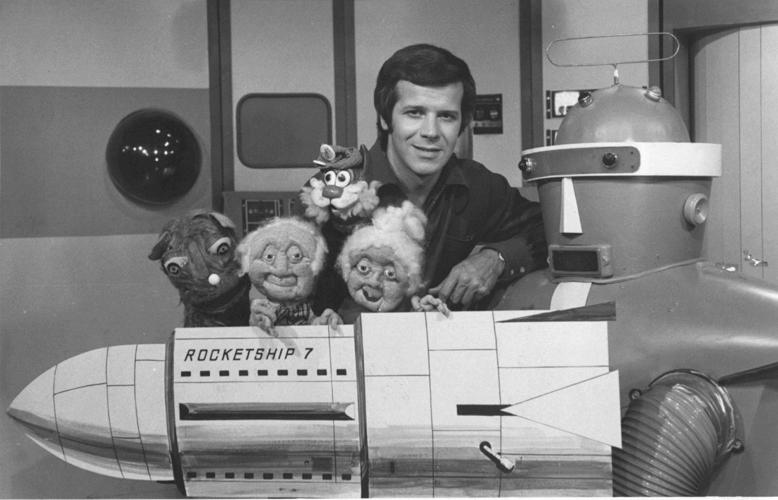
David Boreanaz — known in Buffalo as ‘Dave Thomas’ — with friends on the set of ‘Rocketship 7.’
Right spirit, right channel, wrong show. From Pennsylvania, Dave Boreanaz laughed softly at that tale. No one understands the place Jolls holds in the collective regional memory quite like Boreanaz, who – under the TV name of Dave Thomas – was at the helm of WKBW’s “Rocketship 7” for 16 years.
People are also reading…
Created at the peak of American fascination with space travel, the idea was simple: Boreanaz routinely appeared as an astronaut on a set designed to conjure up a space flight, typically joined by his sidekick, Promo the robot, a character defined by John Banaszak.

Tom Jolls, the affable weatherman on the legendary WKBW-TV (Channel 7) anchor team alongside news anchor Irv Weinstein and sports director Rick Azar that dominated local news for decades, died Wednesday in Buffalo Hospice in Cheektowaga. He was 89.
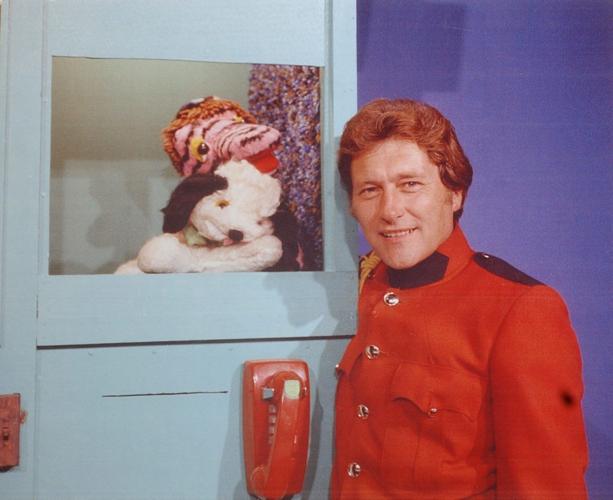
In 1965, Jolls – who did evening weather for years at the station – started an afternoon children’s show at Channel 7, a well-loved feature that soon revolved around Commander Tom and such puppets as Dustmop, Matty the Mod and the unnerving, googly eyed Furry Burry Creature.
For years, those two programs – on the same station – were reassuring bookends for multitudes of children. Boreanaz, 87, swiftly heard from longtime friends about Wednesday’s death of his old colleague at 89, an event that evoked a great sigh of civic loss.
“They don’t come any nicer than Tom Jolls,” said Boreanaz, a morning guy in Buffalo who remembers his first and now-so-faraway meetings with Jolls and his legendary teammates on the Eyewitness News evening team.
Boreanaz, whose earliest home was a Niagara Street apartment house, was a young guy doing “summer relief” at WBUF when he shook hands with future sportscaster Rick Azar. He returned from the Army to join WKBW, where he saw Irv Weinstein’s tryout for the anchor slot – a moment, Boreanaz said, when the producer asked Weinstein to stand on a pop carton to project a greater height.
As for “Rocketship 7,” Boreanaz said Bill Wagner, a program director, came up with the notion of a show inspired by the American space program that could celebrate work being done in greater Buffalo by Bell Aerospace.
In 1962, the result was a rocket-styled set designed by “floor man” and World War II veteran Fred Greanoff, 97, who on Thursday clipped a copy of Alan Pergament’s Buffalo News article about Jolls’ death to mail to Boreanaz, an old friend.
On “Rocketship 7,” you might see episodes of “Looney Tunes” or “Davey and Goliath,” but there were also science experiments, weather segments, math quizzes – and the time producer Steve Zappia played a key role in raising enough money to bring two snow leopards to the Buffalo Zoo.
“I even went to Cape Canaveral for a launch,” said Boreanaz, who emphasized “a real responsibility to young viewers.”
Biniasz, the broadcast historian, said “Commander Tom” had a different genesis: It started off by celebrating the superhero craze, then evolved into a gentle show built around Jolls, in his red uniform, and puppets made from his kids’ stuffed animals.
Greanoff also created a set for Jolls, which he describes “as nothing more really than a puppet stage, a plywood box with a hole cut into it.”

Tom Jolls was the creator and star of "The Commander Tom Show," which ran from 1965 into the late '80s. Here he is with his two of his main puppet sidekicks, Dustmop and Matty the Mod.
In a tag team of what kids watched before and after school, “Rocketship 7” and “The Commander Tom Show” turned into what Biniasz calls a bedrock part of “our collective childhood in those years in Western New York and Southern Ontario.”
That leads into another Biniasz reflection: Because greater Buffalo never experienced recent waves of population growth like, say, a Charlotte or a Houston, shared memory here retains unusual communal power – which accounts for the profound melancholy when someone like Tom Jolls dies.
Here, too, is a surprising note from Boreanaz, reminding me of something basketball great Bob McAdoo told me not long ago: McAdoo, a Hall of Famer whose best years were with the old Buffalo Braves, does not believe he ever met Buffalo Sabres great Gilbert Perreault when they were both electrifying their sports at the old Aud in the early 1970s – and McAdoo cannot remember any photo, ever, of the two of them together.
(If somehow you have one, please: Send it this way.)
The similarity is this: From 1965 until Boreanaz left Buffalo to become Dave Roberts, a beloved television weather guy in Philadelphia, he and Jolls were dominant figures on legendary children’s shows broadcast from the same station, in the same city.
Yet there was no crossover, Boreanaz said. They never appeared in character on each other’s sets. He does not remember any public appearances together during that time, though it seems like it would have been a promotional bonanza.
Biniasz has a photo of them side by side years later, in their 70s, but there was never any, well, 1960s or 1970s Marvel-style teamup between Commander Tom and Dustmop and Dave Thomas and Biff Beeper.
The reason was simple: Boreanaz said they lived in different programming worlds. He would wake up at 4 a.m. – sometimes to shovel his driveway – and get to the station. Boreanaz would do “Rocketship 7,” “Dialing for Dollars” and for a while, a show called “The Money Movie,” and then walk out the door when Jolls, who did the weather for the Eyewitness News team, was just coming in.
He remembers Jolls as gentle and powerfully sincere, “the kindest guy you’d ever see.” In the mid-1960s, Boreanaz was young and what he diplomatically describes as “rowdy” – a guy who enjoyed going out – when Jolls first joined the station, while Boreanaz recalls Jolls as the kind of person who embraced his job, was warm to everyone and then headed home.
What they shared in a tangible way was something Boreanaz said seasoned broadcaster Mac McGarry, a longtime host of “It’s Academic,” once advised him about going on the air: “Just be yourself … and you’ll know soon how the public takes to you.”
Viewers took to Boreanaz and Jolls, for life. In 1970, if either man walked into a Loblaws or a Tops or any local mall, they were quickly recognized by joyful little kids.
Boreanaz remembers being on a busy street in 1978 in Philadelphia, his new city, not long after moving there. From somewhere in the crowd, he heard a shout:
“Rocketship 7!”
At Chef’s on the Go, Dave Thomas put it best: “Only Buffalo people would come out in weather like
Some child of Western New York was now a grown-up, in Philly.
The farewell to Jolls leaves a pensive Boreanaz reflecting on just how few people are still around who were part of Channel 7 in that era. He and Jolls were shaped by tumultuous days in the late 1950s and early 1960s, when TV was still a new technology and today’s legends had only started to figure out their spot.
“When we were young, we didn’t realize we had that kind of impact, and you begin to feel it more as you get older,” Boreanaz said. “I saw a picture of Rick and Irv and Tom last night and it was very emotional, and that Tom died is very sad.”
Sixty years ago, there were only three stations in Buffalo – four, if you count fuzzy UHF. Unlike today, there were few options for children’s TV, making everything they tried feel new.
“It was exciting, magical, and we all learned by the seat of our pants,” Boreanaz said.
Generations of girls and boys, often watching on black-and-white screens, felt a deep connection to these two guys who showed up on their programs every day, grown-ups who never spoke down to their young audience.
A half-century or more later, it is why that audience – now its own evening show of life – knows it just lost a friend.