digital work of Cryptocurrency or money transfer backgrounds
The way a customer pays no longer dictates what a business receives. Payment platforms can typically handle the conversion between the two, so a shop can take a Bitcoin payment and still end the day with dollars. Traders follow BTC to USD on exchanges such as Binance to price the asset, while a Tucson merchant can look at the same exchange rate as a conversion step handled by software.
Customers already pay with cards, phone wallets and bank transfers without expecting the merchant to manage the networks behind them. Newer options basically extend that pattern by treating the price, the payment method and the settlement currency as separate pieces.
Does a customer’s payment method set the price?
No. A business sets its price in the currency it operates in, and the payment method comes later. A Tucson restaurant lists a meal in dollars. A contractor quotes a repair in dollars. A boutique on Fourth Avenue keeps dollar tags on every rack.
People are also reading…
Accepting another payment method does not require changing any of that. Point-of-sale systems that support Bitcoin typically start from the dollar amount entered at checkout and calculate the Bitcoin equivalent at that moment.
How does a Bitcoin payment turn into dollars?
The conversion happens at settlement. Most platforms that offer Bitcoin at checkout usually let the merchant choose whether to receive Bitcoin or dollars. If the merchant chooses dollars, the platform converts the payment at the time of sale.
Consider a customer buying a $40 item. The shop sets the $40 price. The customer chooses Bitcoin and pays the amount shown on the screen. With dollar settlement selected, the platform handles the conversion, and $40 in value lands in the merchant’s account, less any processing fee.
The business sets the price, the customer chooses how to pay, and the processor bridges the gap. None of those steps have to use the same currency from start to finish.
How many customers want to pay with crypto?
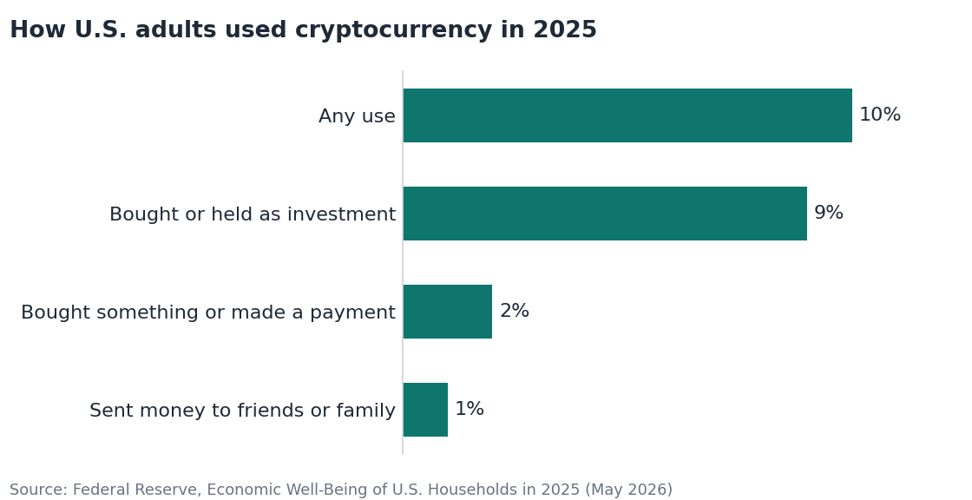
Not many yet, and the numbers show why merchants treat it as an add-on. The Federal Reserve's 2025 household survey, published in May 2026, found that 10% of U.S. adults used cryptocurrency in 2025. Most of them used it as an investment: 9% bought or held it that way, while 2% used it to buy something or make a payment.

How U.S. adults used cryptocurrency in 2025. Source: Federal Reserve, Economic Well-Being of U.S. Households in 2025 (May 2026).
For a merchant, that gap is the main point. Plenty of people may hold crypto, but few typically spend it. A checkout option lets that small group pay without asking the business to change anything else.
Does a merchant have to manage every payment rail?
No. Payment processors generally already absorb most of that complexity. A customer who taps a phone may be using a wallet linked to a card. Another may pay from a bank account. The merchant rarely needs to know how each network works before accepting the sale.
Bitcoin typically fits the same model when the processor handles conversion. The merchant can focus on what price was charged, what currency arrived, when it settled and how the sale appears in the books.
How do converted payments appear in business records?
They appear as dollar sales with a payment-method tag. Staff can see the dollar value and how the customer paid without moving the sale into a separate reporting system.
That matters for small teams. Employees need to know which currency was received, when it settled and whether it matches the day’s deposits. A Bitcoin sale that reads in dollars can usually be checked like any card sale.
Why do stablecoins and payments get so much attention?
They get attention because they are typically where crypto meets everyday spending. Binance co-CEO Richard Teng named stablecoins and payments as two of the company’s focus areas when Mastercard interviewed him in July 2025, and he described the card company as a payments partner.
For merchants, the takeaway may be practical. The parts of crypto that matter to a checkout counter are the ones that may convert cleanly into the currency the business already runs on.
What does conversion cost a merchant?
Conversion usually costs a processing fee, just as card acceptance does. The fee varies by provider, so merchants should compare the all-in cost of a Bitcoin sale with their current card rate before switching the option on.
Timing matters too. A merchant that settles in dollars typically avoids price swings after the sale, while one that keeps Bitcoin takes on that exposure. Some small businesses choose dollars for that reason.
What should Tucson businesses weigh?
Tucson restaurants, cafes, retailers, contractors and hotels should weigh three things before adding any payment option: what currency they receive, how quickly it settles and whether staff can match it to the sale afterward.
If all three stay simple, a new option adds a way for customers to pay without changing how the business prices goods, receives money or keeps its records. If any of them gets complicated, the option probably costs more than it brings in.
Frequently asked questions
Can a business accept Bitcoin and receive dollars?
Yes. With dollar settlement selected, the platform generally converts the payment at the time of sale and deposits dollars.
How common is paying with crypto in the U.S.?
Uncommon. The Federal Reserve found that 2% of adults used cryptocurrency to buy something or make a payment in 2025.
Do prices have to be listed in Bitcoin?
No. The tag stays in dollars. The checkout screen typically works out the Bitcoin figure when the customer pays.