

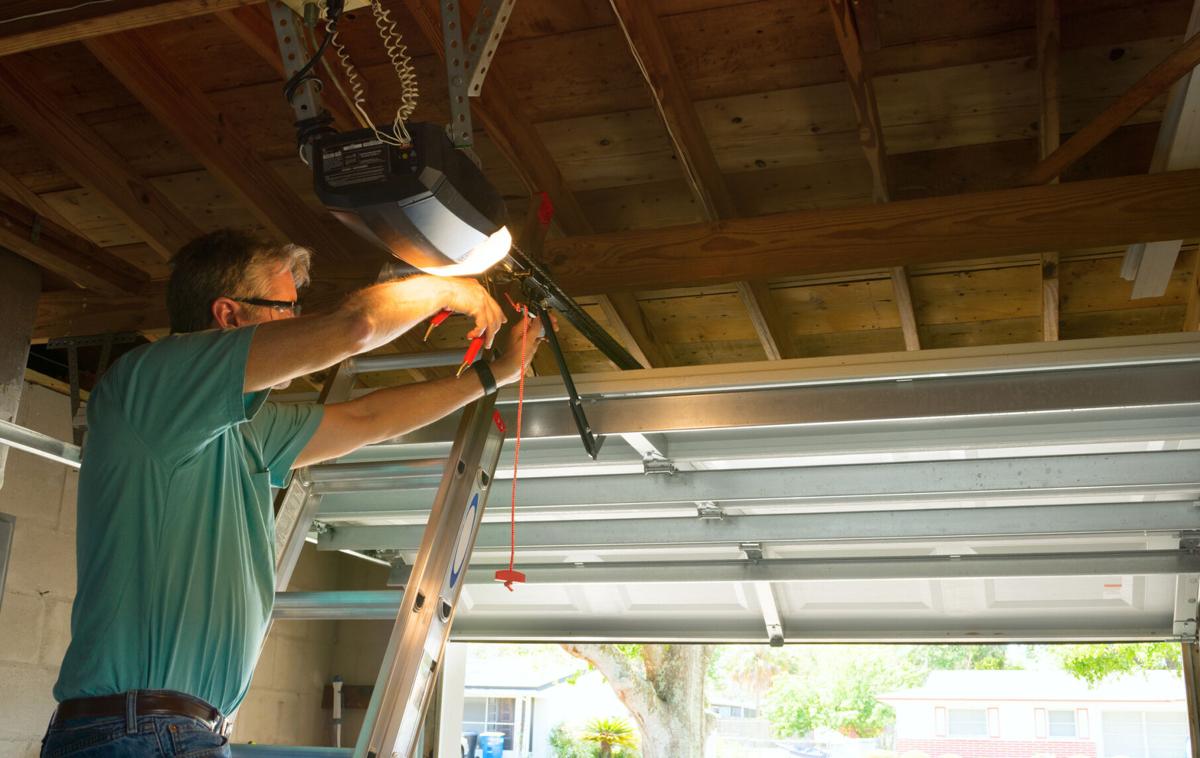
Question: My new house has a garage, which I have never had before. What do I need to know about how it operates?
Answer: There are a lot of moving parts to an automatic opening garage door and every piece plays a role in operating the door.
Garage doors are heavy, and the springs are under tremendous tension.
The garage door’s primary components include:
Rollers: Rollers are made of plastic, nylon or steel and allow the door to move in tracks that guide it. The hinges at the door sections enable the door to move through an arcing motion as it transitions from vertical to horizontal or vice versa.
Motor: Many people believe it is the motor that does the heavy lifting. However, the motor’s job, whether belt or chain-driven, is to start the door’s motion, but it does not do the heavy lifting necessary to open or close the door.
People are also reading…
Springs: It is the coiling of the spring that does the heavy lifting of the door. The springs are calibrated to the door’s weight, which can easily exceed 300 pounds. It is the spring tightening or loosening that supports the door’s weight.
Q: What are the most common problems with garage doors?
A: Chris and Peter Brown, owners of Same Day Garage Door Service, a Rosie on the House certified partner, tell us that the most common service calls they receive revolve around three issues. People call when the garage door won’t open, when it won’t close and when it is not running smoothly.
If you can get your garage open and closed, but it’s running rough, it can indicate any number of problems, such as:
Worn bearings and gears: There are bearings and gears inside the motor that can be worn out, causing the door to operate with a jerky motion or a creaking sound.
Misalignment: Operational sounds can be attributed to misalignment, track obstructions or more serious problems requiring a thorough inspection to determine the root cause.
If your garage door is running rough, have it looked at by a qualified garage door contractor. Early detection and repair of the issue can prevent major repairs or the need for replacement.
If the garage door doesn’t go up or down, troubleshooting begins with a visual observation of these components:
Sensor beam: Look at the sensor beam, sometimes called the “eye,” located near the bottom of the garage door track, close to the floor. There are two sensors located across from each other on either side of the garage door. These sensors are a safety feature designed to stop the door if there is an obstruction. If there is not an obstruction, try to realign them.
Springs: If the sensor beam is clear of obstruction, the garage door technicians will look to see if there is a broken spring or if the door has come off the track. Over time, springs will stretch, wear out and can break. Chris Brown tells us that spring issues are their most common repairs.
Motor: When the visual inspection doesn’t reveal a cause, a look into the power system is next. First, the techs will check to see if the motor is getting electricity. If the unit is getting electricity, the motor will be tested to determine if a replacement is needed.
Chris Brown says the best type of motor system is the DC motor. It has a transformer in the motor that converts AC power to DC for smoother, gentler operations.
A good technician will be able to pinpoint the issue with your garage door and make necessary repairs. However, sometimes a simple repair isn’t an option, and replacement of parts or even the whole door may be necessary.
Replacing a spring is a job for a professional, as garage door springs are under extreme tension. There is a specific spring for each door that is calibrated, or wound, to handle its weight.
Replacing garage door springs is an extensive process. The door is weighed in place using a portable, heavy-duty scale. Once door weight is established, the technician selects the appropriate spring based on a rating system known as Inch Pounds Per Ton (IPPT).
Q: What tips do you have for selecting a garage door?
A: When a door needs to be replaced, choosing the right door goes beyond aesthetics. There are dozens of designs to choose from. There is a door that will fit your home design and may even increase your home’s curb appeal.
A qualified door company will help you through the decision process by asking questions like these:
Do you want window panels in the door for natural daylight?
Do you want the windows to be translucent or see-through?
Do you use your garage during the summer months in the desert areas?
If you have a mountain home, will you be using the home during the winter months?
An insulated garage door is always a good choice and adds R-value to your garage. An insulated door also has the added benefit of protecting the interior walls of your home adjacent to the garage from temperature swings, either hot or cold. You can see a 15-degree drop in the summer, which could be worth real dollars off your energy bill.
Remember, while you are waiting for a repair, you can usually get the garage door open without the motor. Each automatic garage door has a handle on a rope that can be used to open the door when the automatic opener is not working. When you pull the handle, it disengages the motor but not the spring. The springs allow you to open the door with one hand and without a weightlifting workout.
Be sure that when you call the repair technician, they have a way to get inside your garage that is not through the garage door.
An Arizona home building and remodeling industry expert for more than 40 years, Rosie Romero is the host of the syndicated Saturday morning Rosie on the House radio broadcast, heard locally from 10 to 11 a.m. on KNST-AM (790) in Tucson.


