The hub of the spaceship was too crowded and chaotic for communication, so Frank Kuligowski motioned his pal to the peace of a nearby corridor. In the distance, the two ― both staffers of nondenominational Christian organization Cru ― spied a female avatar standing alone in the virtual hallway and decided to strike up a chat.

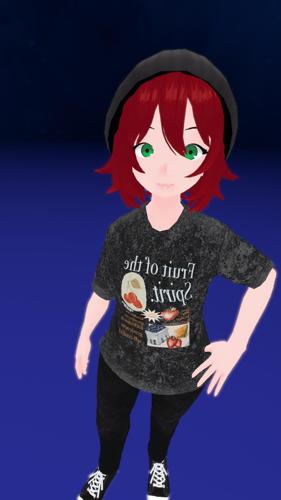
An avatar created by Geoffery Powell of Eureka, Ill., to connect with others as part of virtual-reality ministry outreach he and others conduct on the VR platform VRChat. Powell, 28, connected in summer 2022 with members of Cru, a nondenominational organization formerly known as Campus Crusade for Christ, who saw the virtual reality landscape as ripe for missionary outreach. Four years later, they now visit VRChat almost weekly.
In real life, the three were wearing headsets in separate geographic locations around the world. But here in this 3-D spacecraft created on the virtual-reality platform VRChat, they were soon engaged in conversation.
When Kuligowski, of Orlando, Florida, found a chance to mention his Christian faith, the woman, who lived in East Asia, said churches were hard to find there.
“There’s churches here in VRChat,” Kuligowski told her. “I can take you to one.”
Welcome to virtual-reality ministry, where street evangelism and fellowship building merge in digital form. While VR worlds created to mimic Christian churches have occupied such landscapes for some time, organizations like Cru, missionary groups and a handful of faith leaders nationwide believe the virtual territory beyond those walls can provide fertile ground for spreading Christian gospel.
People are also reading…
Kuligowski, Cru’s digital strategist, has been with the group for 26 years, many of them spent conducting face-to-face outreach. The Florida-based organization launched in 1951 as Campus Crusade for Christ and is active in 190 countries.
VR, Kuligowski said, gives him and his fellow evangelists the ability to connect with people they wouldn’t be able to otherwise. While Cru ambassadors have historically approached students on campuses or asked them to join local clubs, many people are less accessible now, he said.
“There’s a lot of brokenness and pain that people experience and it’s harder for them to connect face to face,” Kuligowski said. “But behind the anonymity of an avatar … we’ve found that as we engage people, they start opening up and asking hard questions.”

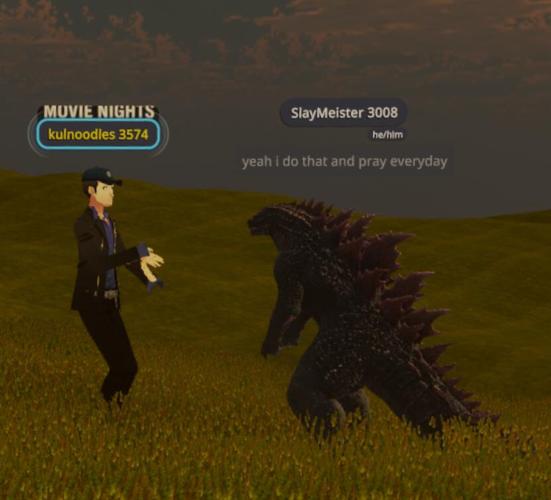
At left, Frank Kuligowski, digital strategist for Orlando-based Christian organization Cru, speaks through his avatar to a young man whose avatar resembles the film monster Godzilla, about spiritual matters in an image captured from the virtual reality platform VRChat in January. Cru, formerly known as Campus Crusade for Christ, is among a growing number of Christian groups embracing virtual reality platforms, seeing them as fertile territory for evangelism.
Virtual anonymity breeds honesty
It was around summer 2022 that Kuligowski was watching a webinar when a featured pastor spoke about the connections he’d made in virtual reality.

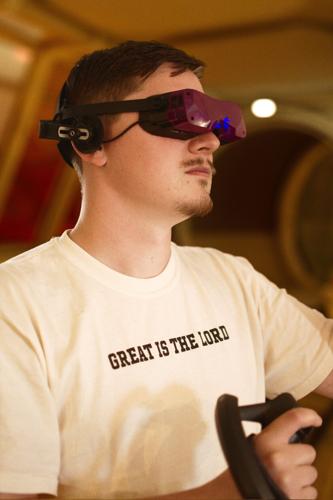
Geoffery Powell of Eureka, Ill., wears his virtual-reality headset as he visits a VR world. Powell, a 28-year-old computer science worker and part-time photographer, started joining members of Christian organization Cru for virtual-reality ministry outreach in summer 2022; four years later they conduct such outreach nearly weekly. The Orlando-based organization, formerly Campus Crusade for Christ, is among a growing number of Christian groups embracing VR platforms such as VRChat as an avenue for evangelism.
Kuligowski bought a headset and, along with other Cru staff who were into online gaming, he started entering VR worlds to strike up conversations. The group has visited the platform weekly ever since.
There are thousands of VR worlds in the metaverse, on platforms such as VRChat and Roblox. While they can be accessed via computer or mobile devices, they’re most fully experienced with special headsets.
“When you go into VR, you enter a world somebody has created,” said Geoffery Powell, a 28-year-old computer science worker in Eureka, Illinois, a non-Cru employee who joined Kuligowski's group soon after it formed. “They had an idea and built it out in 3-D.”
Such worlds can be reality-based or fantastical, or somewhere in the middle. Participants entering VR worlds do so as avatars, characters rooted in cartoons, popular media, anime or identities that express their interests or how they want to be perceived.
Powell believes many participants enter VRChat seeking escape from life stresses or complications, or because they have social anxiety.
The anonymity of avatars allows people to make connections and express themselves freely and without anxiety, he said.
“They feel safe saying what’s on their mind, because they might never meet you again,” Powell said.
Mixed reactions to virtual evangelism
The outreach conducted by Kuligowski’s group is an informal and part-time enterprise, in contrast to a newer, more official effort spearheaded by Cru’s Jesus Film Project, which offers an online toolkit for churches looking to pursue such activities.
Before they begin, Kuligowski meets virtually with his team in a preselected VR world. The members ― Powell in Illinois, with others in Florida, Mississippi and North Carolina ― pray together before splitting into small groups and embarking on their missions in whatever worlds they choose.
Their approaches vary. They read the room. Sometimes they’re direct, bringing up faith discussion right away. But mostly, Powell said, they look to make connections before transitioning to their gospel message, if at all.

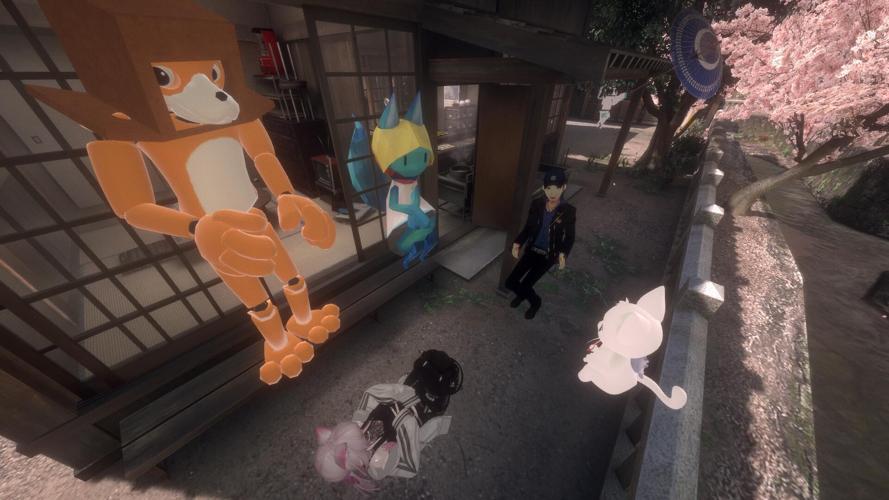
At upper right, Frank Kuligowski, digital strategist for Orlando-based Christian organization Cru, chats with other avatars in the guise of his own avatar, a ballcap-wearing high-school-aged warrior from a role-playing videogame. Their March discussion took place in a Japanese garden world set in the virtual-reality platform VRChat. Members of Cru, formerly Campus Crusade for Christ, have taken to VR platforms to build relationships and spread the Christian gospel.
“We’re not just there to push a message on them and leave. We want to be their friend,” Powell said. “Maybe things at work or at home are hard and they can’t find hope, so we share, like, ‘This is the hope I have, and it’s how you can have hope, too.’”
Occasionally, digital evangelists encounter resistance from others who find it off-putting and don’t react kindly. Others are curious, if not won over.
On Reddit, a discussion took place under the heading “Anyone else noticing an influx of Christians.”

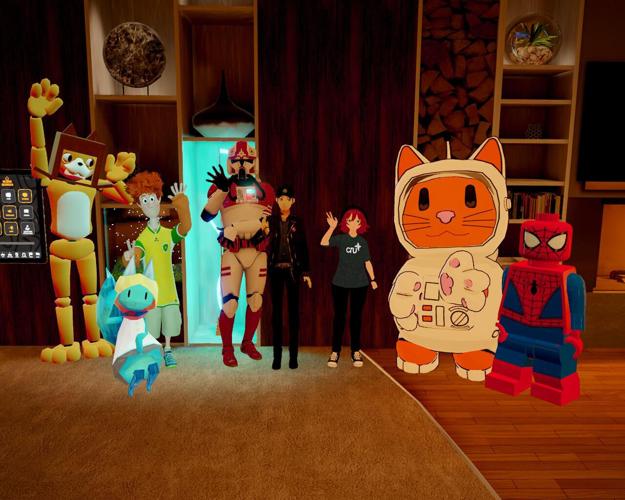
Appearing as their virtual-reality avatars, members of Cru and others prepare to embark on their virtual missionary outreach on the platform VRChat in an image captured in March. Cru, formerly Campus Crusade for Christ, is among a growing number of Christian groups looking to spread the gospel on virtual reality platforms , seeing them as fertile territory for evangelism.
The person who posted the thread wrote: “i’ve been on this game for 5 years and i haven’t seen this ever and now all of a sudden there’s christian’s (sic) who only go into lobbies to tell people to repent and to accept god and they’re not trolling either they are dead serious. like brother it’s vrchat.”
Powell said the Cru team rarely gets such blowback because of its gentler approach, though the occasional troll will act up.
“By the time we bring up our message, it feels natural. We don’t want to make people uncomfortable,” he said.

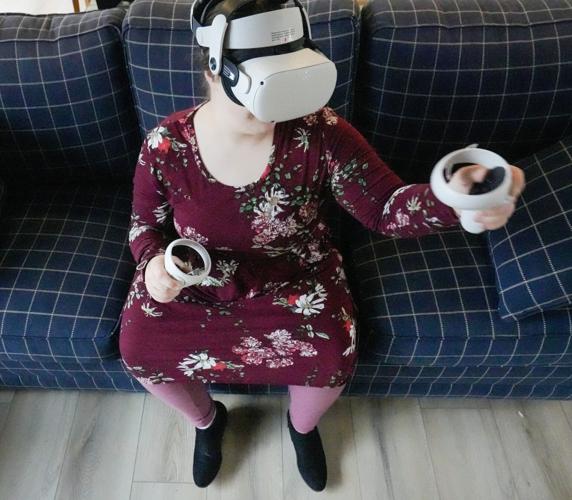
Gemma Firth uses a VR headset to create social connections from her home in New Berlin, Wis., on Dec. 10, 2023.
Real-life connection the ultimate goal
The predecessor to today’s VR worlds is Second Life, a virtual environment launched in 2003 in which people can create avatars and participate in a virtual economy.
Brett Robinson, a professor of theology, media and rhetoric at the Pontifical University of St. Thomas Aquinas in Rome, said he’s not surprised to see new efforts emerging, given technological advances. Such efforts, he said, eclipse old barriers of what religion can be.
“My broader view is that nothing is impossible with God,” Robinson said. “It’s not like you can create an environment that cordons him off. The spirit can touch anything and anyone, anywhere.”

A woman plays a video game with virtual reality headset at the Mobile World Congress in Barcelona on Feb. 27, 2024.
That said, he added, the long-term consequences of such efforts should pose a separate concern for VR missionaries.
“Their standard line is that they’re going to where people are, and that begs the question: Why are people spending significant portions of their lives in those places?” Robinson said. “Is this the most productive way to reweave the bonds of community?”
Kuligowski said while virtual connections are valuable, the goal is to get people to connect with real-life faith communities wherever they live.
“People sometimes get very close in these spaces,” he said. “We know that human-to-human connection is real. But we hope to develop relationships and eventually connect people with actual churches.”