

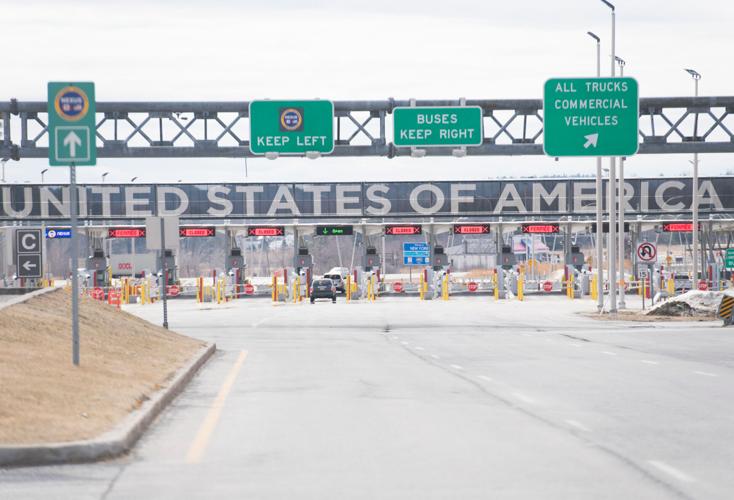


The last time Paul Doroshenko was in the United States for longer than a day was more than nine years ago. The Vancouverite has no plans to return anytime soon.
The lawyer was in Arizona in 2017 for a trade conference that coincided with President Donald Trump's first inauguration. He saw the swearing-in on a television in the hallway.
Since Trump's second inauguration, Doroshenko said he felt "very concerned" by the administration's stance on diversity, equity and inclusion, detainments and rhetoric about the U.S. taking over Greenland and Canada.
"All of these things come to play, and it is, in fact, political, but we also hear of Canadians being detained, Canadians locked up in immigration detention, Canadians facing Americans talking about the '51st state,'" he said. "It’s insulting and offensive and not the way you treat your neighbor or business partner."
People are also reading…
He said he canceled all U.S. vacations until there's a "significant shift."
Canadians were once the U.S.'s largest group of international travelers, but recent data shows a shift as some turn away from the U.S. based on values and a weakening Canadian dollar.
According to Statistics Canada, 1.1 million Canadians returned from the U.S. in February 2026 — a drop of 13.25% from 1.41 million in February 2024.
A Toronto University study published in May analyzed cellphone data. Comparing the time frame of April 1, 2024, to March 31, 2025, to the period from April 1, 2025, to March 31, 2026, it found a median 42% decline in Canadian visits to the U.S.
Many travelers from the Great North choose other destinations they feel more aligned with, welcomed to and even safer in.
Shifting attitudes
Doroshenko traded a trip to Florida for a trip to the Dominican Republic, and his wife and children canceled a visit to Disneyland and went to Europe. He skipped conferences and trade shows in the U.S. but will attend a gathering in Mexico. He also explored more of his home, British Columbia, than he has in the past decade.
This summer, more Canadians will lean into domestic travel, where shorter, closer trips give them more bang for their buck, according to Expedia's Summer Travel Outlook. The most popular domestic destinations for Canadians this summer are Toronto, Vancouver and Montreal, based on the platform's lodging searches from Jan. 5 to April 5, for travel between June 1 and Aug. 31. Europe's Paris, London and Rome are the top international destinations.
U.S. Travel Association data shows overall foreign nationals visits to the U.S. dropped 5.5% last year, driven mainly by fewer Canadians.
That amounted to a 2.4% loss in inbound travel spending revenue. Canadian travelers spend three times as much on their U.S. trips as Americans do.
Homeland Security Secretary Markwayne Mullin recently floated the possibility of ceasing customs and immigration processing of international travelers and cargo at major airports in "sanctuary" cities such as Denver, New York and Los Angeles. Industry organizations opposed the proposal; Airlines for America said reduced staffing at major hubs would have a "devastating effect" on U.S. tourism and the airline industry.
The latter half of the year could see some recovery with major events like the FIFA World Cup 2026 drawing more travelers — including a projected 21% increase in Canadians. The Trump administration temporarily suspended a visa bond requirement for World Cup ticket holders. But that depends on "policy conditions, global sentiment and geopolitical stability," the organization said in its spring U.S. travel update.
Past the divide
Some Canadians say they still feel welcome in the U.S. and human connection matters more.
Sharon Wickham, who lives in Alberta, continues to visit the U.S. She mainly comes to cowboy-mounted shooting competitions with her horses and said she enjoys meeting "like-minded" people. As long as her paperwork is in order, she said, she hasn't had trouble at the border.
"Those boycotting traveling to the U.S., I believe, are missing out," she said.
Winnipeg-based Carla Foley also still sojourns to the U.S., mainly as a snowbird. She recently spent three weeks in Arizona and heads to New York in June.
Trump's rhetoric about Canada's sovereignty and the trade wars felt "disheartening," she said, but that was outweighed by pride for her country: "We're very strong, and Canada to me will always be Canada."
The small-business owner encourages Canadians to consider who is affected by boycotts: "You're not hurting Trump and you're not hurting people who have billions of dollars. You're just hurting those little small businesses that relied on you coming down every year to support your little town or whatever it is."


