

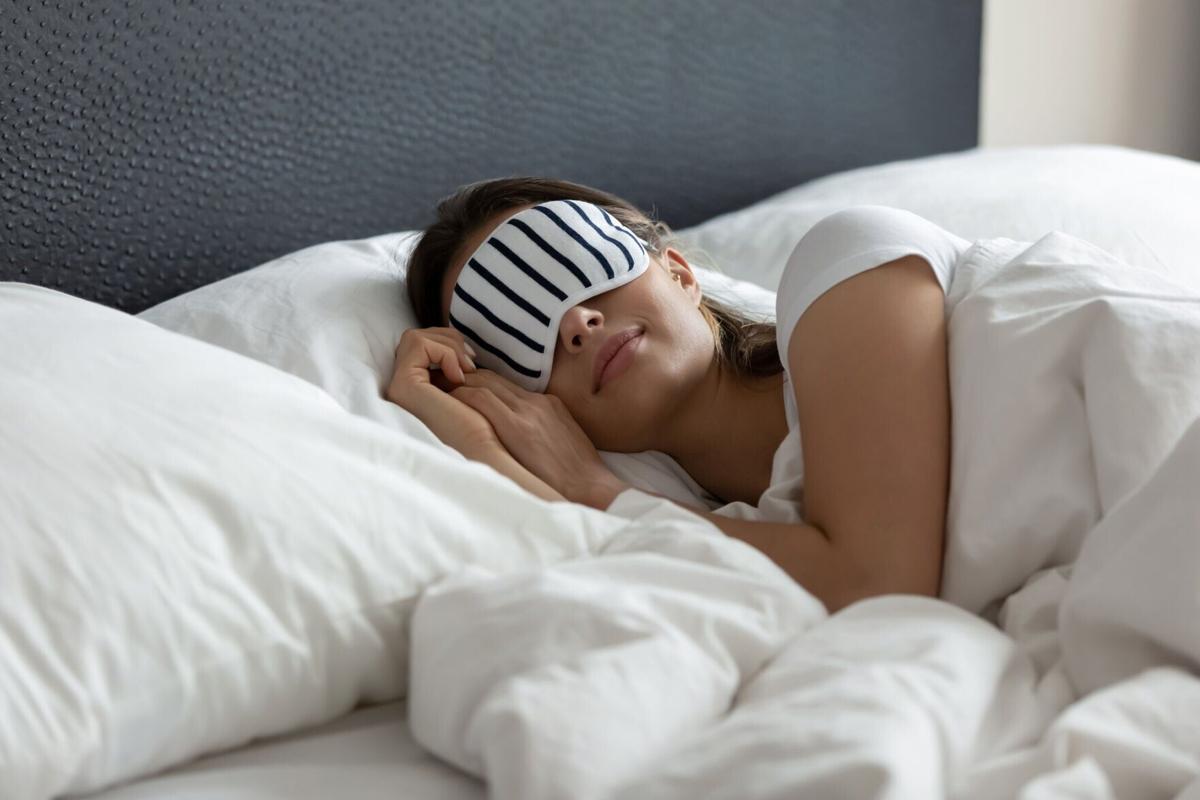
Here’s a disturbing fact: A third of U.S. adults fail to get the recommended minimum of seven hours of daily sleep. As many as 70 million Americans experience chronic sleep disorders or disturbances, with 20% of those reporting daytime drowsiness.
And although I don’t have equivalent statistics, I’m almost certain that they are worse when people are traveling. And it’s not just jet lag.
Other than bringing ear plugs and an eye mask, here’s what to do about it, whether you’re staying in a hotel, flying, or cruising.
Cool, dark, quiet
Three things are essential in choosing hotel accommodations. While air conditioning can be taken for granted at most hotels these days, you also need a dead quiet room with floor-to-ceiling blackout drapes that obliterate any trace of light.
People are also reading…
Even the slightest crack between the window and the drapes can be a problem.
When I think of pitch-black hotel rooms I think of Las Vegas. Maybe because of the desert environment — blinding light, intense heat — the Bellagio, the Cosmopolitan, the Vdara, the ARIA and others offer thick pitch-black drapes that help keep rooms cool and dark. So I spoke to Nicole Fournier, VP of Interior Design at MGM Resorts, to find out how they manage this so consistently. As I suspected, it is no accident. “We have very strict drapery standards,” she told me. “In addition to drapes our windows have blackout liners, and on windows where the drapes meet in the middle we use a ‘bypass’ drapery system that overlaps them by five inches so there’s no light gap.” Wherever light can sneak in—whether at the top, bottom, or sides of the window—extra care is taken to defeat light-creep. “Vegas is a 24/7 town,” she said, “and our guests need to rest and recharge to enjoy it all.”
But it’s not just about blackout drapes and cool, quiet rooms. Here are some other ways to sleep better while traveling.
Bring your own pillow
This is key. I once asked Eileen Ford, founder of Ford Models, what her number one travel tip was. “I always advise my girls to bring their own pillow when they travel,” she told me, “because they’ll sleep better which means they’ll look better.” Your pillow is too bulky to lug on a plane, you say? Then bring a travel-sized version with the same composition and firmness as your favorite one at home. It’s my number one tip to sleep better when traveling, and I never leave home without mine. You can find travel pillows at a reasonable price from Royal Pillow in Miami (royalpillow.com ). Their 16-by-20-inch travel pillows, in a variety of firmnesses, start at $14.95.
Other sources of light
Sleep-disrupting light doesn’t just come through windows. There are the annoying LED and other lights constantly blinking in the modern hotel room, starting with the clock radio, if there is one, right by the bed. (Pro tip: just unplug this varmint. Not only does it shed light but there’s no telling if the previous guest set the alarm for three in the morning).
Anything else that emits even the smallest amount of light either needs to be unplugged or taped over (yes, the sleep-obsessed bring duct tape when they travel) such as the room’s thermostat control, TV, smoke detector (cover just the blinking light, not the device’s sensors), or anything else with annoying LED standby lights. Just remove tapes when you check out please.
Even the best window drapery cannot defeat the light sneaking under the door from the hallway. Place a towel along the floor to block this insidious intrusion. Better still, book or ask for a room with a foyer and second door between the room and the corridor, more likely in older, upscale hotels. This genteel architectural detail provides both light and sound insulation.
Choose the right room and floor
Always request a room at the very end of the corridor and at the top of the hotel. The farther away from the elevators and foot traffic, the less chance of noisy neighbors careening past your room in the middle of the night.
Beware conventions and groups
Always ask if there’s a convention or large group in the hotel during your stay and what floors they’re booked on (do this when you reserve). Groups tend to get rowdy, like the gaggle of teenagers (where were the parents?) celebrating someone’s Sweet 16 literally all night, mostly in front of my hotel room’s door.
Courtyard and windowless rooms yes, connecting rooms no
If the hotel has rooms overlooking an interior courtyard, such as at Boston’s Fairmont Copley Plaza or New York’s Sherry-Nethlander, book them. You’re less likely to hear sirens and other street noise, and they’re often cheaper. Who cares if there’s no view? You’re there to sleep.
Or try a windowless room. The Standard Hotel in London, for one example, offers these (look for the “standard king interior category”). Search online for “hotels with windowless rooms” for more ideas. They provide the ultimate in quiet and darkness, often at bargain prices.
But avoid rooms with connecting doors to an adjacent room. Unless you actually want to hear whatever is going on next door.
Book older hotels
Those built in the last century or earlier. They often have thicker walls. But make sure the windows have been updated to reduce street noise. Options such as the Hotel Marcel in New Haven and the Westgate New York Grand Central have been fitted with triple-paned windows that keep rooms both quiet and cool.
Sleeping better when flying
It’s often hard sleeping on a long overseas or red-eye flight, even if you’ve booked one of those pricey lie-flat seats. Planes are noisy, even the most luxe seats are worse than your bed at home, there’s turbulence to jolt you awake, the air is as dry as a desert and you’re flying at an equivalent cabin altitude of 8,000 feet (you’re basically on a mountain). If you’ve tried to sleep at high altitude when skiing or hiking I’m sure you’ve experienced weird dreams and restless sleep. That’s because it’s harder to breathe at higher altitudes and less oxygen to the brain (hypoxia) changes normal brain activity.
Fly a Boeing 787 Dreamliner or an Airbus A350
On these planes the cabin interior is pressurized at 6,000 feet, 2,000 feet lower than on other aircraft types. It makes a huge difference on longer flights, especially if you have breathing issues to begin with.
On older airplane models the cabin humidity is typically 5-10%, actually drier than a desert. The resulting dehydration inhibits rest on longer flights as thirst and dry mucus membranes (torture for contact lens wearers) take their toll. The 787 and A350 keep cabin humidity higher — up to 25%— than on older planes, making for a much more restful flight.
Choose a window seat over the wing
Because you can control the window shade and you can rest your pillowed head against the cabin wall, plus over-wing seats are more stable if there’s turbulence (think of a plane as a seesaw with the wing at the fulcrum).
Sleeping on a cruise ship
Many of the same tips for hotel rooms (dark, cool, quiet) apply here as well, except that it’s best to choose a cabin in the middle of the ship and as far down below as possible if you’re prone to sea sickness. As with a plane, think of a cruise ship as a giant seesaw with the fulcrum in the ship’s middle (horizontal movement) combined with an upside-down pendulum (vertical movement) with the fulcrum at the ship’s lowest deck. There’s less movement at the fulcrums so you’re less likely to get tossed around in rough seas. Bonus: these cabins are likely to be far away from discos, theaters, and other noisy public areas. Plus, they’re much cheaper than the ones at the top and front of the ship. That said, most cruise lines do a good job keeping cabins dark and many have windowless interior rooms.
Even with the best planning, sometimes sleep is elusive. One thing I will advise: especially in a hotel, whether it’s a budget property or a five-star, if you sleep poorly because of faulty air conditioning, raucous neighbors or any other reason within the hotel’s control, demand a refund for that night’s stay. I’ve done this more than once (for example: those Sweet 16 girls), marching down to the front desk in the middle of the night, preferably, to emphasize that my sleep was indeed interrupted, without changing out of my pajamas.
______


