At the President's House, an early residence used by Presidents George Washington and John Adams, an outdoor exhibit examines what the National Park Service describes as "the paradox between slavery and freedom." It centers the lives of enslaved people, including Oney Judge, a woman enslaved by George and Martha Washington, who escaped in 1796 and remained free despite efforts to recapture her.
In January, the National Park Service removed slavery-related panels from the site after President Donald Trump last year issued an executive order directing federal agencies and cultural institutions to review and revise programs it says promote "divisive ideology."
People are also reading…
Administration officials say the changes restore balance to institutions they say focused too heavily on America's injustices while critics say they narrow discussion of slavery and race.
The Philadelphia move triggered a legal battle and a federal judge ordered the panels' restoration in February. Then, a federal appeals court ruled last month that the Trump administration could remove and replace the exhibit.
Alan Spears, senior director of cultural resources at the National Parks Conservation Association nonprofit, said the controversy's implications extend beyond Philadelphia, raising questions about whether historic sites can offer uncensored interpretations.
“When you take down those panels, you are sanitizing, softening, whitewashing and erasing American history," Spears said.

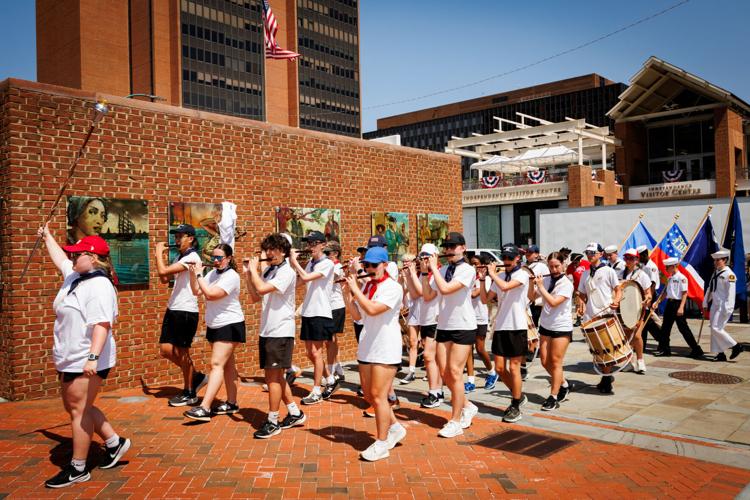
People celebrate with the Red, White & Blue To-Do Pomp & Parade marking the 250th anniversary of the signing of the U.S. Declaration of Independence on Thursday at the President's House Site in Philadelphia, Pa.
As the United States marks its 250th anniversary this year, the debate over historical inclusion is part of a larger national argument over how the country should tell its story: as a celebration of founding ideals and national achievement or a more nuanced reflection that includes slavery, Indigenous dispossession, immigration, exclusion and the struggles of marginalized groups to secure the rights promised in the nation's founding documents.
Museums, historic sites, parks and cultural institutions across the country spent years preparing events intended to draw millions of visitors during the semiquincentennial. But those plans became entangled in a broader fight over historical memory, patriotism and political power.
In Florida, the Stonewall National Museum Archives and Library, one of the nation's leading LGBTQIA+ archives, faces pressure of its own.
Stonewall President Robert Kesten said funding losses could limit efforts to preserve and share historical records as corporate and private donors become more cautious about supporting organizations they view as politically controversial. The museum expects to lose between $70,000 and $90,000 in county grant funding by the end of the year. Kesten attributed the cuts to Florida Republican officials opposed LGBTQ+ inclusion.
The museum's current exhibit features Baron Friedrich von Steuben, the Prussian military officer who helped transform George Washington's Continental Army during the Revolutionary War. Historians debated his sexuality, but some scholars and LGBTQ+ advocates cite him as a possible prominent gay figure in the nation's founding.
Kesten said U.S. history disproportionately skewed toward the stories of white, Christian and heterosexual men. “And if you are anything else, you are expendable.”’

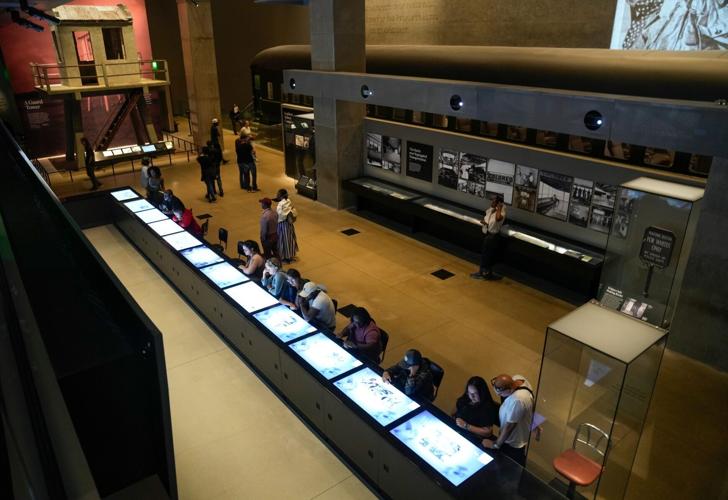
A guard tower from Angola Prison stands in the background at the National Museum of African American History and Culture. The prison, which was referred to as the “the bloodiest prison in the South,” originated on a plantation and cells were located on old slave quarters.
Historians, museum leaders and cultural advocates told Reuters the federal push risks narrowing the range of stories that museums and historic sites are able to tell.
Meanwhile, museums that offer more full accounts of American history remain major draws. Last year, the Smithsonian's National Museum of African American History and Culture in Washington, D.C., drew 1.4 million visits, while the National Museum of the American Indian drew more than 620,000.
The Smithsonian Institution did not respond to a request for comment on whether its museums altered exhibits or curatorial work to comply with response to Trump's order.
The National Museum of African American History and Culture said its programming for the 250th anniversary will "explore the nation's pursuit of a more perfect union."
“History is remembering the full scope of the past, whether it supports or undermines a political goal,” Howard University history professor Ibram X. Kendi said.
Meanwhile, new application language for federal African American history and culture museums grants led many to forgo applying, according to John Dichtl, president and CEO of the American Association for State and Local History, potentially leaving some longstanding museums with uncertain finances.
The Institute of Museum and Library Services, a small federal agency that distributes the grants, now welcomes projects that "foster in all generations a greater appreciation … through uplifting and positive narratives of our shared American experience."
"It makes one wonder what was pushed out of the way to make room for that," Dichtl said. The Institute of Museum and Library Services did not provide a comment.

Administration pushback
Administration officials rejected accusations of historical erasure, saying the goal is not to eliminate difficult chapters of the American story but to restore greater emphasis on the nation’s founding ideals, including freedom of religion and speech.
The White House-backed Freedom 250 initiative promoted patriotic education and public programming tied to the nation's founding through a public-private partnership organization.
Its “Freedom Trucks” — mobile museums housed in tractor-trailers — traveled the country with exhibits on the Declaration of Independence, George Washington and the Revolutionary War, with limited inclusion of slavery and experiences of minorities in the founding era.
“Our role is to integrate different initiatives so Americans can celebrate through one connected experience,” Keith Krach, CEO of Freedom 250 said in a May interview with Reuters.

Clifford Murphy, director of the Smithsonian Center for Folklife and Cultural Heritage, said the institution's work around the 250th anniversary is rooted in presenting American history as both celebration and reflection, even amid broader debates over historical erasure.
For many historians and academics, the concern is not the celebration of the founding era but what they believe is left out.
Kimberlé Crenshaw, a law professor and scholar who helped shape critical race theory, said public institutions risk encouraging celebration while minimizing harms caused by policies and systems that helped shape the nation.
“If our mainstream institutions are not going to critically engage with our past, then we have to ask: What is your role in this democracy?” Crenshaw said.

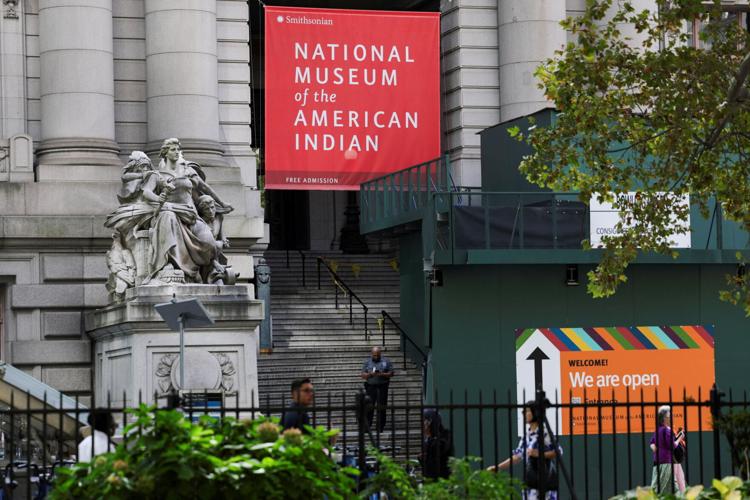
The National Museum of the American Indian is seen Sept. 30 in New York City.
'Dark history'
Ann Burroughs, president of the Japanese American National Museum, said preserving difficult history is essential, noting more than 120,000 people of Japanese ancestry — most U.S. citizens — were incarcerated during World War II. She called the camps “a very dark part of American history” and said the museum has not changed its programming under Trump’s order and since refused to apply for federal grants.
"It (Japanese American history) tells the story of confronting the truth about race and why it's important for us to stand up against authoritarianism," she said.
For Indigenous communities, advocates say their history was long marginalized in American classrooms and public memory, often reduced to textbook mentions around Thanksgiving.
“This has been a continuum of failure, but even more so now,” said Joshua Arce, president of the Partnership With Native Americans nonprofit.