

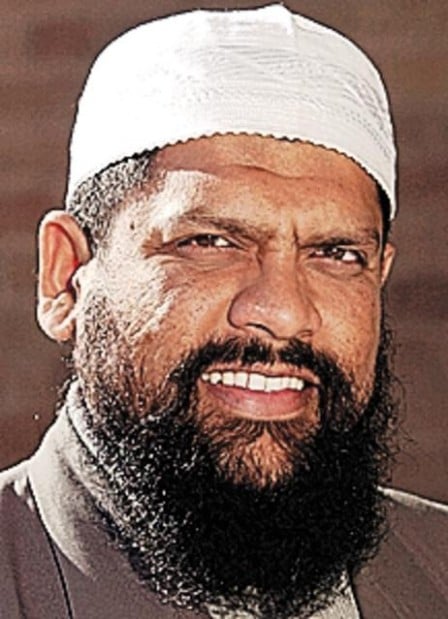
For the third time in three years, Tucson's largest mosque is without an imam.
Officials at the University of Arizona-area Islamic Center of Tucson, 901 E. First St., have confirmed that Mohammed Elfarooqui has quit after less than a year in the position. The 38-year-old native of India left for personal reasons, said Maqsood Ahmad, chairman of the center's board of trustees.
Mosque officials spent more than a year and a half looking across the country for an imam after Jordanian Omar Shahin left abruptly in June 2003 following three years in the job. A replacement for Shahin, an imam from Nashville, Tenn., was hired in late 2004, but he backed out at the last minute. The national search resumed, and Elfarooqui was hired in March 2005.
"It's not that easy to find an imam that can take care of a community as diversified as Tucson," Ahmad said. "Our mosque serves 30-plus nationalities. Tucson is unique — it is a good-sized town but has only one major mosque."
People are also reading…
The Islamic Center of Tucson, a Sunni Muslim mosque, has about 1,200 worshippers. For now, members of the mosque are leading daily prayers.
The mosque has an independent search committee, and an active, national search is under way for a new imam, Ahmad said. The job pays $50,000 to $60,000 per year, and mosque leaders say they're looking for someone with a command of both English and Arabic, a college degree — preferably from an Islamic institution — a thorough knowledge of Islamic prayer and a willingness to work with the local community. Also, imams must be male.
Ahmad, who is not on the search committee, said mosque leaders do not have a preference on whether the imam is American-born or not, though candidates must be legal U.S. residents.
"In our religion, we don't have to have a fixed imam. The reason we are needing one is to take care of day-to-day activities, especially questions that come up in the community," Ahmad said. "This mosque did not have an imam for 20 years of its existence — not until 1990. We just had members leading the services. It's a very simple religion — five times of prayer every day."
Ahmad said the local mosque in particular needs a leader who can help with Muslim youth programs and can represent the Muslim community in interfaith relations. He expects a new imam will be hired sometime this year, possibly within the next month or two.
About 8,000 Muslims live in the Tucson metro area, less than 1 percent of the local population. According to the Macdonald Center for the Study of Islam and Christian-Muslim Relations at Hartford Seminary in Connecticut, there are about 1 billion Muslims worldwide, approximately 4 million of them in the United States.
● Muslims are concentrated in a wide area that stretches halfway around the world — across West and North Africa, through the Middle East and into Turkey, Iran, Iraq, Afghanistan, Pakistan and other Asian countries, parts of the former Soviet Union and western China, Indonesia and the southern Philippines.
● Tucson has three mosques. The Islamic Center, composed mainly of Sunni Muslims, is the largest.
● The five Pillars of Islam are: affirming that there is only one God, and Muhammad is his Prophet; praying five times a day; giving alms; fasting from dawn to dusk during Ramadan; and performing the hajj, the pilgrimage to Mecca, Saudi Arabia.
● Nearly 20 percent of the world's population follows Islam.