

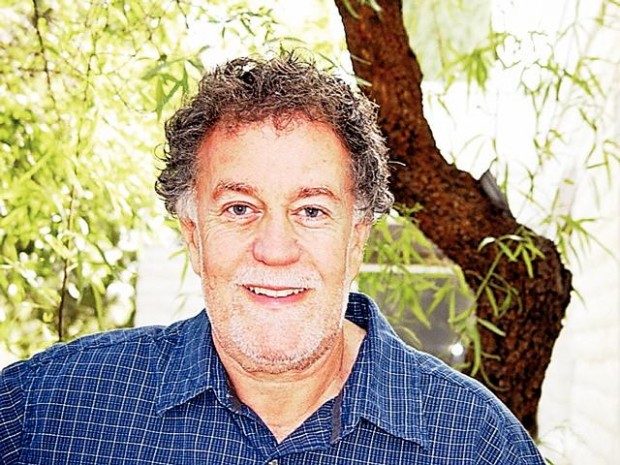
He turns 70 this month, but author, relationship guru and renowned spiritual counselor Hugh Prather isn't slowing down.
In addition to working on a "dictionary of mistakes," he's writing a novel with his wife, Gayle, about a refrigerator that comes to life and tries to save the marriage of a young couple.
Prather and his wife have lived in Tucson since 1990. Before that, they lived in Patagonia for several years.
"I love Tucson. I love the fact that no matter how old you get, there's always someone older, usually driving right in front of you," he said.
"It's an easy place to grow old. There's a relaxed, accepting mind-set. We just like the whole atmosphere. We've lived in places that were perhaps more beautiful but, I don't know, it just has an ease about it."
This Sunday, Prather will speak at all three Sunday services at St. Francis in the Foothills United Methodist Church. He'll deliver a sermon titled, "Chocolate: an Epiphany."
People are also reading…
The Arizona Daily Star spoke with Prather Wednesday and asked him 10 questions:
1. What does chocolate have to do with the religious observance of Epiphany?
In that title, I'm using the word "epiphany" in the conversational sense — as when someone has an "aha" moment.
2. Do you consider yourself religious?
Yes. Gayle and I were resident ministers at St. Francis for about 10 years. We did services and held classes. We still go to St. Francis, though not as often as we should. Before that, when we lived in Santa Fe, N.M., we founded The Dispensable Church.
It was a wonderful all-volunteer organization. When the collection basket was passed, you could either put money in or take it out.
The church motto was, "Your purpose as a teacher of God is to make yourself dispensable."
We kept our promise. When we felt the church had served its purpose, we dispensed with it.
3. Do you think organized religion still has a role in our society?
It can certainly play a crucial role in an individual's life. In that sense, there are many viable religions, and if sincerely practiced, they can give anyone the life-changing experience of the divine.
Organizations, on the other hand, tend to take on a life of their own and sometimes end up having very little to do with God.
4. Have you read any of the current anti-religion books that are on the market, such as "God is Not Great" by Christopher Hitchens, "The God Delusion" by Richard Dawkins" or "Letter to a Christian Nation" by Sam Harris?
I have seen these individuals interviewed, and I think that in some ways they are missing the point.
Many Buddhists, for example, don't believe in a creator, but they do believe in a transcending spiritual experience.
Anyone who has faith in the possibility of love and peace will eventually experience a reality greater than themselves. Once that happens, they no longer feel the need to argue about the existence of God.
5. Your first book, "Notes to Myself," has sold more than 5 million copies since it was published in 1970. Has your perspective changed since then?
I can see the antecedents of my core faith in that diary, but I think I was a little too self-absorbed. Hopefully, I have come to better understand that it's our inner connection with others and not just our inner awareness of a separate self that brings us a truly satisfying life. Unless we feel our sameness, our oneness, life is very difficult.
6. Was the popularity of the book a surprise?
It was so surprising that I didn't really believe the numbers I was seeing.
The publisher was a California couple that had only published two other books, ran no ads and had no sales force. It took three years for it to work its way into stores in the North and East.
Unfortunately, most publishers today are not willing to give a book that long to catch on.
7. In "Notes to Myself," you write about love and detachment in relationships. What do you mean by "detachment"? Is it possible to be in a relationship and still be detached?
I believe that a part of our mind, what most call the ego, remains separate and detached. But that part actually works against our experience of oneness. The other part of our mind is already connected.
The success of a relationship depends on which part we choose to emphasize. To have a real relationship, we have to see our partner directly.
As long as we filter all our perceptions through our past, we don't experience the sheer joy and freedom that acceptance brings.
8. Have relationships changed a lot since you first began writing about them?
Gayle and I and our two boys lived in Patagonia from 1984 to early 1988. During that time, we did no relationship workshops or classes.
When we started teaching and counseling again in the late '80s and early '90s, we realized there had been a profound change in people's attitudes.
Now there was a profound, almost universal fear of getting in the wrong relationship and losing one's self. The new "separation psychology" fed and continues to feed this fear. We wrote about this phenomenon in "I Will Never Leave You."
9. Are you working on any books right now?
Yes, a dictionary of mistakes. We all know well the mistakes we keep making, but it's also interesting that almost anything considered to be a virtue can become a mistake if taken to an extreme. For example, honesty. Honesty can be incredibly hurtful and unhelpful.
10. Any books planned for the future?
We've begun outlining a novel about a refrigerator that comes to life. A refrigerator is an interesting symbol of ourselves and our mind. Things tend to get pushed to the back of shelves where they grow mold and become toxic.
We need to stay aware of what is in our mind and to keep it cleaned out. A simple mind is a good thing. In the novel, the refrigerator belongs to a couple going through a hard time, leaving nasty notes to each other.
The fridge learns how to change the notes. At the same time, the fridge is not perfect. It feels very competitive with other appliances in the house, like the computer and the television.
If you go
Renowned author, speaker and counselor Hugh Prather will be the guest pastor Sunday at St. Francis in the Foothills United Methodist Church for the religious occasion of Epiphany.
Prather will speak at all three Sunday services, at 7:45 a.m., 9 a.m. and 11 a.m. His sermon is titled "Chocolate: an Epiphany" and is expected to focus on the experience of unexpected insights and how to they can be used at the start of a new year. St. Francis in the Foothills is at 4625 E. River Road, on the northwest corner of Swan and River roads.
The biblical story of the Epiphany is in Chapter 2 of the Gospel of Matthew in the New Testament. The story says the Magi — wise men — came from the east and followed the star in search of the newborn king. Because the Magi apparently arrived after Christ was born, the date of Jan. 6 was adopted for Epiphany in about the fifth century.