

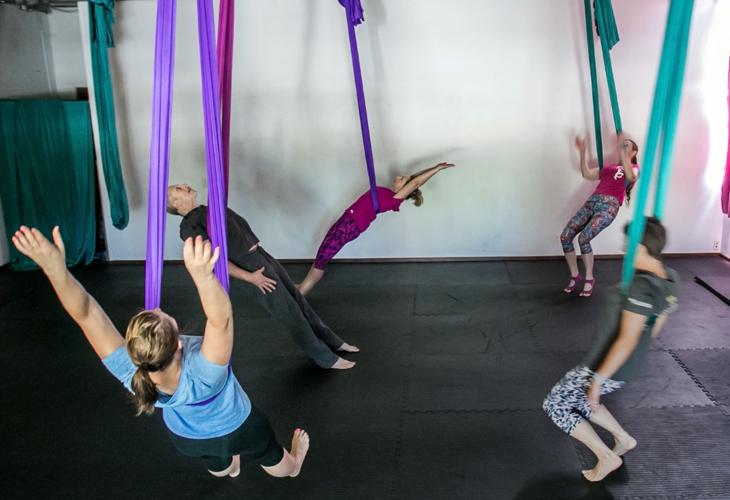
Yoga has taken flight in Tucson.
Aerial yoga — sometimes called antigravity yoga — puts you in the caress of a silky hammock that hangs from the ceiling.
You stretch, you flip, you float.
It’s intense. And thrilling.
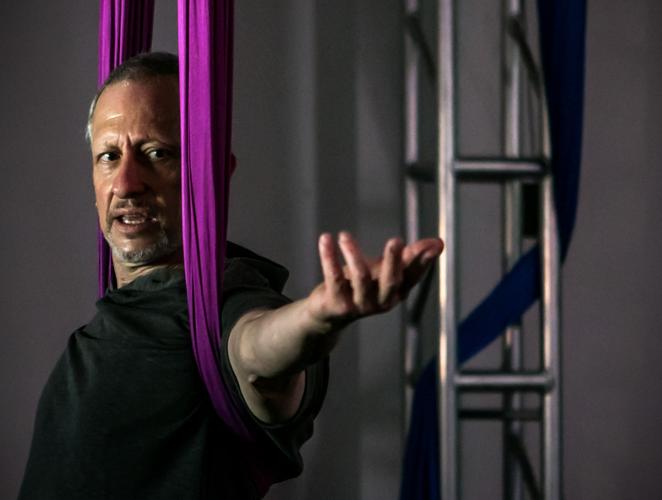
“Yoga feels good,” says Greg Loumeau, 53, who was taking his third class at Take Flight Yoga and Movement. “But the aerial component, being airborne, is always fun.”
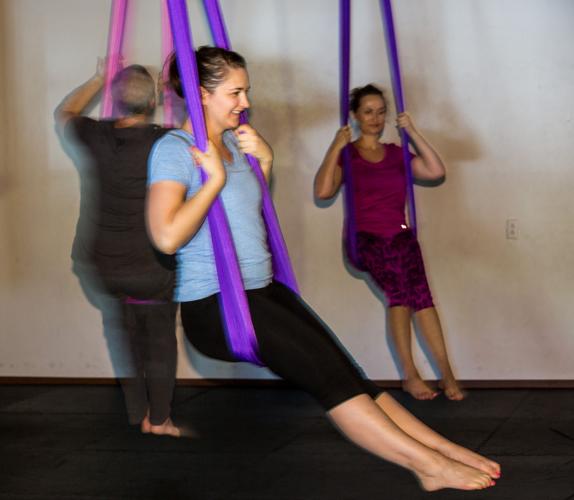
Take Flight is in a corner of a downtown warehouse. Nine colorful hammocks — called silks, though they are actually a high-density nylon that can support up to 2,000 pounds — hang from a high steel grid and float about three feet above the floor, cushiony with rubber mats. Each hammock is secured by webbing straps, carabiners and support chains.
People are also reading…
On a recent Saturday morning, five students filed into the space. Dr. Jack Rosoff, who owns 3-year-old Take Flight with fellow instructor Emily Guindon, stands by a silk in the middle of the cool and dimly-lit room — natural light is filtered through a cloth over a high window.
“We’re going to begin the class the way we’ll end it,” he says, “with savasana.” The yoga pose is a still one, lying on the back, willing the body to totally relax.
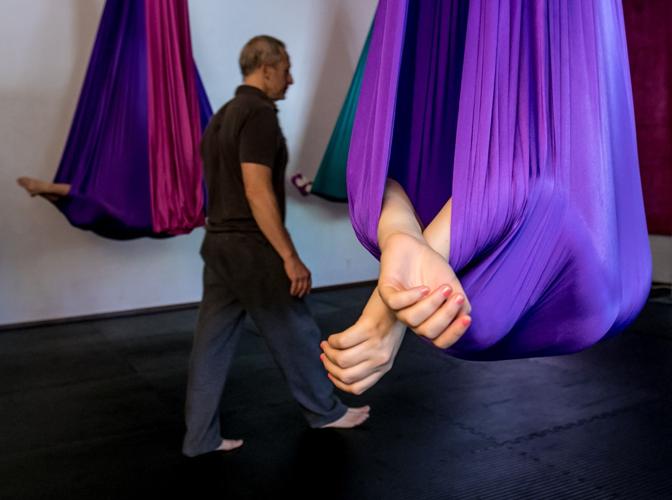
His students know the pose. They gently shake the hammocks so that the material widens. They each hold on to the silks, pull themselves up, and effortlessly jump in, feet first. They lengthen their bodies and lie prone; the material spreads and cocoons them.
“Let go of all of the stresses of the week,” says Rosoff, who is also an emergency-room physician. “Quiet your mind, take a slow, deep breath.”
The room becomes still. The hammocks sway slightly. “Consciously relax,” he says in a soothing voice. “Let your mind wander.”
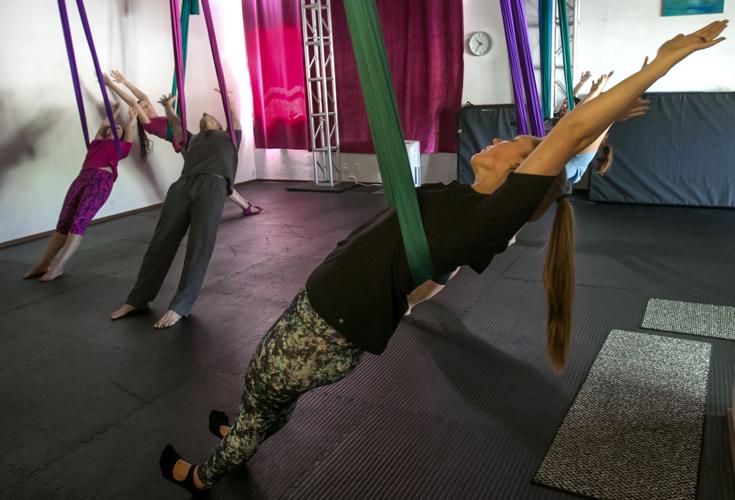
After a few minutes, the more strenuous yoga begins. Rosoff goes through a variety of poses, some done while standing in the hammock (this is a class of experienced students), some while sitting in it, others with feet on the ground. They drape back over a hammock to intensify a back stretch. Slip one leg into the material, and a half-moon pose is deepened. Toward the end of the hour class, just before the final savasana, Rosoff talks the class through the steps to the inversion, hanging upside down from the hammocks. “It opens up the spine,” he says about the pose.
Randi Pantera, a test assessor at Pima Community College, doesn’t wait for Rosoff to talk her through it; she jumps in her hammock and flips herself over.
Pantera, 58, has been doing aerial yoga for about three years.
“One of the huge benefits to aerial is it helps you to develop strength and balance in preparation for basic yoga,” she says. Then she adds, “I think it is amazingly fun. … You feel like a big kid going upside down and it’s so much fun.”
Fun seems to be the operative word for those who have gotten the aerial yoga bug.
“It’s a good workout and it’s fun,” says 29-year-old Jennifer Severson, who has been taking the class with fellow nurse Sarah Zakula since February. Zakula agrees.
But there are other benefits.
“I like the stretches and challenge,” says Zakula, 31. “I like how my body feels after class.”
“I do a lot of work sitting, so my lower back tends to hurt,” says Loumeau, who teaches art at Pima. “I felt relief right away.”
“As a 60 year old, it frees me from pain,” says Rosoff. “It’s both an exercise and it’s therapeutic — more so than anything I’ve ever done.”
To be sure, there is a bit of a learning curve with aerial yoga.
“It was challenging the first time I did it,” says Loumeau. “I had never done anything aerial in my life. By the third time, I felt pretty confident about it.”
“I have a student who took 10 classes to go upside down,” says Rosoff. “She’s worked through her fear slowly. I see that as tremendous courage, and I promote that aspect — courage is doing what you want to accomplish in spite of the fear.”
Contact reporter Kathleen Allen at kallen@tucson.com or 573-4128. On Twitter: @kallenStar

Kathleen Allen
Reporter


