

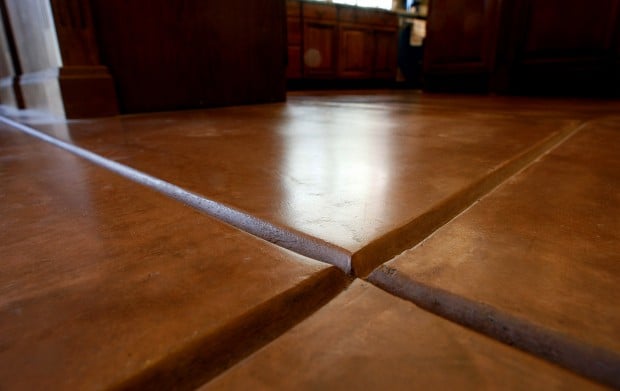
When Patrick Egan came to redo the flooring of his Tucson ranch home, polished concrete was the last thing on his mind. The 1960s home had a brick floor, and Egan's thought was to add travertine tile instead.
Then somebody suggested concrete.
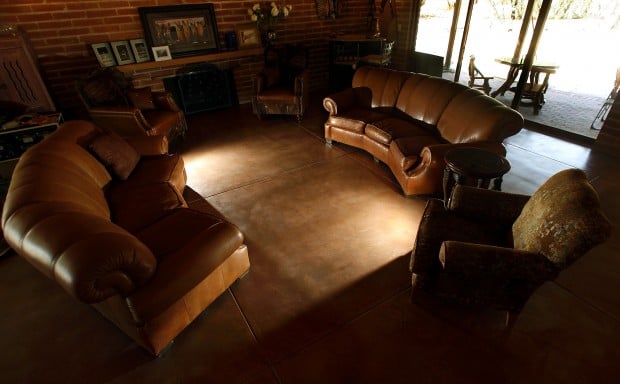
"I thought I'd give it a go," says the automotive dealer, who had his contractors rip out the flooring, including its concrete foundations, and pour a new floor in a reddish brown over the whole house.
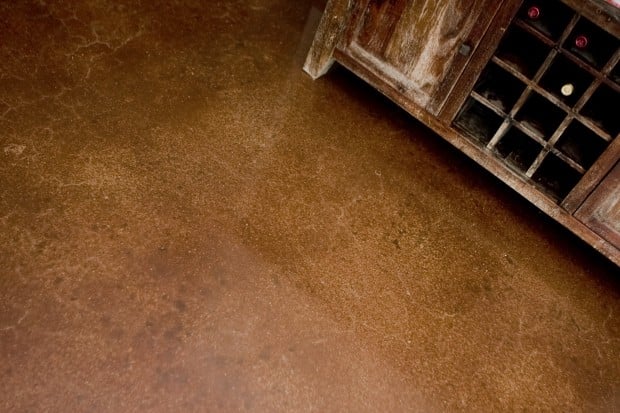
"It gives it a weathered old look," says Egan, "like an old worn saddle".
The result? One more Tucson homeowner converted to a flooring solution that's been popular here for the better part of a century.
Some say famed Tucson architect Josias T. Joesler put colored concrete on the map, but R. Brooks Jeffery, director of the Drachman Institute and coordinator of Preservation Studies at the University of Arizona's College of Architecture and Landscape Architecture, says its origins predate Joesler, to the 1920s.
People are also reading…
"Joesler wasn't a pioneer, but certainly was creative in his use of colored, scored concrete to look like large tiles," says Jeffery.
Whoever the actual pioneers were, they set an interiors trend that's very Tucson. And now customers are playing with some interesting design variations on the concrete floor for ever interesting looks.
"Tucson is ahead of everyone. I don't know why," says Rogo Rodriguez , owner of Rogo's Finishing Touch, who has been restoring concrete floors here since the 1980s.
So what can you expect with a concrete floor? We asked a few Tucson firms for the low-down.
Q: Is it really as inexpensive as people say?
A: It depends what you choose. A simple overlay, which puts a thin layer of concrete over existing tile or concrete foundation, works out at around $5 per square foot or sometimes less - a comparable price to installing decent ceramic tile. Fancier finishes, like diamond-ground concrete or decorative embellishments, run more.
Q: Do you have to pour a new floor ?
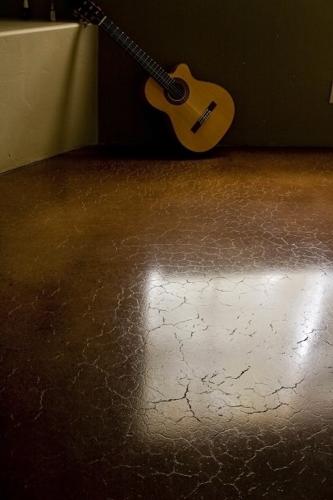
A: No, you can take your existing flooring away and use the home's foundations. Know that there will be cracks in it - it won't be a perfect finish. And if you're not OK with that, consider having an overlay added.
The thickness ranges from credit card-thin (1/16 inch) up to one inch.
If you pour a whole new floor, as in Egan's case, Terry Carson, owner of Benchmark Concrete, recommends having it poured into smaller squares or slabs. At Egan's house, Carson's firm poured 8-by-8-foot squares, which not only gives the effect of tile, but helps prevent cracks.
Q: Can you have an overlay over my existing flooring?
A: On concrete foundations, and on original concrete floors (such as those in many older homes in Tucson), yes. But it won't work on wood, and if you're laying over tile, the tile has to be sturdy with no loose pieces.
"The overlay is only as good as the flooring it's being laid onto," says Troy Wintsch, owner of concrete restoring firm Tile Renaissance.
Rogo's says it adds $1 a square foot for overlay over tile because of the extra cement and prep work involved.
Q: Is installation messy?
A: Surprisingly, it's one of the least messy floorings to install, with just a little dust created. (Rogo's says you can even leave artwork and mirrors hanging in the room. If you're laying concrete over tile, though, extra dust may be created from sanding down the original flooring.
Q: How is the color added? Is it integral to the concrete or not?
A: There are several ways to add color. One is to have color added to the concrete that's being poured - but that only works when you're pouring a whole new floor, as in Egan's case.
The second option is a topical stain. This is troweled on by hand after the concrete has been laid. Then there's acid staining - not so much in favor any more because of the gases it can give off. Wintsch is seeing more use of acetone dye. This gives the look of the acid stain but with less labor.
Q: Are there any special cleaning requirements?
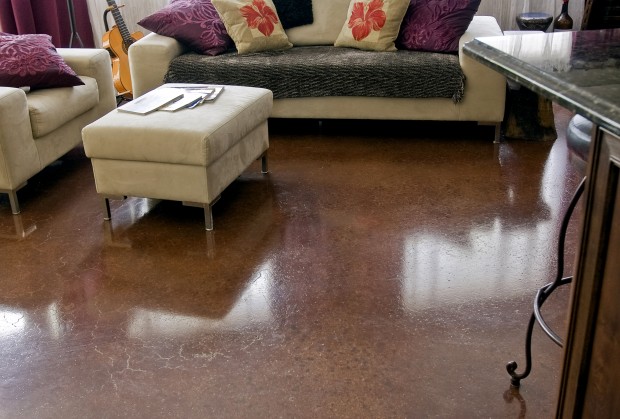
A: It's one of the lowest maintenance floors there are. Although most contractors will recommend cleaning with a solution called 100 SS (a solution with coconut oil that helps maintain polished concrete's sheen), Rodriguez says you can use almost any cleaner on it.
Avoid acidic-based cleaners as they will eat into the concrete, and highly alkaline ones will leave a residue, says Wintsch. The beauty of the 100 SS product is that it doesn't have to be rinsed afterward.
Q: Ground concrete reportedly is the hot new look. How is it different?
A: It's a process where the concrete is ground down with diamonds to expose the aggregate and embedded stones. Add some sealer and polish and the look is an eye-grabber.
"We call it the poor man's terrazzo," says Carson. "You can embed different items in it, like fossils, seashells or coins."
The downside, says Rodriguez, is that no concrete floor is free of cracks, so grinding down the floor will expose them. He has ground concrete throughout most of his own house and loves it. But it's a labor-intensive process, he says, and therefore more expensive than the usual finishes.
Q: What other finishes will make my concrete floor stand out?
A: Wintsch often does a colored border around a concrete floor to hide any cracks or fissures in an original concrete floor. Although he adds that the floors done in the 1930s, '40s and '50s in Tucson are "some of the best quality - there's no one doing that quality of concrete anymore".
You could consider having it scored into tile-look squares or having a pattern etched into it. Tile Renaissance reports that fancy patterns are less popular the last few years because of budget restrictions.
When concrete may be your answer
• In a new home - Have your choice of colored floor poured as part of the build. Or talk to the builder about a more custom finish, like ground concrete.
• In a home with original concrete - If it's cracked or just not looking too hot, have it re-stained and polished, or have an overlay done.
• When you just don't like your flooring - Lift the tile, vinyl and/or carpeting and have an overlay poured for the same cost as decent tile. If the tile is intact, you can have an overlay poured straight over it.
• Using your home's foundations - Remove the existing flooring down to its foundations and have an overlay poured, or have the concrete foundation ground and polished.
Tip
If you're trying to match existing concrete floors, remember that every color is not exactly the same. Rogo's does its best by having a recipe for every house it works on, but the finished color depends a lot on the contractors applying it.
Resources
• Tile Renaissance, 272-0815.
• Benchmark Concrete, 293-1305 or www.benchmarkconcrete.com
• Rogo's Finishing Touch, 295-1818 or www.rogosfinishingtouch.com
• Buy 100 SS at Industrial Chemical of Arizona, 5302 E. Pima St., 327-6331.