

Planting flowering vines is a great way to add color to your landscape.
So many of our properties are surrounded by bare, unattractive walls just begging to be covered with luxuriant vines.
Fences, trellises, arbors and mailboxes also provide vertical spaces to grow and show flowering vines.
Here are some fine vine choices for your home landscape:
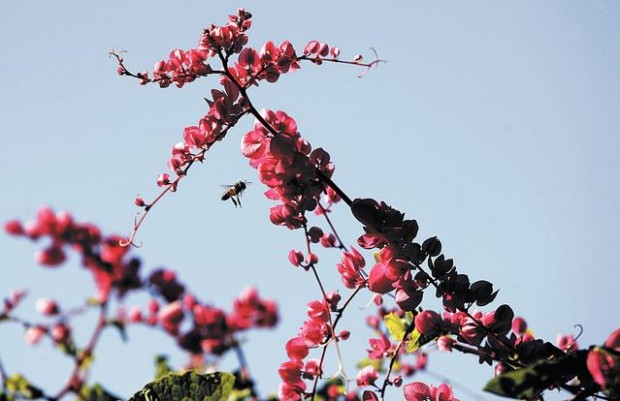
● Coral vine (Antigonon leptopus)
Coral vine is one of the showiest of all the flowering vines. Electric coral-pink flower sprays begin spilling out over its dense canopy of foliage in late August. Blooming continues profusely until the first frost in late November.
Coral vine is deciduous and dies back to the ground during the winter, but, once established, the plant will grow back rapidly from the roots in the spring.
People are also reading…
Not for the faint of heart, coral vine is so vigorous that a single plant can cover a 40-foot section of wall or rocket to the top of a mesquite tree in a single season.
This plant climbs by means of twining vines and needs the support of a lattice or trellis placed against flat wall surfaces, or open-weave fencing.
The only drawback to this vine is that stems and dead leaves must be removed after the vine dies back in late fall.
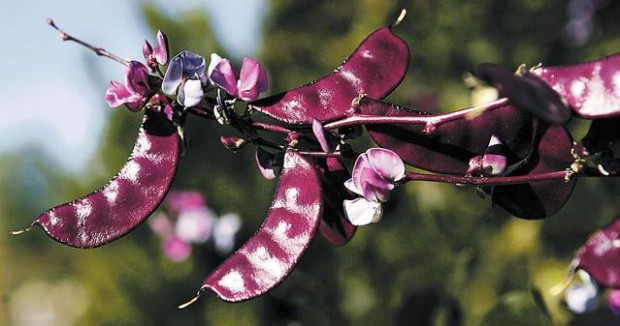
● Hyacinth bean (Lablab purpureus)
Hyacinth bean is another flowering vine for fall color.
Purple, sweet-pea-shaped flowers bloom from late summer to mid-fall and are followed by large, magenta-purple beanlike pods.
Hyacinth bean is an annual vine and is easy to grow from seeds collected from the pods in late fall and planted in garden soil in the spring.
Twining vines grow rapidly to 10 feet, producing large, blue-green leaves in sets of three. As with all twining vines, hyacinth bean needs the support of a trellis, arbor or open fencing to grow over.
No fertilizer is required for this legume — just grow it in full sun and give it ample water to thrive.
● Bougainvillaea (Bougainvillaea spectabilis)
Bougainvillaea is undoubtedly one of the most spectacular of all flowering vines. Modified leaves at the branch ends turn fluorescent red, pink or purple. Bougainvillaeas have so many flowers that the leaves can hardly be seen.
This heat-loving plant grows well leaning against a fence or a wall, or with the support of a trellis or arbor. It can also be trained into a free-standing shrub.
Native to Brazil, bougainvillaea needs the warmth and protection of a south-facing wall for winter protection here in Tucson. The red-blooming variety named Barbara Karst is the most cold-hardy.
Bougainvillaea roots are delicate and should be disturbed as little as possible when planting. Water moderately to establish but don't overdue. Leaves yellow when over-watered. Once the plants are established, apply rose food once or twice a year to keep plants blooming nearly nonstop.
● Pink trumpet vine (Podranea ricasoliana)
Pink trumpet vine is adorned with spectacular, large trumpet-shaped pink flowers with red veins set against glossy dark-green leaves. Flowers appear in clusters in summer and again in fall.
The plant's small size (10 to 15 feet), lends itself to confined garden spots.
Pink trumpet vine should be planted in warmer locations. Tops will freeze back at around 25 degrees, but the plant recovers quickly from the roots in the spring. Once established, trumpet vine is moderately drought-tolerant. Good drainage is a must.
Other vibrant vines to consider include: purple hardenbergia (Hardenbergia violacea), yellow carolina jessamine (Gelsemium sempervirens) and orange-red trumpet vine (Campsis radicans).
● John P. Begeman is the urban horticulture agent for the University of Arizona-Pima County Cooperative Extension. If you have questions, call 626-5161 to reach a master gardener.
Gardening
Advice by John P. Begeman
» No garden classes
There will be no gardening demonstrations the remainder of November and the month of December. Classes will resume Jan. 3. Answers to gardening questions may be obtained by phoning the Extension Center Plant Clinic weekdays in the Tucson area at 626-5161, or in Green Valley at 648-0808.