

Q: I have a cane that was given to my great-grandfather by President Abraham Lincoln. The black cane is 37 1/2 inches tall. The handle twists off, and inside are four clear glass vials with plastic lids that snap on. I want an appraisal so I can sell.
— Eugene, Tucson
A: Abraham Lincoln's term as 16th president of the United States was 1861-65. Contemporary plastic had not yet been invented, and certainly not as Tupperware-like snap-on lids.
My diagnosis is a clear case of family lore. Somewhere down the line, someone in the family linked the stick to Lincoln. It is nowhere near that old.
Your walking stick is most certainly a copy of a gentleman's gadget cane. Variations on old sticks (their heyday was the mid-19th century) with hidden inserts included concealed knives, guns, seats, fans, coat hangers, musical instruments, swords, telescopes, candles, lighters — you name it. One charming variation is the spitting cane. Others had materials for administering last rites.
People are also reading…
In 1995, collector and consummate gentleman Francis H. Monek wrote "Canes Through the Ages" (Schiffer, $79.95). It remains the best book on the subject. Check out the excellent section on gadget canes.
I suggest you forget appraisal and enjoy the family cane for what it is. Value it as a curiosity.
Q: My grandmother gave me this picture of Jesus and Mary. I have seen the picture in stained-glass windows. The frame looks like 24-karat gold. Value?
— Cheryl, Bar Harbor, Maine
A: The pairing appears in church windows because it is a popular religious theme.
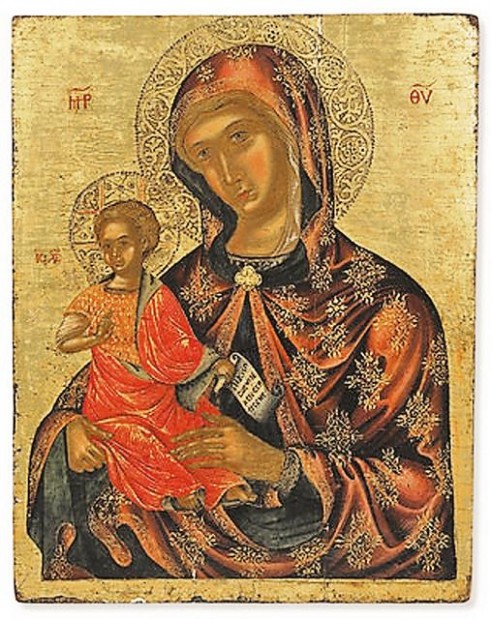
The artwork is in the style of an icon. Today, the word "icon" most commonly refers to a religious image associated with the Orthodox churches, where these objects are a prominent part of religious observance. Icons are not worshipped, but the images hang in houses and churches as objects of faith.
Note the icon shown in the art accompanying this column. The style is typical: The image is painted on wood. Mary is prominent. She holds a manlike baby with an adult face. The poses, dating to the early centuries of Christianity, are stiff and formal. Figures have wide eyes and large heads. There is no eye contact between mother and child, and no artist signature.
Dennis Easter, co-founder of Made in Russia in Palm Beach, Fla., buys and sells 15th- to 19th-century Russian, Greek and Ukrainian icons and religious artifacts. He identified the reader's icon as a print on paper, in its original frame. It is a copy, not an original icon.
In general, Easter said, more than 90 percent of icons are images on wood. Most are painted over gesso and include gold leaf. The finest are painted with tempera on hard woods, using ground jewels as pigments. Some include precious metals with inset jewels. Provincial icons use provincial woods such as birch or linden.
Reproductions and downright fakes abound.
In this case, the print cannot be older than the mid-1960s. Easter pegs value at less than $50. Gold on the frame cannot be 24 karat, as that is pure gold and too soft to work. It is gold leaf or paint.
Danielle Arnet welcomes questions from readers. She cannot respond to each one individually but will answer those of general interest in her column. Send e-mail to smartcollector@comcast.net or write to Danielle Arnet, c/o Tribune Media Services, 435 N. Michigan Ave., Suite 1400, Chicago, IL 60611. Please include an address with your question. Photos will not be returned.
3/4 AUCTION ACTION
A 16th-century "Madre della Consolazione" icon that sold for $47,500 at Sotheby's recently came from the area of Crete. Typical of icons produced there from the mid-15th through the 16th centuries, it is identified stylistically as Veneto-Cretan. Painted on wood, the icon measures 21 inches by 16 1/2 inches.