

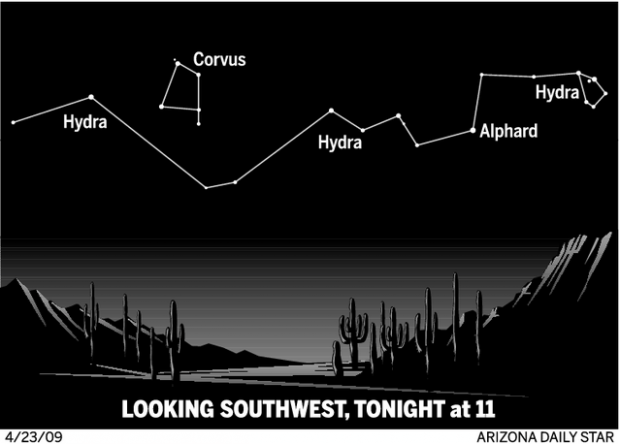
Now is a good time to see one of the largest yet least recognized constellations in the northern skies, because the moon will be new Friday and out of the late evening sky for a few days.
Hydra the Water Snake is an ancient constellation that actually resembles what it is supposed to portray.
It stretches nearly completely across the sky when it is fully risen, but it is often not recognized due to its faint stars.
The best time to see Hydra extending across the sky is from 9 to 11 p.m. this time of year.
Look toward the south about a third of the way up from the horizon. Hydra's head is toward the west and is a misshapen pentagon of five stars. The long body stretches from its head in the southwest to its tail in the southeast.
A must-see in Hydra is the bright star Alphard. It can be viewed in fairly light polluted conditions and has a distinct pale orange color.
People are also reading…
Its luminosity is 400 times that of the sun, and it is 40 times larger than the sun. Alphard would be more spectacular if it did not lie at a distance of 175 light-years from the Earth.
While you are exploring Hydra, be sure to look for Corvus the Crow. Corvus is small but bright and easily found.
How Corvus is supposed to resemble a crow beats me. It's an old constellation and was probably added to the sky by the ancients to honor the crow, which is ubiquitous, feisty, often annoying but admirable for its cleverness and durability.