

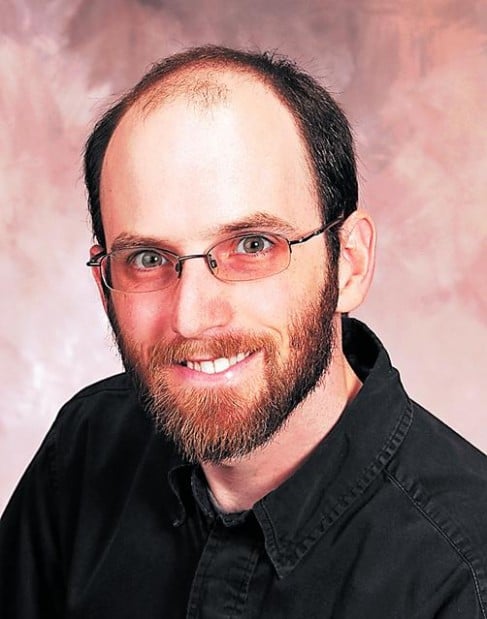
Mike Schmidt is known for a couple of quirky interests that set him apart from your average math teacher.
There's a certain attraction to comic books and all things "Star Trek."
There's the peculiar talent for riding a unicycle with a sink plunger affixed to his forehead.
There's the ability to juggle spherical objects (Come on, he's a high school teacher. Euphemisms are necessary.)
But the University High School teacher now has a new claim to fame, as one of seven elementary and high school teachers selected from across the nation to take a trip into space.
The 31-year-old is the only math teacher in the initial group of would-be astronauts selected by Teachers in Space, an organization that eventually aims to send 200 educators into space every year on private-sector spacecraft. If you nudge Texas into the Southern contingent, he's also the only Westerner.
People are also reading…
The suborbital craft that will take the educators 60 miles above the Earth's surface are still being built. But presumably, in the next two to four years he'll be embraced by the inky black of space and beguiled by stars. And while he won't be able to see the planet in its entirety, he should be able to see the curvature of the Earth.
Each teacher will be responsible for an experiment. In his case, he's interested in studying the surface tension and viscosity of liquid to find out more about how fluid reacts in space.
To prepare for the journey, he's already taken a glider trip to get a feel for non-powered flight, simulating descent into Earth's atmosphere. He also had a chance to go on a stunt flight that performed parabolic arcs in the sky and created, at least for four seconds, near-weightlessness.
The Prescott native said it's a chance to combine his childhood obsession with his chosen profession.
"Every little boy is fascinated with either dinosaurs or astronauts," said Schmidt, who teaches algebra to Advanced Placement calculus. "For me, when I figured out I couldn't really be a dinosaur, I was fixated on being an astronaut."
He still has the bite-sized space camp jumpsuit he wore in fifth grade to prove it.
As teaching became a more practical professional target — his father is a math teacher, his mother teaches science — his old Atari video games were as close as he might have gotten had he not found out about the program from a student and applied.
The premise behind the program is that the teachers will be on the front end of the eventual commercialization and privatization of space travel — something akin to the Kitty Hawk of the cosmos. It remains out of reach for most. Last week Cirque du Soleil founder Guy Laliberte announced he'll be launched into space aboard a Russian spacecraft and will spend a week at the international space station — at a reported price tag of $35 million.
That ain't happening on a teacher's salary.
At any rate, the idea is that teachers returning from space will be better able to inspire their students.
He already teaches students about parabolic arcs, for example, but now he can introduce their role in his flight plan, giving the lesson added relevance for his students.
"One of the big aspects is letting the kids know that I'm going to space — but so will they," he said, suggesting such travel might be as common in the future as commercial air travel is now, and may even be a faster alternative someday for point-to-point international travel.
There is some sensitivity around the venture, given that the program's very name conjures up memories of the 1986 death of teacher Christa McAuliffe when the orbiter Challenger exploded after launch.
"There's some inherent risk, and we all understand that," he said, "but there's also an opportunity to reach a whole lot of kids, combined with the chance for an adventure."
Juggling, alas, might not be part of the adventure. Greg Chamitoff and Richard Garriott in 2008 already claimed the honor of successfully juggling and passing six spherical objects in zero-gravity while on the international space station.


