

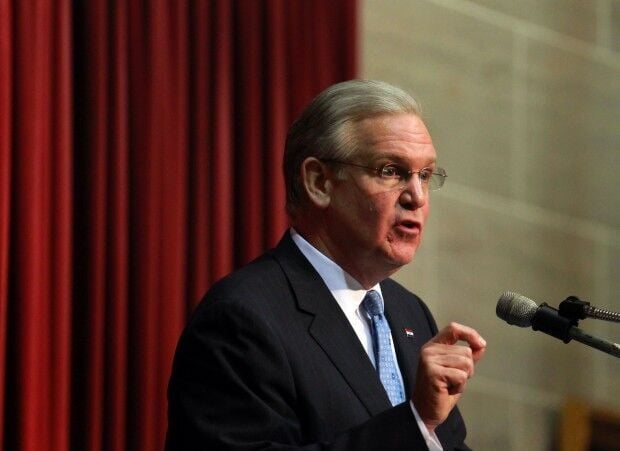
JEFFERSON CITY • Missouri health care providers stand to see a significant boost in payments for treating Medicaid patients under Gov. Jay Nixon’s proposal to expand the health care program for the poor.
The budget proposal Nixon released last week would close a long-standing gap between what Medicaid pays for health care and what providers get on the private market, but it would also add millions to the federal government’s tab for the expansion.
Supporters of the governor’s plan say increased Medicaid payments will encourage more doctors to accept patients from the Medicaid program, as several thousand people enter the system.
Opponents say the plan will increase costs charged to the federal government for implementing the optional provision of the federal Affordable Care Act.
Nixon, a Democrat, made the Medicaid expansion plan a key focus of his State of the State speech, but GOP leaders have largely balked at the proposal.
People are also reading…
“It’s all a process,” Nixon said Monday. “My sense is we’re clearly moving in a positive direction.”
The expansion would add some 260,000 Missourians to the program in the coming year, according to estimates from the governor’s budget office. The federal government already pays part of Missouri’s Medicaid costs. Under the federal health care law, it would pick up the full tab for new recipients in the first three years and continue paying most of the costs beyond that.
Nixon’s budget proposal calls for $907.5 million in federal spending for the influx of new Medicaid enrollees. That includes about $82 million to bring Medicaid payment rates up to commercial levels.
State budget director Linda Luebbering said the payment increase could ultimately make the program more efficient by drawing more doctors into the system, which could make cheaper preventive care more accessible.
“By using rates that are closer to the commercial rates, we hope to encourage more active participation by doctors and other care providers,” she said. “If this proves to be a cost-effective strategy, we could broaden the concept to the rest of the Medicaid population.”
The issue of how much health care providers should be paid for treating Medicaid patients isn’t a new one for Missouri. The program is a state-federal hybrid, but payment rates are largely left to states to set.
Missouri’s program has long paid less money to doctors than they would get for providing the same services to patients who have private insurance or Medicare, a federal program for seniors.
The disparity has prompted some doctors to stop seeing Medicaid patients and led to repeated calls for rate increases.
“Medicaid rates are just abysmally poor and they really limit what physicians can do in terms of providing Medicaid services, because they lose money every time,” said Tom Holloway, executive vice president of the Missouri State Medical Association.
Dave Dillon, spokesman for the Missouri Hospital Association, agreed.
“Medicaid is only as good as the access it provides you – especially if you want to keep health care costs lower you have to get people into primary care,” he said. “I don’t think it’s something that we had pushed as the health care community. I think it’s just a logical policy standpoint.”
The Affordable Care Act this year has raised Medicaid rates for primary care physicians to match Medicare levels — a move approved by the state Legislature in its current budget. That increase, covered by federal dollars, is only for this year and next year.
But Sen. Rob Schaaf, R-St. Joseph, questioned the motives this time around.
Many within the health care industry have backed Nixon’s Medicaid proposal and have been lobbying on its behalf.
“Commercial rates would be a huge windfall for them, so it’s no wonder that they would be supporting this,” Schaaf said.
Providers are paid based on a fee scale, so the increased costs would vary by service.
About 881,000 Missourians are now enrolled in Medicaid, which has varying degrees of coverage based on income. More than 60 percent are children, and 18.6 percent are people with disabilities.
The governor’s budget office estimates that the state would see a $300 million boost to its general revenue fund over the next three years if the Legislature expands Medicaid. Once the state’s costs kick in, savings from other programs and estimated new revenue would more than cover the cost of the expansion, according to the estimates.
Republicans have remained skeptical.
“I think we’re going to have a lot of discussion about the assumptions that go into that — including all of the new jobs that supposedly are created and the tax revenue that produces,” Senate Budget Committee chairman Kurt Schaefer, R-Columbia, said in a recent hearing.
Schaaf is among several GOP lawmakers who have dismissed a common refrain that the money will be covered by the federal government, so it won’t harm the state budget.
“I have to pay my federal taxes as well as my state taxes,” he said.
Elizabeth Crisp covers Missouri politics and state government for the Post-Dispatch. Follow her on Twitter at @elizabethcrisp.


