

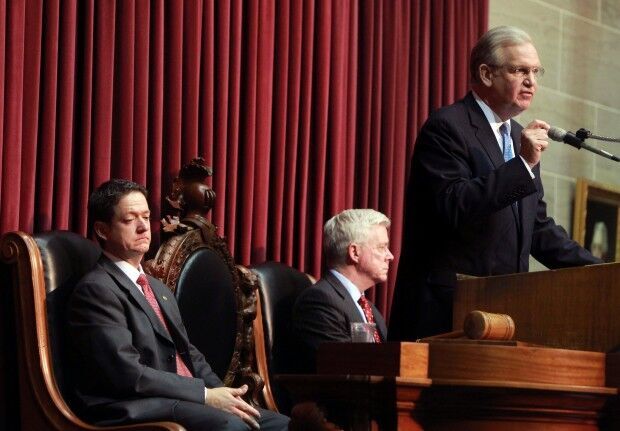
House Speaker Tim Jones says Gov. Jay Nixon should put his Medicaid expansion proposal to a vote of the people if he wants to grow the health care program for the poor to cover an additional 260,000 people.
During his State of the State address, Nixon threatened to push a ballot measure that would cap campaign contributions, if lawmakers don’t approve limits this year, but Jones said he thinks the governor should try with Medicaid – another of his proposals and an optional provision of the federal Affordable Care Act.
“I think I know where Missourians are on Medicaid expansion – they’re opposed to it. They’re opposed to Obamacare,” said Jones, R-Eureka, during a meeting with reporters this week. “The governor suddenly feels that he thinks Missourians are thinking differently so maybe we should find out where Missourians are on that.” “That’s an issue that really affects our budget and the taxpayers.”
People are also reading…
Nixon, a Democrat, made the Medicaid expansion plan a central piece of his budget proposal for the fiscal year that begins July 1, but GOP leaders have largely balked at the proposal.
The federal government already pays part of Missouri’s Medicaid costs. Under the federal health care law, it would pick up the full tab for new recipients in the first three years and continue paying most of the costs beyond that Nixon’s budget proposal calls for $907.5 million in federal spending for the influx of new Medicaid enrollees for the fiscal year that begins July 1.
The governor’s budget office estimates that the state would see a $300 million boost to its general revenue fund over the next three years if the Legislature expands Medicaid. Once the state’s costs kick in, savings from other programs and estimated new revenue would more than cover the cost of the expansion, according to the estimates.
But Jones said he thinks expansion could cramp the budget.
“We have fiscal concerns about Medicaid,” Jones said.
Missouri is one of 15 states whose bonds carry a triple-A rating from Moody's Investors Service.
Last week, Moody’s changed its outlook for Missouri from stable to negative, citing the state’s reliance on federal spending.
The Moody’s report has been cited by Jones and other Republicans who oppose expansion as another point against the governor’s proposal.
“If you massively expand that reliance on federal spending, I would assume you are going to create that fear even worse in the eyes of the credit reporting agencies,” Jones said.
Jones noted that Missouri voters have repeatedly come out against the federal Affordable Care Act. The Missouri Health Care Freedom Act, also known as Prop C, which passed with more than 70 percent in a statewide vote in 2010, was a largely symbolic measure in opposition to the federal health care law. Last year, voters also overwhelmingly approved a provision that blocks the state from setting up a health care exchange without a vote of the Legislature or approval on a statewide ballot.
“If we’re going to go to the ballot on an issue that is important to Missourians that he’s advocating for, maybe we should go to the ballot and question Missourians whether we should expand Medicaid,” Jones said. “That’s an issue that’s going to affect our budget, a lot more deeply than whether or not someone receives ‘X’ amount of campaign contributions.”
Ultimately, Jones dismissed Nixon’s call for a campaign contribution cap.
“I’m not sure where I should be setting those contributions – should I set it at the governor’s highest campaign contribution, which would be $1 million from the Democratic Governors Association? Should that be the cap?” he said. “The governor threw that out there but really gave no specifics.”
Elizabeth Crisp covers Missouri politics and state government for the Post-Dispatch. Follow her on Twitter at @elizabethcrisp.


