

JEFFERSON CITY • A Missouri House committee has approved a Republican alternative to the Medicaid expansion plan outlined in the federal Affordable Care Act, setting up the proposal for a potential debate on the House floor.
The decision on whether to expand Missouri’s health care program for the poor has been one of the most debated topics of the session.
Democrat-backed expansion efforts have swiftly been killed this session, but the House Government Oversight Committee gave bipartisan support Wednesday evening to a reform-based bill that would expand coverage in Missouri — but not to the level outlined in the federal health care law.
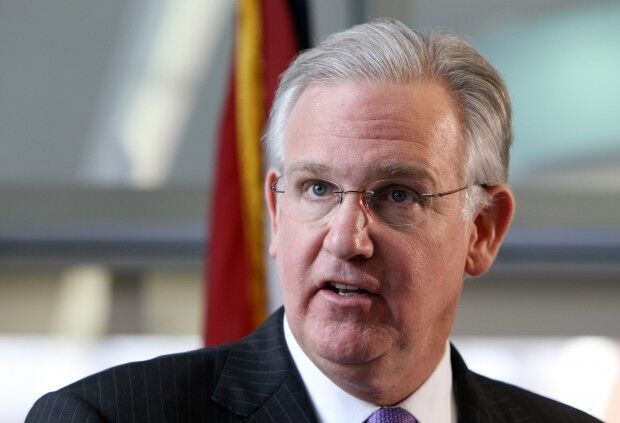
Gov. Jay Nixon, a Democrat, privately met with House Republicans earlier in the day to try to persuade them to support the larger expansion of Medicaid. He has spent several weeks traveling the state to speak in favor of it, but Republicans who control both chambers of the Legislature have so far opposed it.
People are also reading…
“Under the three bears analogy: The porridge is a little warmer, but we’ve got work to do,” Nixon said after Wednesday’s meeting with the House majority caucus.
The federal law calls on states to expand Medicaid eligibility requirements to cover more people. If states agree, the federal government will pick up most of the costs.
Last week, the Missouri House approved a budget for the coming fiscal year that doesn’t include federal dollars for the Medicaid expansion. The clock is still ticking as senators get their shot at the budget, but Nixon said he saw the GOP-backed Medicaid reform bill that the Oversight Committee passed as a potential vehicle for the expansion.
If approved by the House, the Medicaid bill would still have to pass the Senate to become law. The session ends in less than seven weeks, but Nixon said he also had been meeting privately with senators to try to garner support.
Republican lawmakers have for years alleged that Missouri’s Medicaid program is inefficient and plagued with fraud. The bill, sponsored by Rep. Jay Barnes, R-Jefferson City, would use the federal government’s expansion offer as a starting point to retool the program.
The reform elements of the bill include a shift to private managed care systems, an added push toward preventive care and financial incentives for recipients to keep their health care costs low. If it passes the Legislature, the state will need multiple waivers from the federal government to implement the reforms.
Currently, more than 850,000 Missourians are on Medicaid, which has varying degrees of coverage based on income. The federal government pays part of the costs, but the state currently spends nearly half of its general revenue dollars on Medicaid each year.
The federal expansion model would set eligibility at 138 percent of the poverty level, or about $15,800 for a single person or $32,500 for a family of four. Under that plan, the federal government would pick up all of the costs of new enrollees for the first three years and scale back to a 90 percent match by 2020.
Barnes’ plan instead calls for eligibility at the poverty level, which is $11,490 for a single person or $23,550 for a family of four.
Nixon said he didn’t believe the state would be able to get federal expansion dollars if it adopted the lower rate.
“How you get (to 138 percent) could be a little bit of an art, but you’ve got to get there,” Nixon said.
Barnes said the state should seek a waiver for the eligibility cap. If it doesn’t agree to one, then Missouri’s expansion plan would be void.
That plan, Barnes said, would shift power back to Missouri and put the pressure on the federal government to decide whether to let the state take partial action or no action.
“I don’t think the federal government has been put to the test,” Barnes said. “I believe there is the legal authority to do this.”
Rep. Todd Richardson, R-Poplar Bluff, said he saw Barnes’ bill as a creative alternative to the Affordable Care Act.
“I think this presents us an opportunity to craft a Missouri solution to health care delivery in this state,” Richardson said.
He said the federal law’s elimination of some federal funding that many Missouri hospitals get for treating the uninsured had amounted to a “gun to the head.”
“We’re forced to deal with it,” Richardson said. “I think this measure is an important step toward trying to deal with that problem.”
But for some Republicans, the bill still has too many ties to the federal health care law.
“Would we be here today having this conversation would it not have been for Obamacare? Probably not,” said Rep. Mark Parkinson, R-St. Charles, who voted against Barnes’ bill in committee. “I appreciate the hard work, but we’re just going to have to disagree on this one and move on with life.”
But Barnes said the reforms in the bill separated it from the federally proposed expansion. He said that the opportunities to convert Missouri’s Medicaid program to a market-based system and save money “is something that any conservative ought to be serious about and seriously considering.”
“Obviously, I’m voting for it, and I think anyone who looks at it through that prism should as well,” he said.
Elizabeth Crisp covers Missouri politics and state government for the Post-Dispatch. Follow her on Twitter at @elizabethcrisp.


