

JEFFERSON CITY • Hundreds of people descended on the state Capitol on Tuesday, urging lawmakers to expand Medicaid to cover thousands of poor Missourians.
Not expanding Medicaid, they said, will have a negative impact on the state’s economy and the health of its citizens.
“Expansion of Medicaid in Missouri under the Affordable Care Act is certainly the most prudent course of action for our state,” said Joe Reagan, chief executive of the St. Louis Regional Chamber.
The Medicaid proponents — a rare coalition of health advocates, business leaders, labor groups and law enforcement officials, among others — lobbied lawmakers directly in the Capitol hallways and in their offices.
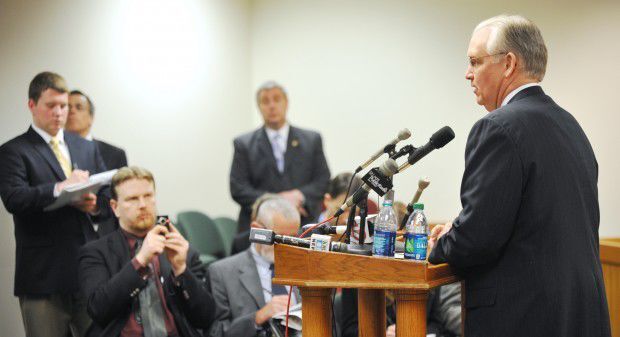
They also held a rally in the rotunda that drew one of the largest crowds of the session and featured a keynote speech from Gov. Jay Nixon.
People are also reading…
But it’s unclear what impact – if any – their efforts Tuesday will have.
Missouri’s Republican-led Legislature has balked at the Medicaid expansion proposal outlined in the federal health care law.
Last month, the House approved a budget plan for the coming fiscal year that doesn’t include federal dollars for the expansion. The Senate Appropriations Committee has been working through its own proposal, but it also doesn’t include funding for expansion of the health care program.
Nixon has met with Republicans and Democrats in the House and Senate in recent weeks, but no agreements were reached.
House Speaker Tim Jones, R-Eureka, said House Republicans want to fix the Medicaid system rather than “put a billion-dollar Band-Aid” on it. But there’s no “immediacy” to that issue now that the federal government has delayed hospital cuts that were slated to start next year under the Affordable Care Act, he said.
The House ended its day before the demonstration, and most of its Republican members left the Capitol for a special caucus meeting at the Missouri Farm Bureau headquarters during the rally. At a news conference, Jones denied trying to shield colleagues from the pro-Medicaid crowd. He said he didn’t call the special caucus meeting and believed it was scheduled several weeks ago.
But Assistant House Minority Leader Gail McCann Beatty, D-Kansas City, released a statement calling the move “a display of both cowardice and contempt.”
“Our system of government is depends on elected officials who listen to the concerns of their constituents and act accordingly,” she said. “By running away and hiding when confronted with opinions they don’t want to hear on the most important issue of the legislative session, House Republicans have embarrassed themselves.”
During the rally, Nixon, a Democrat who has made Medicaid expansion his key focus in recent weeks, urged the crowd to continue their efforts in support of the expansion, which would expand eligibility to some 300,000 low-income Missourians.
“Now is the time to use our heads and our hearts to do the smart thing and the right thing for our state,” Nixon told a cheering crowd, many of them waving red and green banners.
One group of workers came from the Noranda aluminum smelter in new Madrid in Missouri's Bootheel. They were part of a delegation organized by the United Steelworkers, Local 7686.
"All of us have insurance," said Cameron Redd, assistant chief steward. "We're here for the people who don't."
Others expressed the same sentiments. The Rev. Doyle Sager of First Baptist Church in Jefferson City said lawmakers often hear from high-paid special interest groups. “Who lobbies for the thousands upon thousands of Missourians who are left behind? We do,” he said. “History and God Almighty will judge us for what we choose to do with this opportunity.”
The federal Medicaid expansion proposal would set eligibility at 138 percent of the poverty level, or about $15,800 for a single person or $32,500 for a family of four. Under that plan, the federal government would pick up all of the costs of new enrollees for the first three years and scale back to a 90 percent match by 2020.
Nixon said he sees expansion as the greatest opportunity in his 26-year political career to help the greatest number of people, and he doesn’t want to look back on expansion as “an opportunity that passed us by.”
“This is our clarion call,” he said.
Jim Shortal of St. Louis said his world was turned upside-down five years ago by his bipolar disorder. He lost everything – his small business, his family support – but was able to recover with the help of treatment through Medicaid.
“People like me can and do recover when they are able to access and pay for treatment,” he said. “Medicaid literally helped save my life.”
Shortal, now a member of the board of directors for the National Alliance on Mental Illness, said he wants lawmakers to put aside partisan politics and focus on the “moral and economic benefits” of the expansion.
“Medicaid expansion will benefit many of our sickest, our poorest, our weakest and our disenfranchised,” he said.
The Medicaid expansion effort has drawn a diverse coalition of supporters – more than 200 organizations, including 60 statewide and local business groups.
Sikeston Department of Public Safety Chief Drew Juden told the crowd about the ongoing frustrations law enforcement agencies face when dealing with people who have mentally illnesses but have no means of getting treatment. When suspects with mental disabilities are detained or receive a court order, police have to search for a facility that has beds open to take them.
“The answer is to strengthen Medicaid and get these people the treatment they need,” Juden said. “It will keep our officers where they belong in the community.”
Dr. Heidi Miller of St. Louis’ Family Care Health Center, said she worries that doctors, nurses and other health care providers will leave Missouri for states that do expand Medicaid.
“I cringe to witness this,” she said. “Medicaid is not perfect, but it can be lifesaving compared to being uninsured.”
Elizabeth Crisp covers Missouri politics and state government for the Post-Dispatch. Follow her on Twitter at @elizabethcrisp.


