

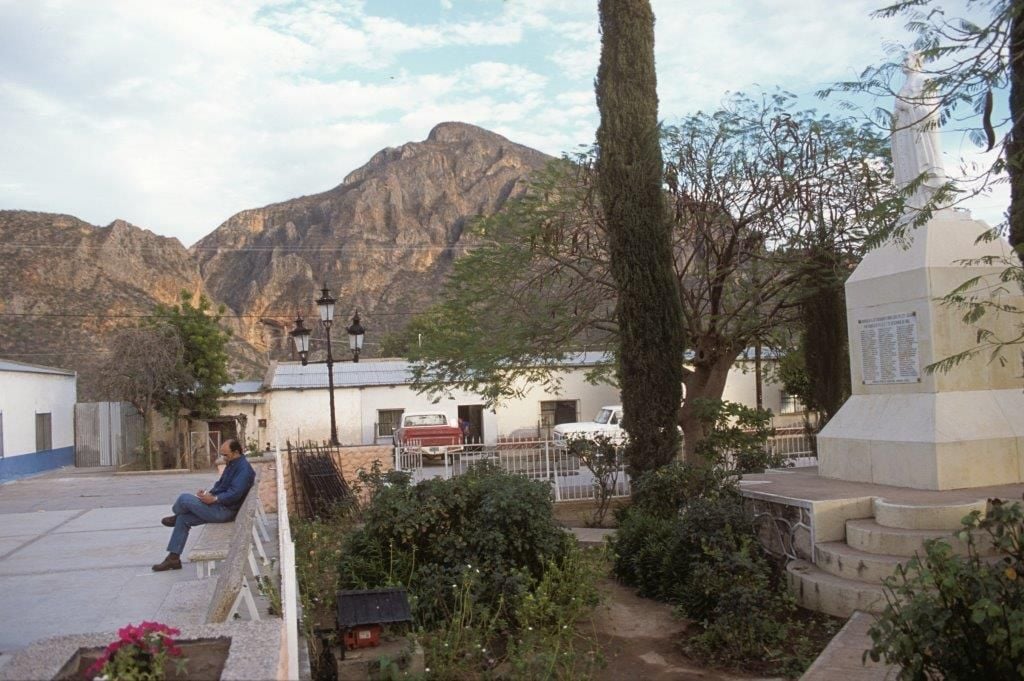
A while back I wrote a blog entitled “A Tale of Two Statues” in which I briefly described Pancho Villa’s revenge on the Sonoran village of San Pedro de la Cueva, and the remarkable career of one of the survivors of that tragic event. Now it’s time to separate those stories and give you more details.
In October 1915, Pancho Villa, who had met with disastrous defeats in central Mexico at the hands of the Carranza government, decided to recoup his fortunes by invading the state of Sonora. He arrived outside Agua Prieta under the impression that that border town was lightly garrisoned, only to meet with an unpleasant surprise. The United States had recognized Carranza’s government as legitimate, and had allowed thousands of Mexican federal soldiers to travel by rail from Eagle Pass, Texas to Douglas, Arizona. Upon his arrival Villa was faced with artillery, machine guns, and well-made trenches. He apparently had not learned from such earlier battles as Celaya not to employ his signature all-out charges against fixed machine guns, and his troops were mowed down.
People are also reading…
He then retreated to the west, where he successfully extorted money and supplies from the Cananea Copper Company, He then attacked the state capital of Hermosillo. Defeated with heavy losses and with his troops deserting in droves, Villa headed for Chihuahua and home. His plan was to cross the Sierra at a particularly rugged part, devoid of roads and cut by deep barrancas. On the way his army passed near the village of San Pedro de la Cueva, where the Río Moctezuma comes out of a deep gorge.
The villagers had long experienced robberies and raids on the part of every band of revolutionaries who passed their way. This time they decided to mount an ambush when they saw a new cloud of dust approaching. They fired, killing a Villista soldier before realizing whom they were shooting at. It was too late.
Villa, maddened by his many defeats and furious at what he saw as a betrayal on the part of the United States in transporting his enemies the previous month, summarily ordered all the males of fighting age in the village to be shot. This was done on December 2, 1915. When the village priest, 35-year-old Father Andrés Abelino Flores, begged for clemency, Villa sent him away twice, the second time with a warning not to return. The third time, Villa shot the priest as he approached. Only seven men survived the slaughter, being wounded and left for dead. Villa escaped to Chihuahua with what was left of his army.
A grim footnote to Mexican history, to be sure…but perhaps something more. Villa’s repeated defeats in Sonora may have unhinged him enough to help explain his later murder of 17 American mining engineers at Santa Ysabel, Chihuahua, as well as his pointless raid on Columbus, New Mexico, questions that have bothered historians ever since.
The most thorough treatment of Villa’s Sonoran campaign is “Massacre at San Pedro de la Cueva: The Significance of Pancho Villa’s Disastrous Sonora Campaign,” by Thomas H. Naylor in The Western Historical Quarterly Vol. VIII, No. 2, April, 1977.


