

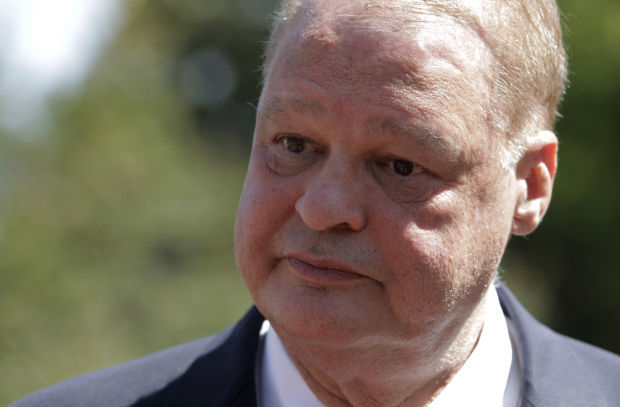
PHOENIX -- The Arizona Supreme Court this morning gave former Attorney General Tom Horne another chance to escape a $1.2 million fine for campaign finance violations.
In a unanimous decision, the justices said it was wrong for Yavapai County Attorney Sheila Polk, who initially concluded Horne and a former aide had broken the law, to then overrule the findings of an administrative law judge who said there was no violation.
”We hold that due process does not permit the same individual to issue the initial decision finding violations and ordering remedies, participate personally in the prosecution of the case before an administrative law judge, and then make the final agency decision that will receive only deferential judicial review,” wrote Clint Bolick for the court.
But the justices did not absolve Horne of guilt. Instead, it sends the issue back for a review by someone, unlike Polk, who is neutral.
People are also reading…
At issue is $513,340 spent by Business Leaders for Arizona on a last-minute commercial attacking Felecia Rotellini, Horne's 2010 Democrat foe.
The group was formed by Kathleen Winn, a staffer in Horne's office, and registered as an independent campaign committee. That status prohibits it from legally coordinating its expenses with the candidate.
The FBI, looking into other matters after the 2010 election, came across what it said was evidence that there was communication. The case went to then-Secretary of State Ken Bennett who, by law, had to pass it on to the attorney general's office.
But with Horne now running that agency, an aide farmed the case out to Polk.
She found evidence of violations, citing a series of phone calls between Horne and Winn.
When they appealed, the case was sent to an administrative law judge — essentially a hearing officer — with one of Polk's deputies presenting the evidence against the pair. Polk acknowledged later that she “was involved with the prosecution of the case, by assisting with the preparation and strategy."
The result was a finding that Winn's expenses really were contributions to Horne's campaign, contributions that exceeded the limit by $400,000 of what he could take from any one source. So Polk imposed a penalty equal to three times that.
Both a trial judge and the state Court of Appeals rebuffed the bid by Horne and Winn to overturn those findings.


